
 English
 Arabic
 Polish
 Russian
Shopping for top vitamin D supplements? Check the daily dose first. For most UK adults, 10 micrograms (400 IU) a day in autumn and winter is enough. Consider that amount all year if you get little sun or have darker skin. Then choose the form and format that fit your routine.
Start with the dose, not the brand
The NHS advises adults and children over four to consider 10 micrograms (400 IU) of vitamin D a day during autumn and winter. That advice extends throughout the year if you spend little time outdoors, cover most of your skin outdoors or have darker skin. The NHS says the amount is enough for most people. Babies and younger children have separate year-round guidance, so keep adult servings for adults.
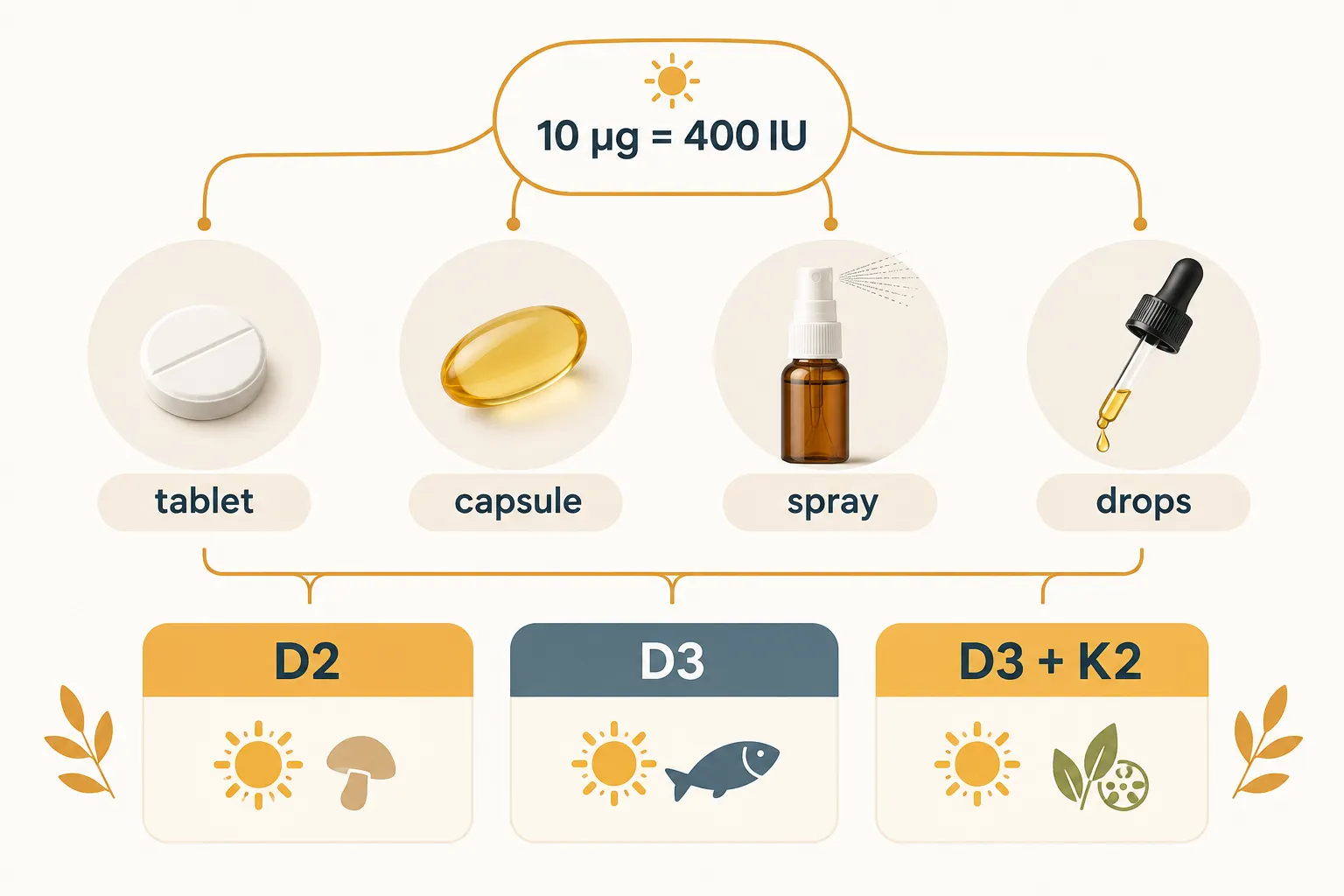
In the UK, supplement labels may give vitamin D amounts in micrograms (µg or mcg), international units (IU), or both. One microgram equals 40 IU:
|
Vitamin D per day |
Equivalent in IU |
How to interpret it |
|---|---|---|
|
10 µg |
400 IU |
NHS baseline for most adults in autumn and winter |
|
25 µg |
1,000 IU |
Above the baseline; not automatically a better choice |
|
50 µg |
2,000 IU |
Consider your total intake and individual advice |
|
100 µg |
4,000 IU |
Adult upper limit, not a daily target |
Adults should not exceed 100 micrograms (4,000 IU) a day without medical advice. For children, the NHS sets lower limits: 50 micrograms (2,000 IU) for ages one to ten and 25 micrograms (1,000 IU) for infants under one. These are upper limits, not doses to aim for. Include the vitamin D in your multivitamin or other supplements when you work out your total.
If a GP identifies a deficiency, sometimes following a blood test, they may advise a different dose. That is separate from choosing a daily supplement. A “strong” label is no reason to start with a large dose.
D2 or D3: which form should you choose?
“Vitamin D” names the nutrient. D2 and D3 are its two supplement forms; if the front of a pack does not specify one, look on the ingredients panel.
Vitamin D2, or ergocalciferol, generally comes from fungi or yeast. D3, or colecalciferol, may come from lanolin or lichen. Both appear in supplements. An everyday product needs to provide a suitable dose that you can take consistently; no one bottle is the most effective vitamin D supplement for everyone.
For vegan D3, look for lichen as the source and check the capsule and other ingredients. The D3 name alone does not tell you whether the whole supplement is vegan. D2 is another option if the finished product meets your dietary needs.
On a plant-based diet, lichen-derived D3 is worth considering alongside D2. The best type of vitamin D for you has the dose and source you want, in a format you can take regularly.
Which format fits your routine?
Tablets are convenient if you already take pills. If you would rather avoid them, UK shops also sell vitamin D3 supplements as sprays, drops and liquids. Compare doses before choosing between them.
|
Format |
May suit |
What to watch for |
|---|---|---|
|
Tablets |
Adults happy with a fixed daily serving |
Size, swallowability and dose per tablet |
|
Capsules or softgels |
People who prefer a ready-measured serving |
Capsule material, allergens and added ingredients |
|
Oral sprays |
People who dislike swallowing pills |
Number of sprays per serving and total dose |
|
Drops |
Anyone needing a measured liquid serving; useful when an age-appropriate product is chosen for a child |
Concentration per drop and whether the dropper is easy to use |
|
Standard liquids |
People who prefer a spoon or measured dispenser |
Dose per millilitre, sweeteners and storage instructions |
|
Liposomal liquids |
People who prefer this type of liquid formulation |
Dose, other ingredients and cost; “liposomal” does not itself prove better absorption |
For someone with difficulty swallowing tablets, a spray or drops may be easier. A child needs an age-appropriate product and its stated serving; do not divide an adult high-dose capsule.
“Liposomal” describes the delivery system. It does not, on its own, prove better absorption than a standard tablet or liquid. Compare vitamin D per serving and the other ingredients before choosing it.
When should you take a vitamin D3 supplement?
You can fit vitamin D around your meals; the NHS does not require a morning or evening dose. It advises taking colecalciferol tablets and capsules with your main meal of the day. As vitamin D is fat-soluble, a meal is a sensible time for an oral supplement, without seeking out a fatty one. Follow your product’s directions.
Should you choose D3 with K2?
In a D3 + K2 supplement, K2 supplies a form of vitamin K. The label may call it MK-7. Vitamin D contributes to the maintenance of normal bones, muscle function and the normal function of the immune system. Vitamin K contributes to the maintenance of normal bones and normal blood clotting. NHS advice to take vitamin D does not mean you also need K2.
If you prefer both nutrients in one liquid serving, InfiniVit’s Liposomal Vitamins D3 + K2 is one option. Its serving amount and ingredients should make sense for you, as with any combination product.
If you take warfarin or another blood thinner, speak to your GP or anticoagulation team before taking vitamin K, including D3 + K2. The NHS advises people taking warfarin not to take vitamin K supplements without medical advice. A vitamin D-only product avoids added K2; ask a healthcare professional about supplements alongside your medication.
How to compare vitamin D supplements in the UK by their labels
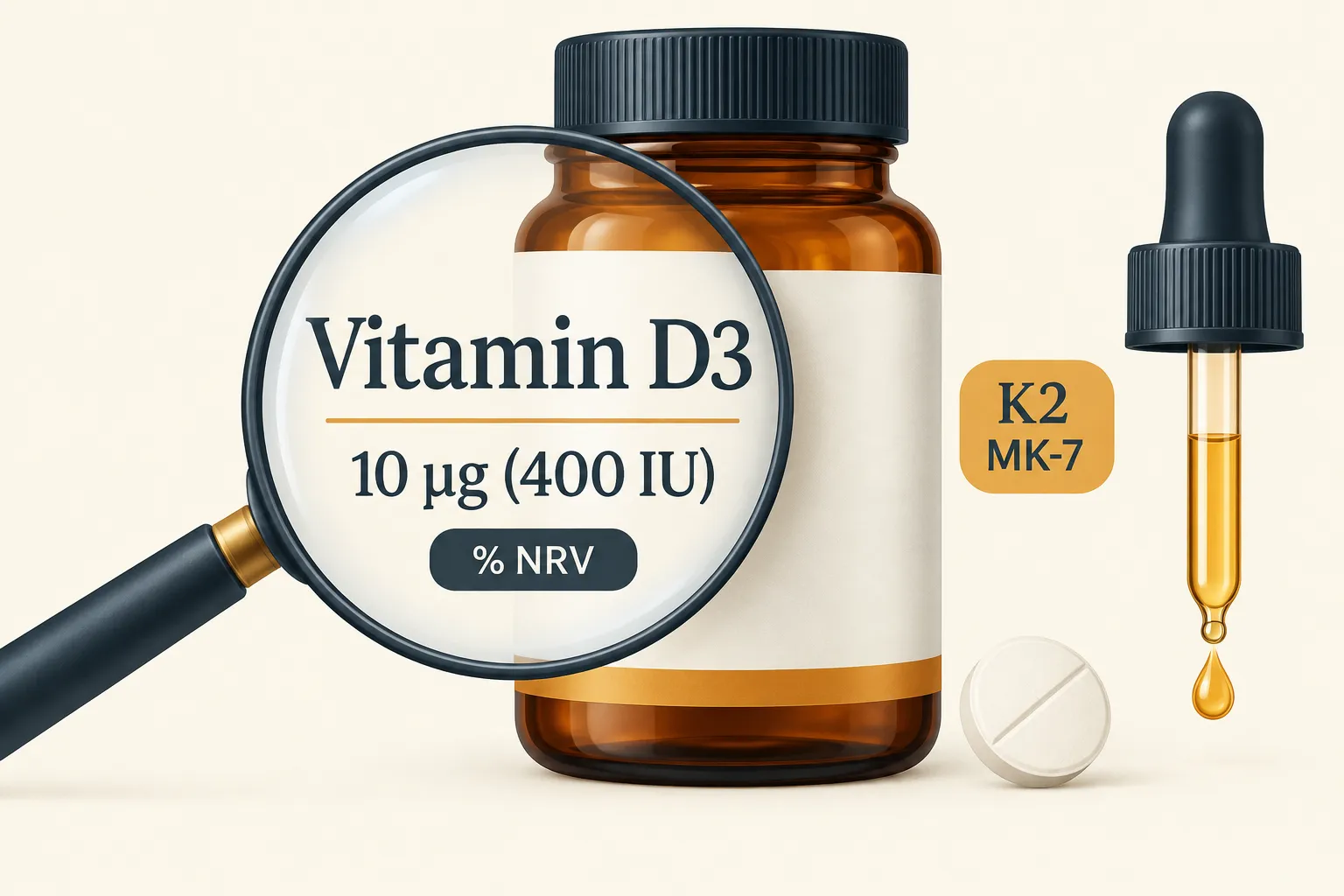
The serving panel is more useful than “premium”, “high strength” or a large IU number on the front. Read it for:
-
Form and source: Does it say D2 (ergocalciferol) or D3 (colecalciferol)? If vegan suitability matters, identify the source of the D3 and check the rest of the ingredients.
-
Amount per actual serving: Record both micrograms and IU. If a serving takes two sprays or several drops, calculate the amount you would really take each day.
-
NRV percentage: This is a label reference value, not a personal target or proof that a higher percentage will work better. The daily dose is the more useful figure for your decision.
-
Added K2: If included, look for the form, such as MK-7, and the amount per serving. Do not overlook it if you take medication that interacts with vitamin K.
-
Other ingredients: Look for sweeteners or flavourings in liquids, allergens, capsule materials and clear vegan or other dietary information where relevant.
-
Cost per serving: Divide the pack price by the number of daily servings, not by the number of tablets or millilitres alone. A bottle with more drops per serving may last less time than it first appears.
If you take a multivitamin or cod liver oil, keep those labels to hand. Add their vitamin D amounts to any new daily serving you are considering. A “top rated” badge cannot tell you whether the combined dose suits you.
When to seek individual advice
The usual 10 micrograms (400 IU) routine is general advice. If you suspect a deficiency, your GP can decide whether you need a blood test and a different dose. Do not use an everyday supplement as a substitute for a treatment plan.
Speak to a GP or pharmacist before choosing a supplement if you are pregnant, take medication, have kidney problems or have high calcium levels. This matters especially if you take warfarin and are considering D3 + K2. For a baby or child, use the NHS age-specific advice rather than the adult limits above.
The practical verdict
For most adults, start with a clearly labelled 10 microgram (400 IU) daily supplement in autumn and winter. Consider it year-round if you get little sun or have darker skin, as the NHS advises. Pick D2 or D3 to fit your diet, and a format you can use. K2 is an optional addition, while a stronger tablet brings no automatic advantage.
At InfiniVit, we want you to know what is in each serving. Browse the InfiniVit range if a combined liquid fits your needs, or ask our team a product question at info@infinivit.co.uk. Your GP or pharmacist is the right person for medical or medication advice.
FAQ
What is the most effective vitamin D to take?
The useful choice is a supplement that provides a suitable dose in a form you will take consistently. D2 and D3 are both used; if you prefer D3 and are vegan, look for lichen-derived D3 and check the other ingredients too.
Which vitamin D does NHS recommend?
The NHS advises most adults and children over four to consider 10 micrograms (400 IU) daily during autumn and winter. People who get little sun or have darker skin should consider that amount throughout the year; it is not a recommendation for a particular brand or delivery format.
What is the best vitamin D in the UK?
For most adults, a clearly labelled product providing the NHS baseline of 10 micrograms (400 IU) daily is a sensible starting point. Compare its source, serving size, ingredients and cost per serving instead of treating the highest strength as the best.
How much vitamin D should I take in the UK?
Most adults should consider 10 micrograms (400 IU) daily in autumn and winter, or all year if they have little sun exposure or darker skin. Do not exceed 100 micrograms (4,000 IU) a day as an adult unless a clinician advises otherwise; lower limits apply to children.
Should I take vitamin D with K2?
You do not need a combined product simply to follow the NHS vitamin D advice. If you want both, check the K2 form and amount; if you take warfarin or another blood thinner, speak to your GP or anticoagulation team before taking vitamin K.