
 English
 Arabic
 Polish
 Russian
The best value multivitamin UK shoppers can buy is one with useful doses at a sensible cost per daily serving. Count the supplements you already take, too. A cheap bottle can get expensive if its serving is several tablets; a premium one needs to earn its price through the formula, not a long ingredient list.
How to identify the best value multivitamin in the UK
Start by dividing the price by the number of daily servings, then look at the nutrients per recommended daily serving. Those amounts need to make sense alongside your diet and anything else you take.
A multivitamin supplements a varied diet; it cannot treat a diagnosed deficiency or make up for poor food choices. Pay for the nutrients you need. If the cheaper product lacks one, include the price of the separate supplement you would buy to cover it.
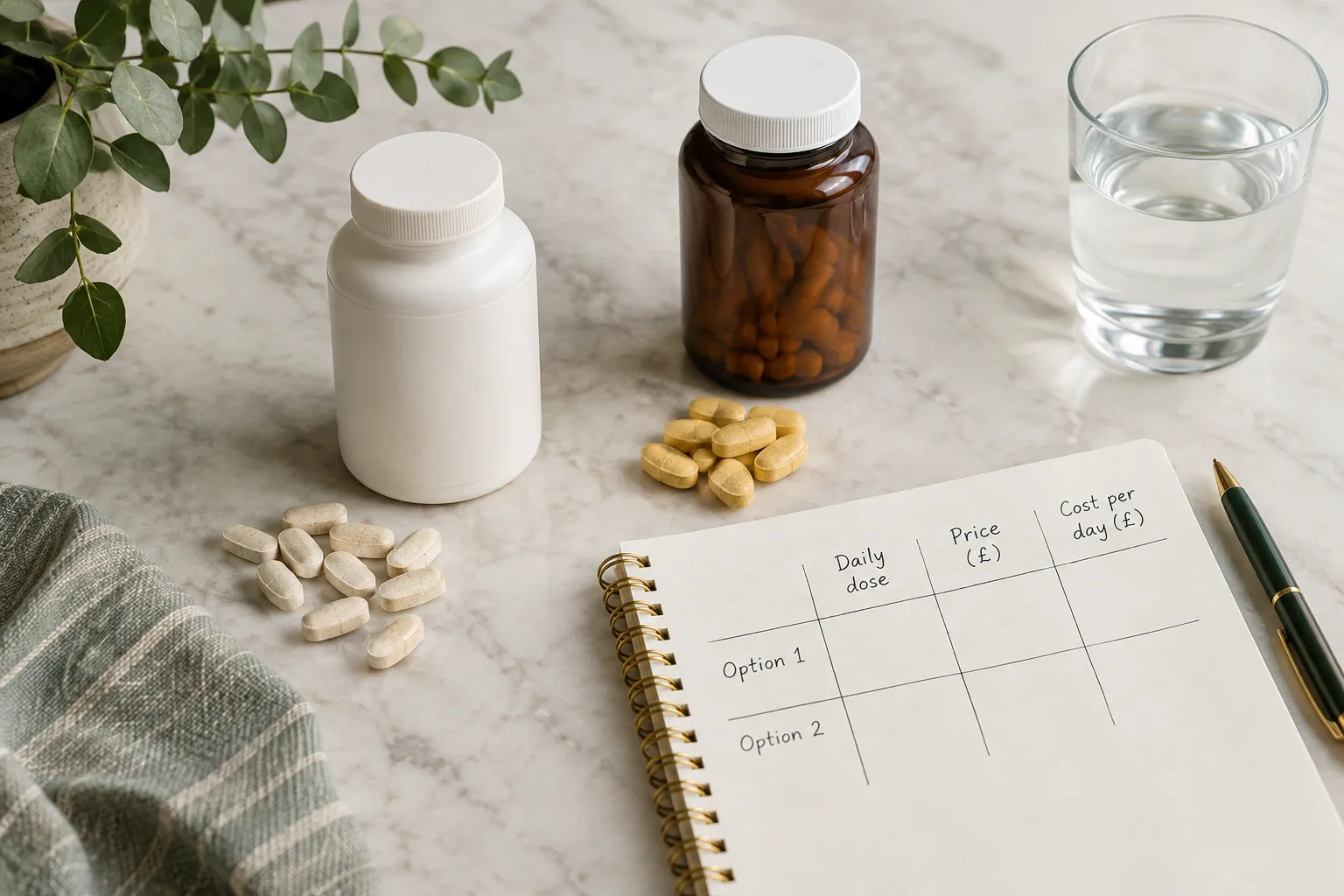
Calculate the true cost per day
Use the checkout price, without discounts you cannot claim:
Cost per day = pack price ÷ (number of tablets or capsules ÷ recommended tablets or capsules per day).
These illustrative figures are not current product prices:
|
Example pack |
Pack price |
Daily serving |
Days supplied |
Cost per day |
Approximate 30-day cost |
|---|---|---|---|---|---|
|
Budget tablets |
£6 |
60 tablets, one daily |
60 |
10p |
£3 |
|
Premium capsules |
£24 |
60 capsules, two daily |
30 |
80p |
£24 |
|
Larger budget pack |
£12 |
180 tablets, one daily |
180 |
6.7p |
£2 |
The £24 pack costs four times as much at checkout as the £6 pack, but eight times as much per day. You might choose it for a better-fitting formula. Delivery charges belong in the calculation, while subscription and multi-buy discounts count only if you qualify. Sixty capsules taken two a day last half as long as sixty one-a-day tablets.
Compare the whole routine, not just the multivitamin
If a low-cost multi leaves you buying another supplement, add that item’s daily cost. The premium blend saves money only if you can stop buying the other product. Do not assign a saving to ingredients you had no plans to use.
Read the label before paying more
Read the nutrient amounts per daily serving first. %NRV (nutrient reference value) is a useful adult labelling reference, although it is not your personal requirement. More than 100% does not, on its own, make a product better.
|
Label question |
What to look for |
Why it changes value |
|---|---|---|
|
How many servings? |
Tablet count divided by tablets per day |
Prevents a low bottle price hiding a short supply |
|
How much of the nutrient? |
Amount in mg or µg per daily serving, plus %NRV |
A named ingredient can appear at a small dose |
|
Which form? |
The named form where relevant, rather than an undefined blend |
Helps compare like with like; a premium-sounding form is not proof of superior outcomes |
|
What is missing? |
Nutrients important for your situation |
You may need a separate product, changing the total cost |
|
What is duplicated? |
Nutrients in your existing vitamin D, iron or other supplements |
Stacking products can create unwanted overlap |
“High strength” and a long botanical list tell you little without quantities. The back label may show that a compact tablet contains only a small amount of calcium or magnesium. If you are buying it for either mineral, compare the stated dose.
Look for overlap before you buy
Put your gummies, fortified drinks and single-nutrient capsules on the same list as the multivitamin. Add the per-day amounts wherever vitamin A, vitamin D, iron, iodine or vitamin B6 turns up twice. A pharmacist or clinician can advise on unsuitable combinations if you take prescribed medicines or have a health condition.
Match the formula to your circumstances
Vitamin D in the UK
The NHS advises adults and children over four to consider 10 µg of vitamin D daily in autumn and winter. Those at risk of deficiency may need to consider it year-round. A multivitamin with less than 10 µg leaves a gap for this purpose, so include a separate vitamin D product in your price calculation. Our guide to choosing a vitamin D supplement explains the options.
“Everyone (including pregnant and breastfeeding women) should consider taking a daily supplement containing 10 micrograms of vitamin D during the autumn and winter.” – NHS
Iron, pregnancy and other reasons to choose carefully
Iron is worth having if you need it. Otherwise, an iron-free formula may suit you better. Suspected anaemia calls for an assessment rather than a general multivitamin.
If you are pregnant or could become pregnant, follow pregnancy-specific guidance. The NHS pregnancy supplement advice recommends 400 µg folic acid daily when trying to conceive and through the first 12 weeks of pregnancy. It says not to take supplements containing vitamin A as retinol during pregnancy; some people need a prescribed higher folic acid dose. A “women’s” label does not establish pregnancy suitability. See our women’s multivitamin label checklist for needs across life stages.
If you eat vegan, read the amounts of vitamin B12, vitamin D and iodine as well as the suitability statement. “Plant-based” on the front does not say how much of each nutrient a daily serving contains. The capsule’s appearance cannot tell you whether the product meets your dietary restrictions, either.
Cheap versus premium: when is the extra cost justified?
Cheap multivitamins can be the best affordable multivitamin choice if you get the nutrients you want without buying an extra product. Paying more makes sense if the nutrient mix fits better, the amounts are clearer or the format is easier for you to take. It does not establish that the premium product is clinically superior.
Try this decision rule:
-
Set a monthly budget, then calculate each product’s 30-day cost using its actual recommended serving.
-
Identify the handful of nutrients that matter to your circumstances. Compare their amounts, not the total ingredient count.
-
Exclude unsuitable formulas, then add the cost of any separate supplements you will still take.
-
Pay more only when the difference addresses a need you have identified.
InfiniVit offers targeted supplements alongside everyday nutrition, which may suit you if you have a particular wellness goal. A specialised routine can cost more than a basic multi. Before dropping a single-nutrient supplement in favour of a blend, compare the amounts on both labels. For the broader price-and-quality question, read premium vitamins versus supermarket vitamins.
A quick buying checklist
-
Calculate cost per recommended daily serving, including any unavoidable delivery charge.
-
Compare mg or µg and %NRV for the nutrients you care about; check the label states the daily serving clearly.
-
Note what you already take and add overlapping daily doses before buying another formula.
-
Choose an appropriate formula for your diet, life stage and health needs, rather than the longest ingredient list.
-
Compare the total monthly routine cost, not just the multivitamin bottle.
The bottom line
Choose a clearly labelled formula that meets your needs at a manageable cost per day. A basic multivitamin is good value when its doses suit you without extra purchases. If it leaves a gap, explore InfiniVit’s targeted options and compare the cost of your full daily routine.
FAQ
Which company is best for multivitamins?
No company is best for everyone. Look at the daily serving, nutrient amounts, suitability and cost per day of a specific product. Brand recognition alone cannot tell you whether it fits your needs.
Which multivitamin is the best in the UK?
Choose a formula with useful amounts of the nutrients you want, at a cost per day you can maintain. A one-a-day budget product may offer better value than a pricier blend whose extras you do not need.
What’s the best multivitamin that actually works?
A multivitamin can help with gaps in intake. It cannot replace food or treat a diagnosed deficiency. Compare the amounts per daily serving with your needs; a higher price is no evidence of a better result.