
 English
 Arabic
 Polish
 Russian
Do Cognitive Support Supplements Work?
If you have ever stood in front of a shelf of “memory”, “focus”, or “brain support” products and wondered whether any of them truly do anything, the short answer is: sometimes, but not in the way most marketing suggests.
For most healthy adults, cognitive support supplements are far more likely to help when they correct a genuine shortfall than when they are used in the hope of creating a dramatic mental upgrade. That distinction matters. Replenishing a low nutrient status is very different from expecting a broad, all-purpose boost in memory, focus, or long-term brain health from a capsule alone.
At InfiniVit, we believe adults deserve a clearer answer than hype. Premium supplementation can absolutely have a place in a smart wellness routine, but the role of supplements should be evidence-led, realistic, and tailored. The strongest foundation for cognitive wellbeing still comes from sleep, exercise, diet quality, stress management, social connection, and appropriate medical care. Supplements are best viewed as supportive tools, not magic solutions.
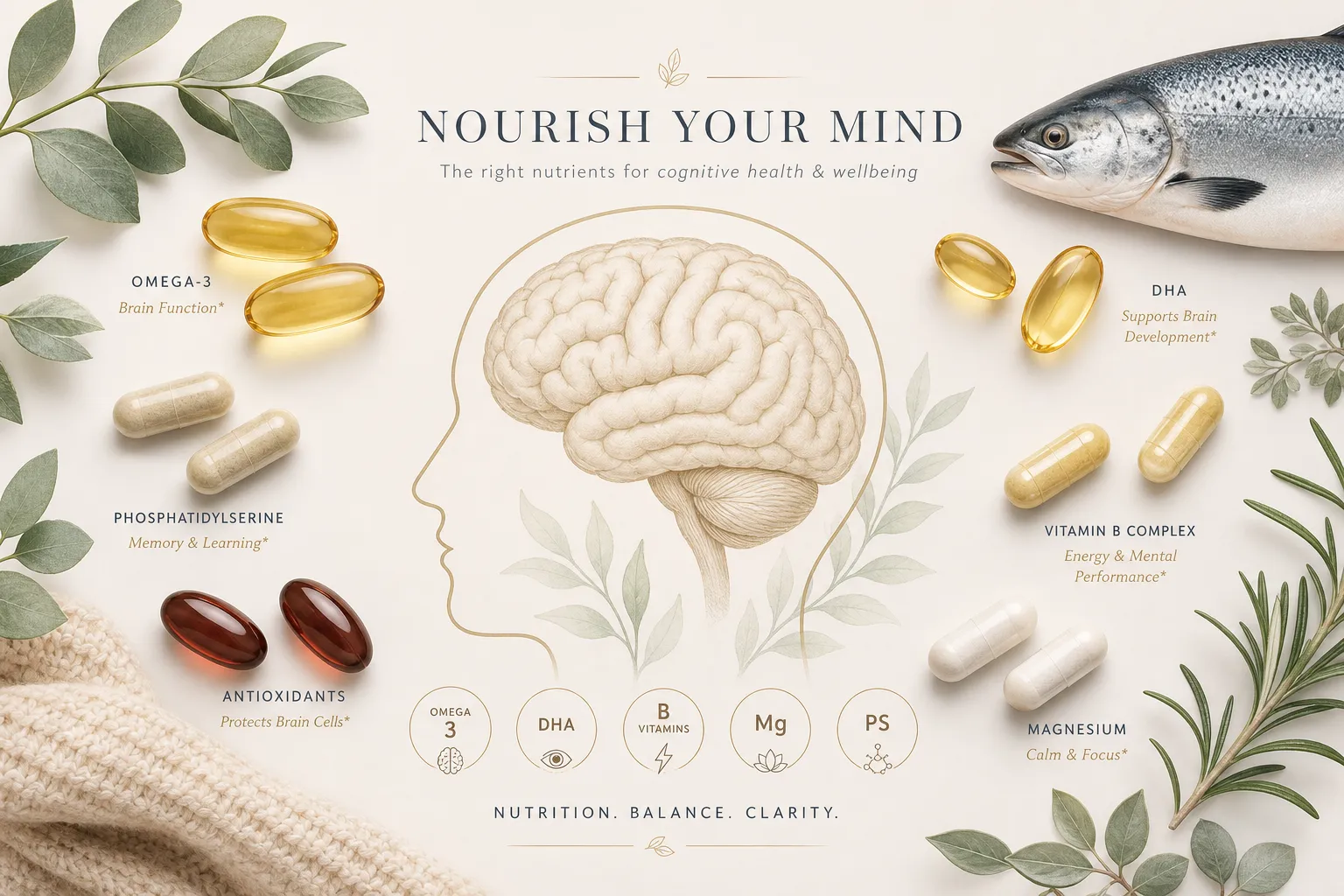
The direct answer: yes for deficiencies, uncertain for broad brain enhancement
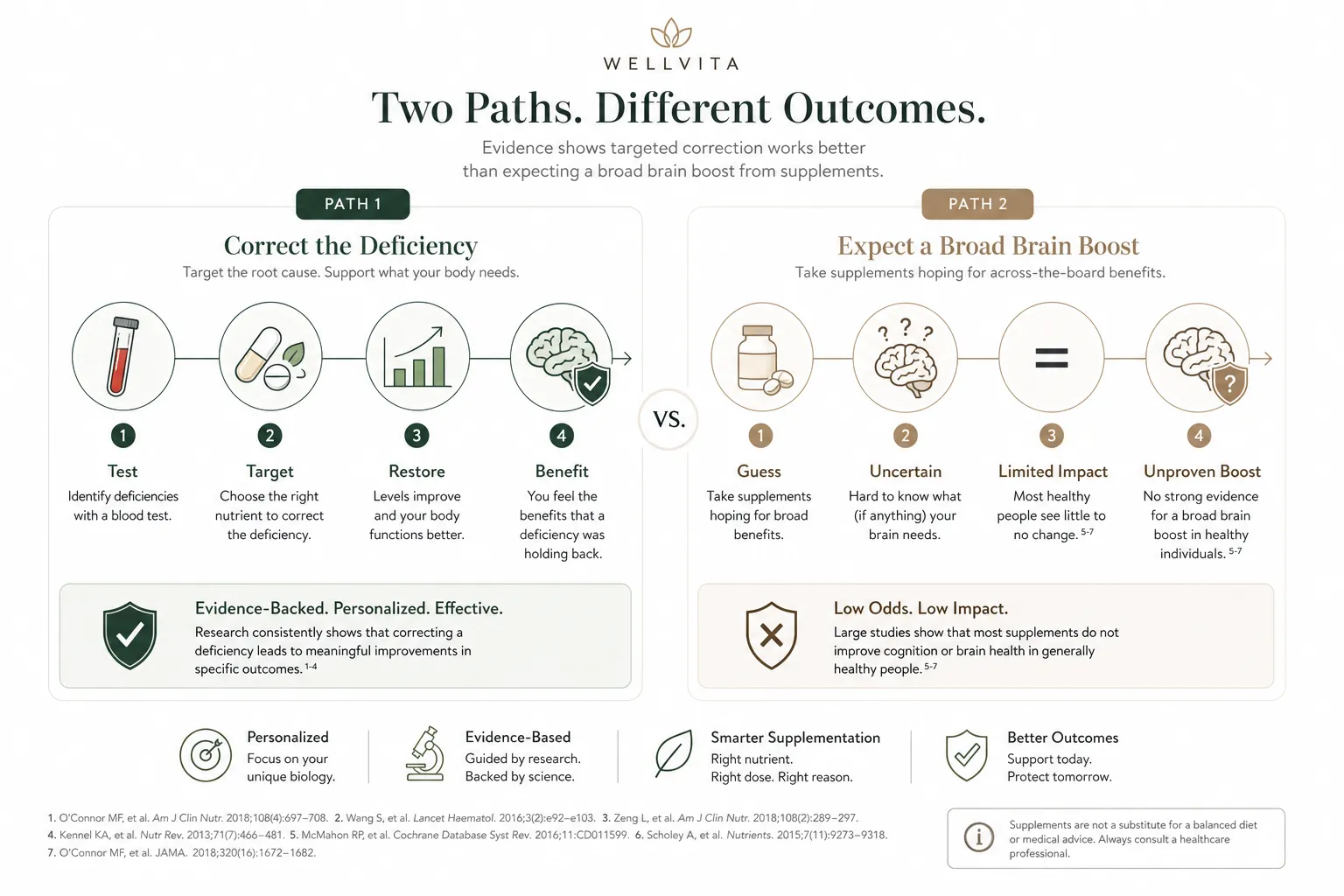
The biggest misunderstanding in this category is assuming that all “brain supplements” do the same thing. In reality, there are two very different scenarios:
-
Correcting a deficiency or nutritional gap
-
Trying to enhance cognition beyond your current healthy baseline
The evidence is much stronger for the first.
If someone is low in vitamin B12, vitamin D, omega-3 intake, or another relevant nutrient, bringing levels back into a healthy range may support normal cognitive function, reduce fatigue, or improve overall wellbeing. But if someone is already well nourished, the case for extra supplementation creating noticeably sharper memory or better concentration is much weaker.
That is why the most trustworthy conversation around the best cognitive support supplements starts with context: your diet, age, health history, medications, stress load, sleep quality, and whether there is any reason to suspect a deficiency.
A useful rule of thumb
-
Deficiency correction = plausible and often worthwhile
-
General “brain boosting” in already healthy adults = possible in limited cases, but often overstated
-
Disease prevention claims = should be treated with caution unless backed by strong clinical evidence and medical guidance
What competitor content often gets wrong
Many top-ranking articles list ingredients one by one but skip the question people actually want answered: “Will this help me?”
The more useful answer is:
-
A supplement may help if it fills a nutritional gap
-
A supplement may have a modest effect in specific groups
-
A supplement is unlikely to compensate for poor sleep, chronic stress, inactivity, or a low-quality diet
-
Multi-ingredient products can be sensible, but only if the formulation is transparent and purposeful
This is where quality matters. InfiniVit focuses on science-led formulations, high-grade ingredients, and responsible communication, rather than exaggerated miracle language. That matters especially in cognitive support, where many products are underwhelming because they are either under-dosed, poorly balanced, or built around fashionable ingredients without enough rationale.
For readers wanting a broader look at ingredients commonly discussed in this space, our guide to best brain supplements for memory and focus explores the category in more detail.
Why the market is so confusing
One reason people struggle to judge cognitive support supplements is that “brain health” covers several different goals:
-
Memory
-
Focus and attention
-
Mental energy
-
Mood resilience
-
Ageing support
-
Nutritional support for the nervous system
A single ingredient rarely addresses all of these at once.
On top of that, research outcomes differ depending on whether a study looked at:
-
healthy young adults
-
older adults
-
people with mild cognitive concerns
-
those with diagnosed conditions
-
short-term attention versus long-term memory
-
food intake versus supplements
That is why a claim that sounds impressive in an ad can fall apart on closer reading.
What the evidence suggests about the most common ingredients
B vitamins: useful when low, not a guaranteed cognitive upgrade
B vitamins are some of the most common ingredients in cognitive support supplements, especially:
-
B6
-
B9 (folate)
-
B12
These vitamins are involved in energy metabolism, nervous system function, and homocysteine metabolism. A deficiency, especially of B12, can contribute to symptoms such as fatigue, brain fog, and cognitive changes.
When B vitamins may help
-
Older adults with lower intake or absorption
-
People following vegan diets without appropriate B12 support
-
Individuals with diagnosed deficiency or borderline low status
-
Those with medically assessed elevated homocysteine in the context of nutritional need
When expectations should stay modest
If your intake and status are already adequate, taking more B vitamins does not automatically translate into sharper thinking or stronger memory. In other words, they support normal function, but they are not reliable “smart pills”.
Omega-3s: a better case for long-term nutritional support than instant focus
Omega-3 fatty acids, especially DHA, are heavily marketed in the cognitive category for good reason: they are structurally important for the brain, and diets rich in oily fish are associated with healthier ageing patterns.
But here again, it is important to separate dietary patterns from supplement marketing claims.
Research often suggests that people who eat more fish as part of a Mediterranean-style pattern tend to do better over time than those who do not. That does not necessarily mean fish oil supplements will produce the same effect in every healthy adult.
The balanced view on omega-3
-
Strong nutritional rationale
-
Particularly relevant if oily fish intake is low
-
Promising for general wellness and normal physiological support
-
Less convincing as a universal “memory booster” in healthy people
This is why omega support can still be a smart inclusion in a broader wellness routine, especially when dietary intake is not ideal. If you want to understand the category more fully, see our guide to omega 3, 6 and 9 benefits.
Vitamin D: important for health, but not a quick fix for memory
Vitamin D is not usually the first nutrient people think of for cognition, but it is relevant because low levels are common, especially in the UK.
Vitamin D supports a range of functions in the body, and low status has been linked with poorer overall wellbeing in some populations. However, supplementing vitamin D should be viewed primarily as a way to support normal health where intake or sunlight exposure is insufficient, not as a guaranteed way to improve focus or memory overnight.
Who may benefit most
-
Adults with limited sun exposure
-
Older adults
-
Individuals with darker skin living in low-sunlight climates
-
Those already advised to supplement
The value here is often broader than cognition alone. Our article on the power of vitamin D explains why this nutrient remains a foundational part of many intelligent supplement routines.
Selected botanicals: interesting, but not equally convincing
Botanicals such as ginkgo, ginseng, bacopa, rhodiola, curcumin, and ashwagandha are frequently discussed in cognitive support supplements. Some have promising mechanisms or small encouraging studies. But the quality of evidence varies a lot.
Ginkgo biloba
Probably one of the most recognised names in the category. It has been studied extensively, yet stronger trials have not consistently shown meaningful protection against cognitive decline in healthy people.
Ginseng
Popular for vitality and mental stamina. Some studies suggest potential benefits, but the overall evidence is mixed and not strong enough to justify sweeping claims.
Bacopa monnieri
Often discussed for memory and learning support. It may have potential, especially with sustained use, but product quality, standardisation, and dose matter.
Rhodiola rosea
Better known for stress resilience and fatigue support. Any cognitive benefit may be indirect, by helping someone feel less mentally drained.
Curcumin
Scientifically interesting, but absorption and formulation quality are major issues. A positive result in one preparation does not automatically apply to all turmeric products.
Ashwagandha
Often chosen more for stress and sleep-related support than pure memory enhancement. In real life, better stress handling and improved sleep can help someone feel cognitively sharper, even if the mechanism is not a direct “brain boost”.
Supplements that support the brain indirectly can still matter
One content gap in many competitor articles is that they focus too narrowly on memory and forget the upstream drivers of cognitive performance.
If a supplement helps support:
-
better sleep
-
stress balance
-
nutrient sufficiency
-
energy metabolism
-
recovery from demanding lifestyle pressures
then it may help someone feel clearer and more mentally capable, even if it is not acting like a direct cognitive enhancer.
That is why cognitive support should be seen as part of a whole-person strategy, not a stand-alone product category.
Food first still wins
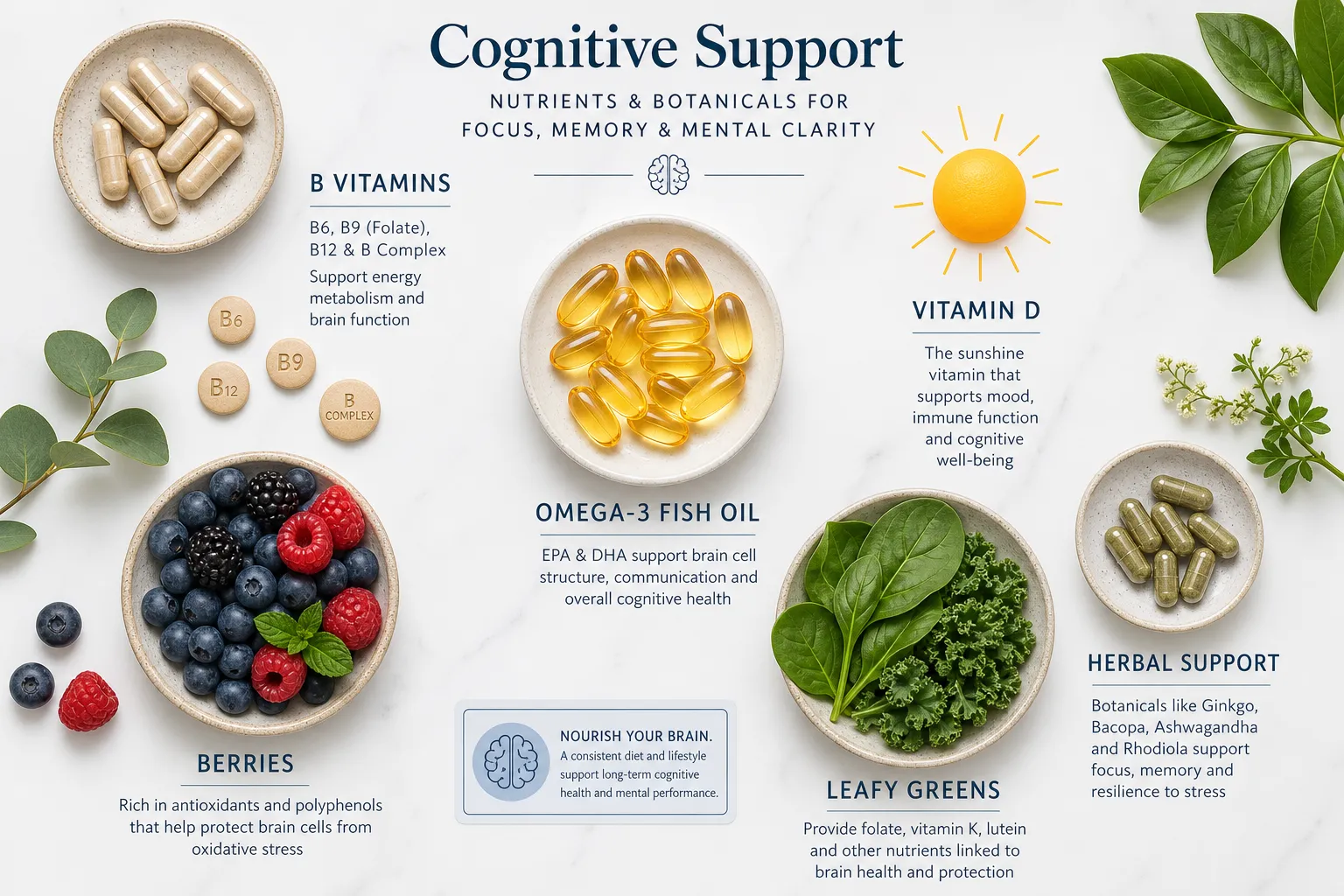
A recurring pattern across the evidence is that dietary patterns consistently outperform pill-based expectations.
Mediterranean-style, DASH-style, and MIND-style eating patterns are often associated with better long-term outcomes than highly processed diets. These patterns typically include:
-
vegetables
-
berries
-
whole grains
-
legumes
-
nuts and seeds
-
olive oil
-
fish
-
modest amounts of minimally processed protein foods
This matters because the benefit may come from the combined dietary pattern, not isolated single nutrients.
For a practical nutrition angle, our brain food guide covers everyday foods that can form a more realistic foundation for mental performance than chasing fashionable capsules alone.
Where cognitive support supplements may be worth trying
For many adults, the smartest reason to consider cognitive support supplements is not to become “superhuman”, but to address realistic needs such as:
-
low dietary intake of key nutrients
-
periods of high mental demand
-
ageing-related nutritional considerations
-
poor sleep affecting mental clarity
-
stress-related fatigue
-
restrictive diets
-
desire for a more complete routine built around diet and lifestyle
Signs the category may be relevant
You may want to think about cognitive support if you:
-
often feel mentally flat when your overall routine is stretched
-
suspect your diet is inconsistent
-
avoid key food groups
-
are older and want to stay proactive about daily wellbeing
-
are looking for targeted nutritional support without exaggerated promises
When supplements are less likely to help
If your goal is to reverse the effects of:
-
persistent poor sleep
-
high alcohol intake
-
chronic unmanaged stress
-
sedentary habits
-
severe burnout
-
an undiagnosed medical issue
then supplements alone are unlikely to make a meaningful difference.
Similarly, sudden or worsening memory changes should not be self-managed with over-the-counter products. Those require proper clinical assessment.
A realistic comparison of common cognitive support ingredients
|
Ingredient |
Best-supported role |
Best fit |
Expectation level |
|---|---|---|---|
|
B vitamins |
Correcting deficiency, supporting normal nervous system function |
Low intake, vegan diets, older adults, deficiency risk |
Moderate if low, low if already sufficient |
|
Omega-3s |
Nutritional support, especially when fish intake is low |
Adults with low oily fish intake |
Modest and long-term |
|
Vitamin D |
Supporting normal health where status is low or intake is inadequate |
UK adults, low sun exposure |
Indirect rather than immediate |
|
Ginkgo biloba |
Mixed evidence |
Selected users under guidance |
Low to uncertain |
|
Ginseng |
Energy and vitality support with mixed cognitive evidence |
People seeking general resilience support |
Modest |
|
Bacopa |
Potential memory support over time |
Adults choosing standardised herbal products |
Modest but formulation-dependent |
|
Curcumin |
Interesting but formulation-sensitive |
Those using well-designed products |
Uncertain |
|
Ashwagandha |
Stress and sleep-related support |
Adults whose cognitive strain is linked to stress |
Indirect but potentially useful |
Why formulation quality matters more than people realise
Not all cognitive support supplements are equal. Two products can contain similar-sounding ingredients and perform very differently because of differences in:
-
active form
-
standardisation
-
dose
-
stability
-
synergy
-
manufacturing quality
-
transparency
This is where premium brands should stand apart.
At InfiniVit, our approach is built around:
-
science-led formulations
-
high-grade ingredients
-
advanced blends designed with synergy in mind
-
UK manufacturing
-
strict GMP and ISO9001 standards
-
a broad range of wellness options, including vegan, vegetarian, halal, kosher, and organic choices where applicable
-
careful communication grounded in authorised EFSA statements rather than inflated claims
That matters because the goal is not to sell fantasy. The goal is to help customers choose supplements that are thoughtful, clean, and appropriate for real life.
The honest sceptic’s question: are most cognitive support supplements overhyped?
In many cases, yes.
That does not mean the entire category is useless. It means the claims are often broader than the evidence.
A sensible adult can be both open-minded and sceptical:
-
open to correcting nutritional gaps
-
sceptical of miracle promises
-
interested in high-quality formulas
-
realistic about what supplements can and cannot do
That is the healthiest way to approach the space.
What to do before buying a cognitive support supplement
1. Clarify your goal
Do you want support for:
-
memory
-
concentration
-
mental energy
-
stress resilience
-
healthy ageing
-
nutritional backup
The better you define the need, the better the choice.
2. Review the basics
Ask yourself:
-
Am I sleeping enough?
-
Is my diet actually balanced?
-
Do I exercise regularly?
-
Am I managing stress?
-
Am I drinking too much alcohol?
-
Could I be low in a key nutrient?
3. Check medications and medical history
Some botanicals and nutrients can interact with medications or be inappropriate in certain conditions.
4. Look for a transparent formula
Avoid vague proprietary language and exaggerated benefit claims.
5. Choose quality over novelty
The most useful cognitive support supplements are usually the ones with a sensible rationale, not the flashiest label.
A smarter way to think about “brain support”

The strongest cognitive support plan usually looks like this:
-
Good diet
-
Good sleep
-
Regular movement
-
Stress management
-
Social and mental engagement
-
Targeted supplementation where it genuinely fits
That last step can be meaningful, but it works best on top of a good routine, not instead of one.
Final verdict: do cognitive support supplements work?
They can work, but mostly when used for the right reason.
If you are correcting a deficiency, supporting a low-intake diet, or choosing a high-quality formula that fits a specific need, a supplement may be worthwhile. If you are expecting a dramatic, broad-spectrum mental upgrade from a generic “brain booster”, the evidence is far less convincing.
The best approach is to be selective, quality-conscious, and realistic. Choose supplements that support your overall wellness strategy rather than chasing miracle claims. That is exactly where InfiniVit aims to add value: premium, trustworthy, science-led support for modern adults who want better options than mass-market guesswork.
If you are ready to build a more thoughtful routine, explore InfiniVit’s targeted wellness range for clean, high-standard formulations designed to support everyday vitality with credibility and care.
FAQ
What is the most effective cognitive enhancer?
For most people, the most effective “cognitive enhancer” is not a single pill but a combination of sleep, exercise, diet quality, and stress management. Supplements may help most when they correct a genuine nutrient gap rather than trying to create a dramatic boost in an already healthy person.
Which supplement is best for cognitive function?
There is no universal best option for everyone. In practice, the most useful supplement depends on the person, but B vitamins, omega-3s, and vitamin D are often the most relevant when intake or status is low and normal function needs support.
What do Japanese use for memory loss?
There is no single Japanese remedy for memory loss that can be recommended broadly. Approaches typically combine medical assessment, lifestyle support, and in some settings prescription treatments, rather than relying on one over-the-counter supplement alone.
What vitamin cuts dementia risk by 40%?
Be cautious with headlines that suggest one vitamin dramatically cuts dementia risk. Current evidence does not support a simple miracle-vitamin answer; vitamins may help when correcting deficiency, but they should not be presented as a guaranteed way to prevent dementia.
What is the one food to avoid for dementia?
There is no single food that alone determines dementia risk, but consistently high intake of highly processed foods is generally less supportive of long-term brain health. A Mediterranean- or MIND-style eating pattern is a more useful focus than obsessing over one item.
What are four drugs that increase the risk of dementia?
Medicine-related risk is complex and should be discussed with a clinician, but concern often centres on some anticholinergic medicines, certain sedatives, some sleep medicines, and some older antihistamines. Never stop prescribed medication without professional advice, especially if you have noticed memory changes.