
 English
 Arabic
 Polish
 Russian
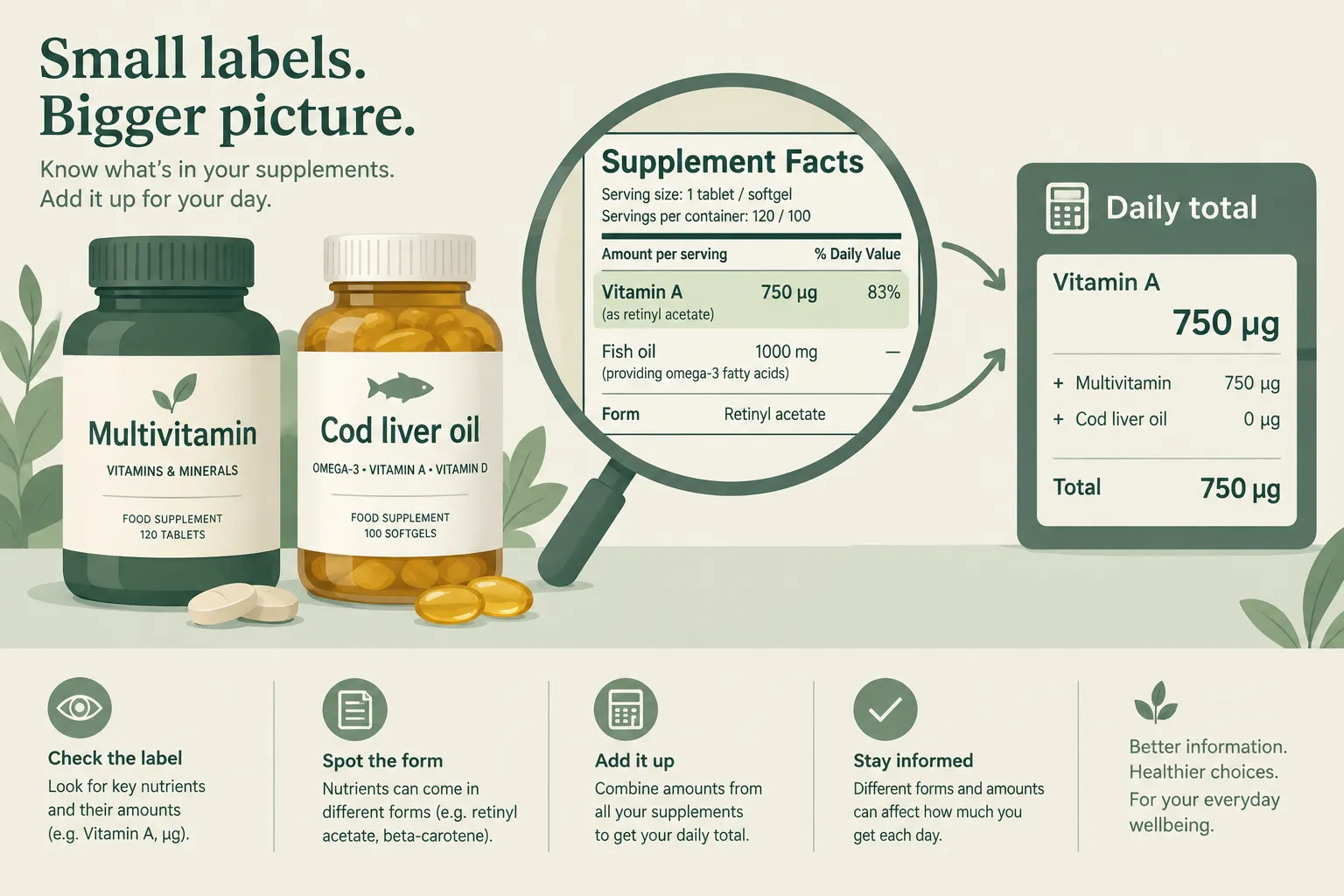
Most UK adults do not need a separate vitamin A supplement. A high-dose tablet offers no advantage if you already get enough. Before buying one, look at the vitamin A in your multivitamin, cod liver oil and any other daily products. Then identify whether it comes as retinol or beta-carotene.
If you are pregnant, avoid supplements containing vitamin A (retinol), including cod liver oil. If you think you have a deficiency, speak to a GP rather than choosing a high-dose product yourself.
Do you need a vitamin A supplement?
The NHS vitamin A guidance says adults aged 19 to 64 need 700 micrograms (µg) a day if male and 600 µg if female. It says you should be able to get what you need from your diet. These are daily needs, not targets to add on top of food with a capsule. For a closer look at everyday intake, see vitamin A foods and safer choices.
Vitamin A contributes to normal vision, skin and immune function, but the largest number on the bottle is no reason to buy it. If your diet is restricted, you have a condition affecting absorption, or you suspect a deficiency, ask a clinician to assess your situation. Symptoms need a diagnosis before you decide on a dose.
How to read vitamin A on a supplement label
Start with the amount per recommended daily serving. A multivitamin and a separate vitamin A tablet both contribute to your total, even if each looks modest alone. Read the ingredient list alongside the nutrition panel to identify the form. The multivitamin label checklist can help you compare the other nutrients in a general formula.
|
Label wording |
What it means for your decision |
|---|---|
|
Retinol, retinyl acetate or retinyl palmitate |
Preformed vitamin A. Count the stated vitamin A amount when considering overlap, and observe pregnancy precautions. |
|
Beta-carotene |
A precursor the body can convert to vitamin A. It is not the same as taking the equivalent-looking amount of preformed retinol. |
|
“Vitamin A” without a clear form on the front |
Read the full ingredients and nutrition information before choosing it. |
|
Cod liver oil |
May supply vitamin A alongside other nutrients; read the label rather than assuming it is only an omega-3 product. |
Micrograms, percentages and IU
UK labels often give vitamin A in micrograms (µg) and as a percentage of the nutrient reference value (% NRV). That percentage is a labelling reference, not a personal dose recommendation. One milligram (mg) equals 1,000 µg. Some labels use international units (IU); the conversion depends on the form of vitamin A, so an IU figure on its own cannot tell you how much retinol a mixed formula contains. Choose a label that states the form and amount per serving.
How much vitamin A is too much?
The NHS advises that if you take supplements containing vitamin A, your daily intake from food and supplements should not exceed 1.5 mg (1,500 µg). That is different from the 600 or 700 µg daily need. More is not a shortcut to healthier skin or eyesight, and taking too much vitamin A over time can be harmful.
“If you take supplements containing vitamin A, make sure your daily intake from food and supplements does not exceed 1.5 mg (1,500 µg).” – NHS
Suppose your multivitamin and separate tablet each list 800 µg of vitamin A. Together, they supply 1,600 µg before you eat anything. If both supply preformed vitamin A, that is already above the NHS 1,500 µg advice. Do not use the limit as a dose to aim for. If either product contains beta-carotene, the combined figure does not tell you how much retinol you are taking; ask a pharmacist if the label leaves the split unclear.
Cod liver oil and “skin” or “immunity” blends can add vitamin A even when the front label focuses on something else. The NHS says averaging more than 1.5 mg a day over many years may affect bones and raise fracture risk in older age, with particular relevance for postmenopausal women and older men.
Who should avoid retinol supplements?
If you are pregnant, do not take cod liver oil or supplements containing vitamin A (retinol). The NHS pregnancy supplement advice warns that too much vitamin A could harm your baby. If you are trying to get pregnant, discuss any retinol-containing supplement with your midwife, GP or pharmacist before continuing it. Do not assume a general-purpose multivitamin is suitable in pregnancy; choose pregnancy-specific guidance instead.
Beta-carotene supplements have their own precaution: the NHS advises people who smoke or have had heavy occupational asbestos exposure not to take them because of an increased lung-cancer risk. The NHS does not extend that warning to beta-carotene in food.
Follow your clinician’s instructions if you have been told to limit vitamin A or take a prescribed dose. Suspected deficiency calls for an assessment, not a high-dose purchase. Vitamin A supplements are not a treatment to choose on your own for acne or eye disease.
Choosing a supplement if you need one
If a clinician recommends vitamin A, follow their advice on form and dose. If you are deciding whether to buy a product yourself, use this short label check:
-
Set out every product you take each day, including cod liver oil and blends with added vitamins.
-
Write down the vitamin A amount, unit and form for the recommended daily serving of each one.
-
Take account of pregnancy precautions and your dietary preferences before deciding whether a product fits.
-
Choose clear ingredient and dose information over a prominent high-dose claim.
InfiniVit has a broad UK supplement range, including multi-ingredient formulas for different wellness goals. If one of those goals brings you to a blend, read its vitamin A line alongside the rest of your routine. The range gives you options, but a blend is not a substitute for clinical advice on deficiency or pregnancy, and you should not assume it is suitable as a vitamin A supplement. InfiniVit also has a guide to choosing quality supplements if you want to compare labels more closely.
The bottom line
The best vitamin A supplement in the UK may be the one you decide not to add. Count what your current products supply and identify the form before buying another. During pregnancy, avoid supplements containing retinol; for suspected deficiency, seek clinical advice. If you want a supplement for a wider wellness goal, browse InfiniVit’s range with those label checks in mind. Its breadth makes it useful for finding a formula that fits, as long as you avoid unnecessary vitamin A overlap.
FAQ
Is it worth taking a vitamin A supplement?
Usually not if your diet supplies enough. A clinician may recommend one for a specific need. Adding a separate tablet to a multivitamin or cod liver oil can make your intake higher than you intend.
What is the best form of vitamin A to take?
The right form depends on your reason for taking it and the vitamin A already in your routine. Retinol is preformed vitamin A and requires care with dose and pregnancy. Beta-carotene is a precursor, with a separate supplement warning for people who smoke or have had heavy occupational asbestos exposure.
What should you not mix with vitamin A?
Count the vitamin A in your multivitamin, cod liver oil and other blends before adding a separate tablet. In pregnancy, do not take cod liver oil or supplements containing vitamin A (retinol). A pharmacist can help if the amounts or forms on your labels are unclear.