
 English
 Arabic
 Polish
 Russian
To choose kosher vitamins and supplements, match the exact product and formulation to a recognised kosher certification. A vegan capsule or a retailer’s “kosher” filter can help you shortlist products. Before buying, read the pack and ask the certifying agency about any detail you cannot settle from its records.
The OU explains its kosher symbol in this short video:
How to check kosher vitamins and supplements
Kosher certification covers a product under defined manufacturing conditions. That includes more than the active vitamins: the capsule, carriers and production equipment matter too. One brand can sell products with different dietary statuses, and certification of an ingredient does not certify the finished supplement.
A certified raw material can end up in a supplement with a different carrier, made on another production line. The kosher agency assesses the final formula and production process. Even if a manufacturer sells kosher-certified food products, its dietary supplements need their own product-level evidence.
Find the kosher symbol on the pack and identify the organisation behind it. Compare the full product name, strength, format and flavour with the certifier’s listing or the manufacturer’s current product-specific certificate. A listing for another variant does not cover yours by default. If the symbol carries a designation, such as a dairy indication, ask the certifier what that means for this product.
Online photographs may show an older label, especially after a formulation change. If the pack and listing disagree, record the batch number and ask the certifier about that version. No symbol on the pack means you lack label-based confirmation; it does not establish that the product is non-kosher.
For UK purchases, KLBD’s product search makes the product-by-product distinction explicit:
“Products not listed should not be assumed kosher, even if others in the range are certified or approved.” – KLBD
Read beyond the active vitamins
The ingredients panel gives you a starting point, but it cannot name every supplier, processing aid or shared-equipment arrangement. Even a suitable-looking list leaves questions for the certifier.
The STAR-K guide to medications, vitamins and nutritional supplements explains the concern with animal-derived gelatine. The word “gelatine” alone will not tell you whether a capsule is considered non-kosher. You need the agency’s approval for that capsule.
|
Label detail |
Why it deserves a closer look |
Useful question to ask |
|---|---|---|
|
Gelatine capsule or softgel |
Gelatine can come from different animal sources; “bovine” or “fish” alone does not establish certification. |
Is the complete capsule or softgel covered by the finished product’s certification? |
|
“Vegetable capsule” or cellulose shell |
A plant-based shell removes an obvious animal ingredient, not questions about the rest of the formulation or equipment. |
Is this exact capsule formulation included in the certified product? |
|
Glycerine or fatty-acid derivatives |
The source and processing may not be evident from the ingredient name. |
Has the certifier approved the source used in this version? |
|
Flavourings, colours and liquid extracts |
These can introduce carriers or extraction solvents not apparent from the headline active ingredient. |
Are these components included in the certification scope? |
|
Fish oil, vitamin D3 or mixed botanical extracts |
Source materials and the route through processing can differ between formulations. |
Does approval cover this source and finished format? |
Vegan and vegetarian do not mean kosher. Those labels address animal ingredients. Kosher certification also considers sourcing and manufacture. Halal, organic, GMP and ISO quality claims serve other purposes, so look for certification covering the supplement itself.
InfiniVit’s guide to vegan supplements in the UK can help if you are also comparing animal-free formulations.
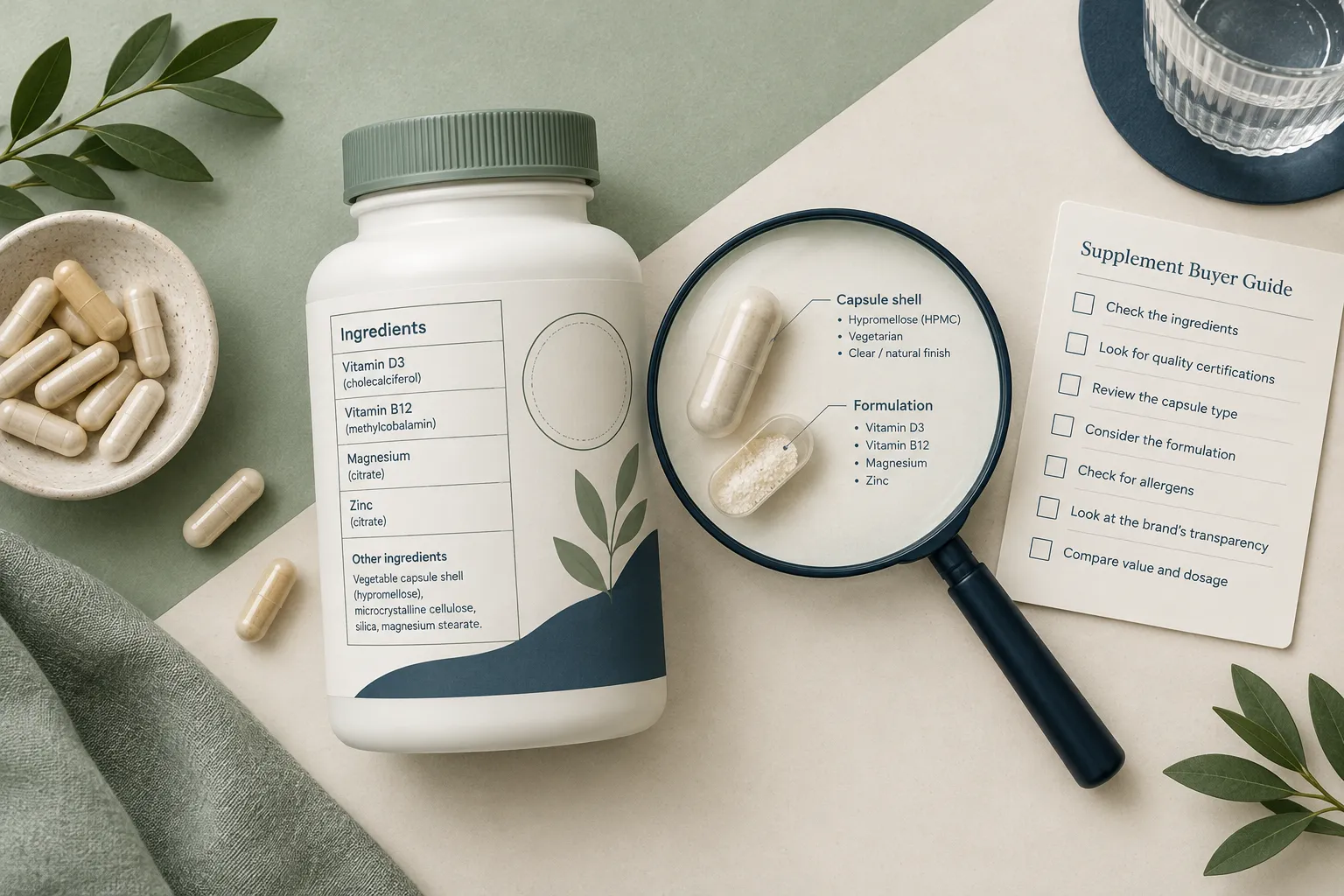
A practical label-check checklist
Use these steps when shopping online or reading a bottle in a UK shop:
-
Identify the precise item. Note the manufacturer, product name, strength, flavour, dosage form and pack size. Save a picture of the front and the full ingredients panel.
-
Find the kosher mark. Read the symbol and any accompanying letters rather than relying on a search filter or a category badge.
-
Match the scope. Look for that exact variant in the certifier’s current product information or request the manufacturer’s product-specific certificate. A general statement about the brand is not enough.
-
Scan the whole formulation. Include the capsule or gummy base, other ingredients and any dairy designation in your assessment. Mark anything the label does not explain.
-
Resolve a mismatch. Give the certifier the label photos, batch number where available and the certificate or listing you found. Ask whether the version sold in the UK is included.
In an email to the certifier, ask: “Is [full product name, strength, format and flavour] sold in the UK, batch [number], covered by your current kosher certification? Does that approval include the capsule shell and any dairy designation?” Attach the label photographs. If the agency cannot establish that formulation’s status, choose a product with certification you can establish.
Special cases to consider
Kosher multivitamins and combination formulas
A kosher multivitamin needs certification for the finished blend, including its coatings, binders, flavourings and any capsule shell. Ingredients can also change between strengths and formats. Approval for one nutrient on the label is no substitute for approval of the whole multivitamin.
For the nutritional question, see what multivitamins can and cannot do.
Vitamin D3, omega oils and softgels
Vitamin D3 and omega products can start with animal or fish-derived materials. In a softgel, there is also the shell around the oil or vitamin. The certifier’s approval needs to cover that shell as well as the source and processing. Treat a tablet and a softgel with similar names as separate formulations.
For the nutrition side of that decision, see how to choose a vitamin D supplement.
Gummies, chewables and liquids
Gummies, chewables and liquids can contain a gummy base, flavours, colours and other carriers. A “gelatine-free” claim on the front of the pack tells you nothing about certification of the finished product.
Passover and supplements taken for medical reasons
Year-round kosher certification may not cover Passover. Ask the certifier about Passover status for the product rather than extending its regular approval yourself. Prescribed medicines and therapeutic use raise different questions from routine supplements. Do not stop or change prescribed treatment over a label question; speak to your clinician about your care and a qualified rabbinic authority about the religious question.
Choose for both dietary fit and daily needs
Once you have established the exact supplement’s kosher status, compare its contents, suggested daily intake and format with your needs. Read past the dietary badge to see what you would actually be taking.
InfiniVit offers supplements across a range of wellness interests, including multi-ingredient formulations. The range may include dietary options, but do not assume an InfiniVit product is kosher because of a brand-level claim. If one of its formulas suits your goals, examine that product’s label and certification before ordering. Buy it when you have the formulation you want and the documentation your dietary requirements call for.
FAQ
Does vitamin D3 have pork gelatin?
Not necessarily. Vitamin D3 is sold in different formats, and a softgel’s shell may contain gelatine from a source that the label does not specify. Read the ingredients for the exact product, then use its kosher certification or ask the certifier to establish the status of the full formulation.
Which vitamin brands are kosher?
A brand-wide answer is unreliable because formulations and certification can vary across products. Look for a recognised kosher mark and match the exact vitamin, strength and format to the certifier’s current approval. A brand’s vegan range or a retailer category label is not enough on its own.
Are Nature’s Bounty vitamins kosher?
There is no sound way to establish the status of every vitamin in a brand’s range from its name alone. For a particular Nature’s Bounty item, match its pack details and kosher mark to current product-level certification, or ask the named certifier about the precise formulation. Do not infer the status of another strength or format from one approved item.