
 English
 Arabic
 Polish
 Russian
Best Time to Take Vitamins in the UK
If you have ever stood in your kitchen wondering whether your supplements belong at breakfast, dinner, or right before bed, you are not alone. The truth is that the best time to take vitamins depends less on chasing a “perfect” hour and more on a few practical rules: the type of vitamin, whether food helps absorption, whether it upsets your stomach, and whether you will actually remember to take it consistently.
For most people in the UK, timing matters far less than supplement quality, suitability, and routine. But there are a few important exceptions. Fat-soluble vitamins are usually better with food, some minerals can compete with each other, and certain formulas may feel more comfortable earlier or later in the day.
At InfiniVit, we believe supplement advice should be clear, evidence-aware, and realistic for everyday life. That means no exaggerated promises about timing “unlocking” dramatic energy or overnight results. Instead, this guide focuses on what actually matters, so you can build a routine that is effective, simple, and sustainable.

The short answer: what matters most
If you want the simplest possible rule, it is this:
-
Take your vitamins at a time you can stick to consistently
-
Take fat-soluble vitamins with a meal that contains some fat
-
Take supplements that upset your stomach with food unless the label says otherwise
-
Separate certain vitamins and minerals from medicines when advised
-
Follow the product label and any advice from your pharmacist, GP, or specialist
That is the foundation of the best time of day to take vitamins for most adults.
When timing really matters
Not every supplement is equally sensitive to timing. Some genuinely benefit from a particular approach.
Fat-soluble vitamins: timing with food matters more than clock time
Vitamins A, D, E, and K are fat-soluble. That means they are generally better taken with a meal or snack containing some dietary fat, rather than on a completely empty stomach.
In practice, this could mean:
-
breakfast with yoghurt, eggs, nuts, or avocado
-
lunch with olive oil dressing
-
dinner with fish, dairy, or another source of fat
This is one reason many people choose breakfast or lunch for vitamin D or multivitamins that contain fat-soluble nutrients.
If vitamin D is part of your routine, you may also like our guide on the best time to take vitamin D in the UK, which explains how meals, routine, and seasonal UK needs fit together.
Water-soluble vitamins: consistency usually matters more
Water-soluble vitamins include vitamin C and the B vitamins. These do not depend on dietary fat in the same way. For many people, they can be taken with or without food, though food may help if you have a sensitive stomach.
The main reason people choose morning for B vitamins is practical: some prefer to take them earlier in the day as part of their breakfast routine. That does not mean they are “stimulants” in the way caffeine is, but some people simply feel they fit better earlier rather than late at night.
Iron: follow specific advice carefully
Iron is one of the clearest examples where timing and pairing can matter. It may be affected by tea, coffee, calcium, and some other minerals. If you take iron, follow the label or medical advice carefully rather than assuming it behaves like a standard daily multivitamin.
Medicines and supplements: spacing can matter
Some supplements should not be taken too close to certain medicines. Thyroid medication, some antibiotics, and prescribed iron are common examples where spacing may be important. If you take regular medication, ask your pharmacist to review your supplement timing.
When timing barely matters
This is where many articles overcomplicate things. For a large number of common supplements, there is no magical “best” hour.
If you are taking:
-
a general multivitamin
-
vitamin C
-
a standard B-complex
-
omega oils
-
a general wellness blend
the most important factor is often taking it regularly and in a way that suits your body.
That means the best time to take multivitamins is often simply the meal you are least likely to miss.
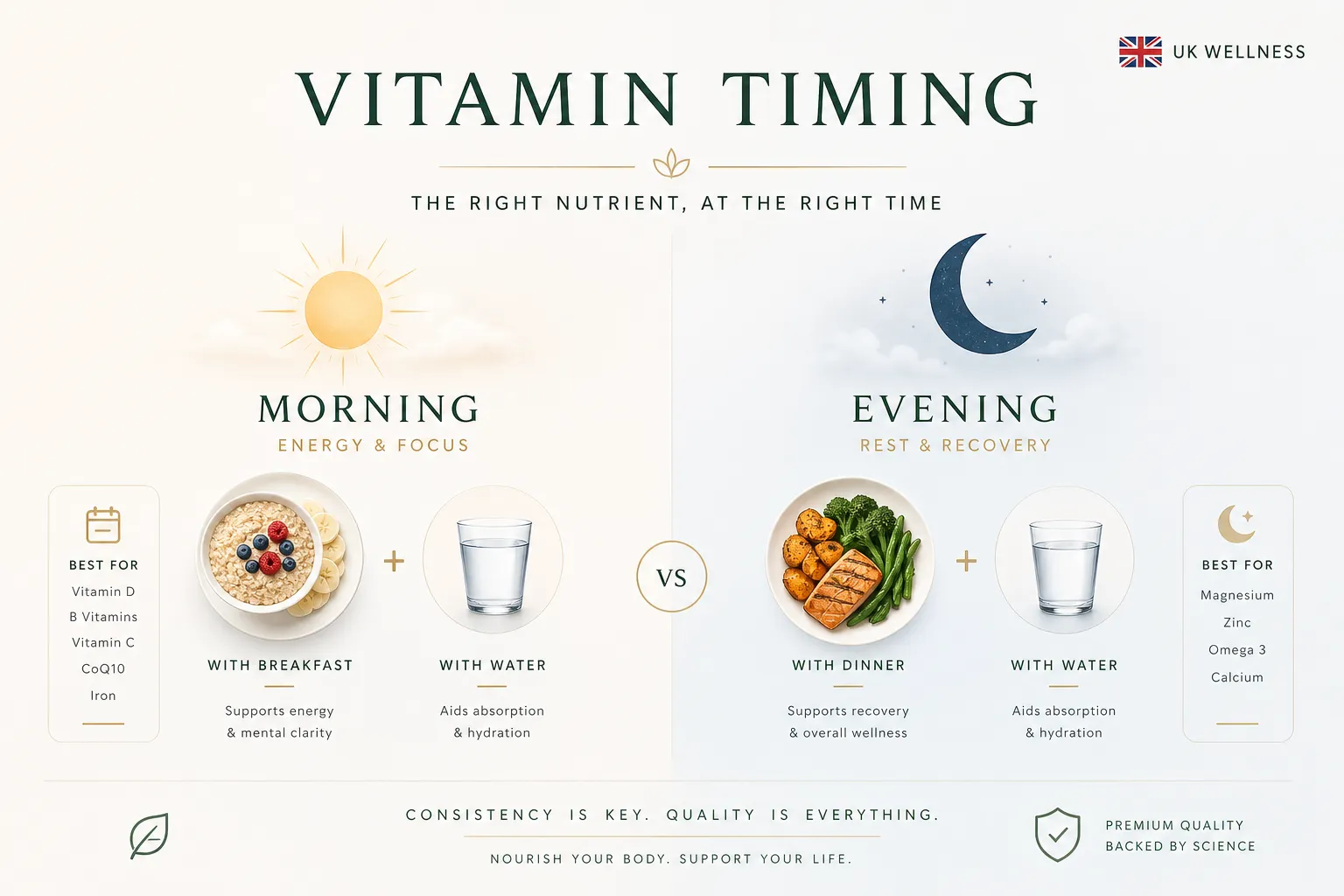
Morning vs evening: which is better?
Morning can be a smart default
Morning works well if:
-
you already eat breakfast
-
you like habit stacking with other routines
-
you want to avoid forgetting later
-
your supplement contains B vitamins and you prefer taking them earlier
For many adults, breakfast is the easiest anchor point. A visible supplement pot next to your cereal, kettle, or coffee machine can improve consistency more than any theoretical absorption trick.
Evening can work just as well
Evening may suit you better if:
-
you skip breakfast
-
your largest meal is dinner
-
your supplement is better tolerated with a substantial meal
-
mornings are rushed and inconsistent
There is nothing inherently wrong with taking many vitamins at night. The main question is whether the supplement feels comfortable for you and whether the meal context supports absorption.
The real winner: whichever routine you keep
The best timing is the one you can maintain for months, not three days. A “perfect” plan you forget half the time is far less effective than a simple one you actually follow.
Should you take vitamins with food?
Usually, yes – especially if:
-
the formula contains vitamins A, D, E, or K
-
the supplement contains minerals such as zinc or magnesium that can feel harsh on an empty stomach
-
you are prone to nausea with tablets or capsules
But not all supplements require food. Some labels will state they can be taken on an empty stomach. The product directions should always be your first reference point.
A practical rule of thumb
Here is an easy guide:
|
Supplement type |
Best taken with food? |
Best time consideration |
|---|---|---|
|
Multivitamin |
Usually yes |
Breakfast or lunch often works well |
|
Vitamin D |
Yes, ideally with a meal containing fat |
Any consistent mealtime |
|
B vitamins |
Optional, but food may improve comfort |
Often morning for routine |
|
Vitamin C |
Optional |
Any time that suits you |
|
Magnesium |
Often better with food for comfort |
Many people prefer evening |
|
Iron |
Often needs specific instructions |
Follow label or clinician advice |
|
Omega oils |
Yes |
With a meal |
What about multivitamins?
A multivitamin is where people most often search for the best time to take vitamins, because one capsule may contain several nutrients with different characteristics.
The practical answer is:
-
take it with a meal
-
choose a consistent time
-
avoid taking it alongside anything that the label says may interfere
For many people, the best time to take multivitamins is breakfast or lunch. That gives you food in the stomach, makes the habit easy to remember, and may feel gentler than taking it late at night.
It is also worth choosing a formula designed with balance in mind. At InfiniVit, we believe premium supplementation starts with thoughtful formulation, not just a long ingredient list. Quality matters: ingredient forms, sensible dosing, manufacturing standards, and overall synergy all shape the real-world experience.
If you are building a daily routine from scratch, our article on what supplements should you take daily can help you decide what is worth considering and what may be unnecessary.
Common vitamin types and the timing rules people actually need
Vitamin D
Take it with food, ideally a meal containing some fat. Morning, lunch, or evening can all work. In the UK, vitamin D is particularly relevant because sunlight exposure is limited for much of the year.
If you want to understand the wider context, including UK-specific considerations, read our guide to vitamin D benefits for UK adults.
B-complex vitamins
These are often taken in the morning simply because it fits better into daily routines. Food may help reduce stomach discomfort. There is no universal rule that they must be taken early, but many people prefer that pattern.
Vitamin C
Timing is flexible. It can be taken with or without food depending on tolerance. Split dosing may be used in some higher-intake routines, but many people are perfectly fine taking it once a day.
Magnesium
Magnesium is a mineral rather than a vitamin, but it often comes up in the same conversation. Some people prefer it in the evening, especially if that is when they are winding down, but this is more about routine and tolerance than a strict universal rule.
Omega oils
These are best taken with food, often lunch or dinner, because that tends to be more comfortable and practical.
Probiotic and digestive formulas
These can vary a lot depending on the product. Always follow label directions, because different strains and delivery systems may have different recommendations. If gut health is one of your priorities, our guide to digestive health supplements and what actually helps offers a more detailed look.

Mistakes that matter more than timing
Many people focus on whether 8am beats 8pm, while missing the things that have a bigger impact.
1. Taking supplements randomly
The occasional capsule “when you remember” is less useful than a stable routine.
2. Ignoring the label
Directions differ by ingredient and formula. Premium products are formulated with intended use in mind.
3. Choosing low-quality supplements
Poor-quality products can mean unclear dosing, less thoughtful formulations, or a less reliable user experience. InfiniVit works with UK manufacturing partners operating to strict GMP and ISO9001 standards, with options across vegan, vegetarian, halal, kosher, and organic preferences where available.
4. Expecting timing alone to transform outcomes
Timing can improve comfort and sometimes absorption, but it is not a shortcut that overrides diet, sleep, medical care, or consistency.
5. Overloading your routine
If you are taking several products, simpler is often better. Group compatible supplements around one or two daily anchor points rather than creating a rigid all-day schedule you cannot maintain.
A realistic daily vitamin schedule
Here is a practical template most adults can adapt.
Option 1: Breakfast routine
-
Multivitamin with breakfast
-
Vitamin D with breakfast if the meal contains some fat
-
Omega oils with breakfast if tolerated well
Option 2: Lunch routine
-
Multivitamin with lunch
-
Vitamin D with lunch
-
Omega oils with lunch
Option 3: Split routine
-
B-complex or vitamin C in the morning
-
Magnesium in the evening
-
Vitamin D with your main meal
This kind of simple structure usually works better than trying to optimise every nutrient to the minute.
How to know if your timing is working
A good supplement routine should feel:
-
easy to remember
-
comfortable on your stomach
-
compatible with your meals and medicines
-
sustainable over time
If a supplement makes you feel nauseous, causes digestive discomfort, or repeatedly gets forgotten, your timing may need to change – even if the nutrient itself is still appropriate.
What UK readers should keep in mind
The UK context matters. People here are often balancing:
-
inconsistent breakfast habits
-
darker winters and vitamin D awareness
-
tea and coffee-heavy routines
-
busy workdays and missed meals
-
a mix of prescription medicines and self-selected wellness products
That is why practical guidance matters more than generic advice. The “best” time is not the one that sounds most biohacked; it is the one that matches how you actually live.
Why supplement quality matters as much as timing
Timing helps, but quality is foundational. A well-made supplement should offer:
-
clear labelling
-
sensible, targeted formulation
-
high-grade ingredients
-
reliable manufacturing standards
-
honest, compliant communication
That is exactly where InfiniVit aims to stand apart from generic high-street options. Our range is designed for modern wellness needs, from immunity and digestive support to cognitive support, sleep, sports nutrition, and everyday vitality. We focus on science-led formulations with purposeful ingredient combinations rather than “more for the sake of more.”
Final verdict
For most adults, the best time to take vitamins is the time you will remember consistently, with one key adjustment: take fat-soluble vitamins and many multivitamins with food. Morning is often convenient, evening can work just as well, and meal context frequently matters more than the clock.
So if you have been overthinking whether vitamins must be taken at a perfect hour, the answer is reassuring: usually not. Choose a high-quality supplement, follow the label, pair food-sensitive nutrients with meals, and build a routine you can stick to.
If you want premium, UK-made wellness support with thoughtful formulations and trustworthy standards, explore InfiniVit’s range and build a supplement routine that feels both elevated and practical.
FAQ
Is it better to take vitamins at night or morning?
For most people, morning and night can both work. The best choice is the time you can take them consistently, although fat-soluble vitamins and many multivitamins are usually best taken with a meal rather than on an empty stomach.
What vitamin should not be taken at night?
There is no universal rule that a specific vitamin must never be taken at night, but some people prefer not to take B vitamins late in the day because morning fits their routine better. The bigger issue is whether the supplement needs food for comfort or absorption.
Can I take 5 different vitamins at once?
Sometimes yes, but it depends on the ingredients, the doses, and whether they overlap. It is often better to keep things simple and intentional, and to check the label or speak to a pharmacist if you also take medicines or have an existing health condition.
What two vitamins should not be taken together?
There is no single pair that everyone must always separate, but some minerals and medicines can interact with supplements. Iron, calcium, magnesium, thyroid medication, and some antibiotics are common examples where spacing may matter, so personalised advice is best.
What vitamins help with sleep?
Vitamins are not a guaranteed sleep solution, and timing alone should not be overstated. Some people include evening-friendly routines with nutrients such as magnesium, but the right approach depends on the product, your tolerance, and your wider sleep habits.