
 English
 Arabic
 Polish
 Russian
The best omega fish oil supplements for a UK adult state EPA and DHA per daily serving, show what that serving costs, and provide evidence of freshness and contaminant testing. A bottle labelled “1,000 mg fish oil” may provide much less EPA and DHA. Look at your diet first, then at the numbers on the bottle.
Start with food or a supplement?
Food is the first option for most adults. UK advice is to eat at least two portions of fish a week, including one oily fish. Salmon, sardines and mackerel supply long-chain omega-3 fats. If oily fish is already a regular part of your meals, a daily capsule may add little. For someone who rarely eats fish, a supplement offers another way to get EPA and DHA.
“A healthy, balanced diet should include at least 2 portions of fish a week, including 1 of oily fish.” – NHS, Fish and shellfish
“Omega-3” covers different fats. Oily fish and fish oil contain EPA (eicosapentaenoic acid) and DHA (docosahexaenoic acid). Flaxseed, chia and walnuts provide ALA (alpha-linolenic acid), which the body converts to EPA and DHA to a limited extent. An “omega 3-6-9” blend will not necessarily supply the EPA and DHA found in fish or algae oil.
Supplementing is a dietary choice, not a substitute for treatment or a proven way to prevent disease. If you are deciding whether you need any daily supplement, read our guide to what supplements are worth taking daily and consider your whole diet before buying a bottle.
Read EPA and DHA on the label
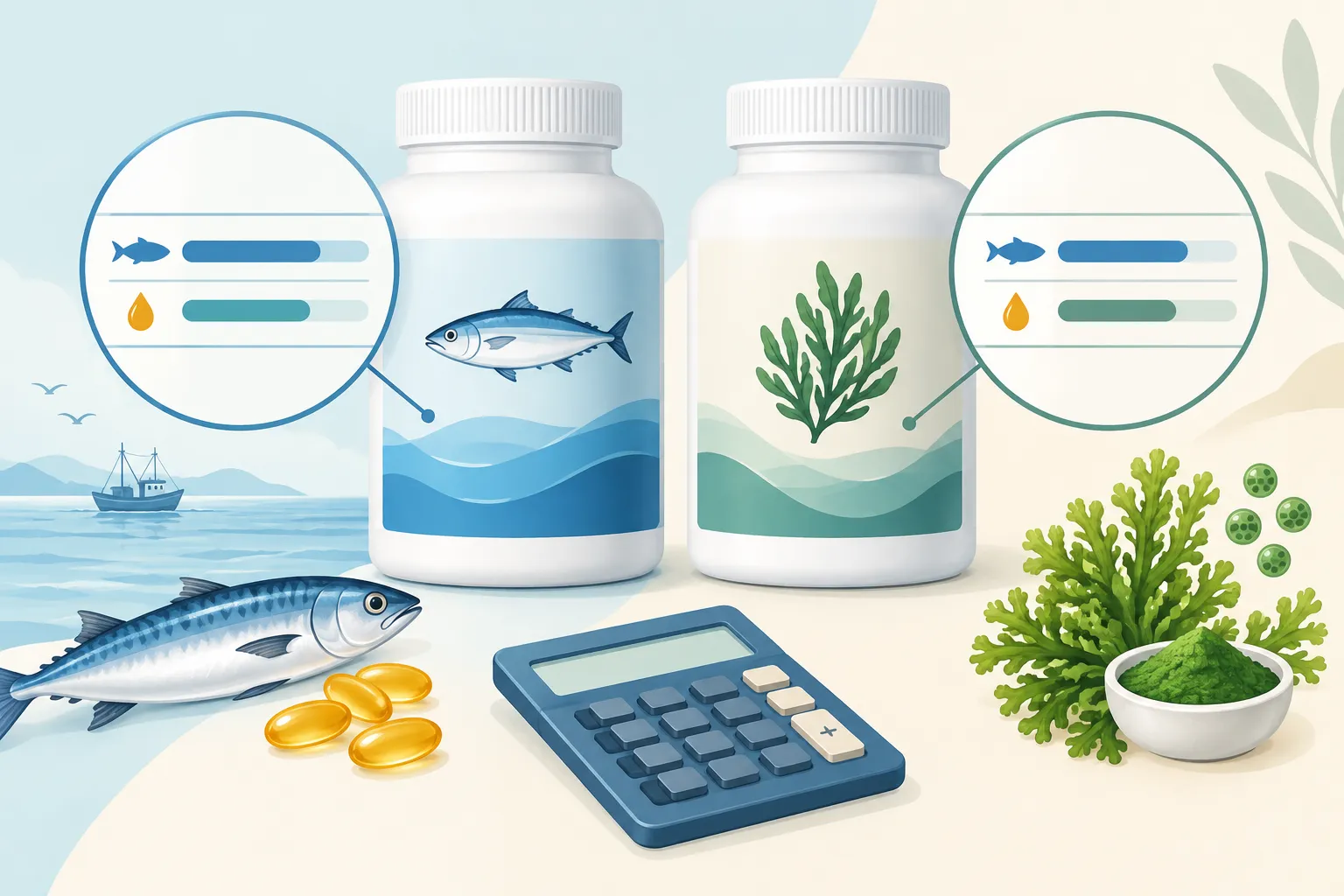
Start with the stated serving size. Find the milligrams of EPA and DHA in that serving and add them. Neither the total fish oil figure nor “total omega-3” tells you how much EPA+DHA you get.
For example, a hypothetical label may say:
|
Label line |
Amount per two-capsule serving |
What it means |
|---|---|---|
|
Fish oil |
2,000 mg |
The amount of oil, not the EPA+DHA dose |
|
Total omega-3 |
1,200 mg |
May include fatty acids besides EPA and DHA |
|
EPA |
660 mg |
Count towards the EPA+DHA total |
|
DHA |
440 mg |
Count towards the EPA+DHA total |
|
EPA + DHA |
1,100 mg |
The comparable figure for this serving |
One capsule from that two-capsule serving gives you half the labelled amounts. Compare products on the same basis: “per capsule” on one pack and “per serving” on another can conceal a sizeable difference. A seller who publishes only “high-strength fish oil” without separate EPA and DHA amounts leaves you unable to calculate a meaningful comparison.
In a shop, note the capsules per pack and per serving, then the EPA and DHA in that serving. Compare a full day’s labelled serving for each bottle. If matching another product means taking twice as many capsules, the cost doubles too. A concentrated capsule may spare you extra softgels, though there is no reason to take a higher amount simply because a capsule contains it.
No single EPA:DHA ratio suits everyone buying a general supplement. Compare the amounts themselves and stay within the label directions. A clinician should advise on doses intended for a medical purpose.
Compare price per usable dose
Price per capsule can hide the difference between dilute and concentrated oils. Compare these figures instead:
Cost per daily serving = bottle price ÷ number of daily servings.
Cost per gram of EPA+DHA = bottle price ÷ (servings per bottle × EPA+DHA grams per serving).
These invented labels and prices show the calculation; they do not describe products on sale:
|
Example |
Pack and label |
EPA+DHA per daily serving |
Servings per pack |
Cost per serving |
Cost per gram EPA+DHA |
|---|---|---|---|---|---|
|
A |
£12 for 60 capsules; serving is two capsules with 300 mg EPA and 200 mg DHA |
500 mg |
30 |
£0.40 |
£0.80 |
|
B |
£18 for 60 capsules; serving is one capsule with 400 mg EPA and 300 mg DHA |
700 mg |
60 |
£0.30 |
About £0.43 |
Example B costs more per bottle, yet less per serving and per gram of EPA+DHA. Use cost per gram to compare value, not as an instruction to take a gram each day. Decide what serving fits your diet and circumstances before comparing prices. Add delivery costs if you order one bottle at a time.
Assess source, freshness and testing
A useful label names the source and gives you a way to assess quality. Use these checks to distinguish specifications from slogans:
|
Check |
Useful evidence |
What it does not prove |
|---|---|---|
|
Origin |
Named fish species and sourcing area, or identified algal source |
“Marine” alone does not identify the source |
|
Sustainability |
A relevant fishery or chain-of-custody certification with scope for the product |
Sustainable sourcing does not establish the oil’s potency or freshness |
|
Contaminants |
A current, identifiable product or batch report showing results for relevant heavy metals, PCBs and dioxins |
“Purified” without results is a process claim |
|
Oxidation |
Peroxide, anisidine and, where applicable, TOTOX results tied to the oil or batch, with stated limits |
Added vitamin E is not proof that oil is fresh |
|
Traceability |
Batch or lot number and best-before date on the pack |
A date alone is not an independent laboratory result |
For a “third-party tested” claim, look for results tied to this finished product or batch, the substances measured, the limits applied and the laboratory’s identity. A certificate for an ingredient does not necessarily cover the finished capsule. GMP manufacturing and ISO quality-system credentials describe production processes; neither is a substitute for independent product-level test results. Our UK guide to judging supplement quality explains what other certifications can and cannot tell you.
Keep the oil fresh after purchase
Omega-3 oils can oxidise. Look for packaging that limits light and air exposure and a best-before date that suits how you will use the pack. Follow the storage directions, close liquids promptly and discard oil that develops a rancid smell or taste. Fishy burps are unpleasant, but they cannot tell you what a laboratory would find. A label may also describe the oil as triglyceride or ethyl ester; the form alone cannot replace a comparison of EPA+DHA, tolerability, price and test evidence.
Choose the format that suits you
|
Option |
Good fit |
Main consideration |
|---|---|---|
|
Oily fish |
Adults who eat fish and prefer food to capsules |
Frequency and fish choices matter |
|
Fish oil capsules or liquid |
People who want direct EPA and DHA but rarely eat oily fish |
Read the serving, source, ingredients and test evidence |
|
Cod liver oil |
People specifically choosing an oil that also contains vitamins A and D |
Vitamin A needs particular care during pregnancy |
|
Algal oil |
Vegans, vegetarians and people avoiding fish ingredients |
Some formulas supply mostly DHA; read EPA and DHA separately |
Algal oil supplies DHA without fish, and some formulas also supply EPA. Flax oil mainly supplies ALA. For other animal-free options alongside algae-derived omega-3, see Best Vegan Supplements in the UK.
Capsules come pre-portioned. Liquids spare you the softgel, although you will need to measure and store them as directed. If you avoid animal gelatin, read the capsule shell ingredients as well as the oil ingredients. During pregnancy, avoid cod liver oil and supplements containing vitamin A (retinol), as the NHS pregnancy supplements advice states.
Safety and taking it
Stick to the pack’s serving directions. Taking fish oil with a meal may help if it leaves a fishy aftertaste or causes indigestion. Nausea, loose stools and reflux can occur; a different format or a smaller labelled serving may be easier to tolerate. Stop taking it if you have an adverse reaction.
Talk to a pharmacist or GP before taking fish oil if you use medicines that affect clotting, have a bleeding disorder or fish allergy, are due for an operation, or are pregnant. If you have high triglycerides or another diagnosed condition, a shop-bought supplement should not replace prescribed care. Fish oil is not a treatment for joint pain or ADHD, nor a way to prevent cardiovascular disease.
“Do not offer omega 3 fatty acid compounds to prevent CVD.” – NICE, cardiovascular disease guideline NG238
The NICE recommendation concerns disease prevention; it does not tell people to stop eating omega-3 foods. A clinician may prescribe treatment for a particular patient, which is a different decision from choosing a shop-bought oil. For a diagnosed condition, talk to your care team instead of increasing a supplement dose yourself.
Best omega fish oil supplements: the verdict
Start with food if it works for you. If you want a supplement, compare the EPA and DHA per serving and the cost of that serving. Look for a traceable oil with product-level quality evidence. An attractive pack cannot make up for missing label details.
InfiniVit’s wellness range is for shoppers who value clear formulations and thoughtful sourcing. Apply the same checklist to our omega oils range: our manufacturing standards do not replace an independent test result for a particular product. Browse the current labels and ask our team for help interpreting a serving before you order.
FAQ
What is the best omega-3 supplement for me?
If you eat oily fish regularly, you may not need one. Otherwise, choose a fish or algal oil with clearly labelled EPA and DHA per serving, a manageable serving size and credible quality evidence; ask a clinician about individual medical needs.
What are the potential side effects of taking omega-3 supplements?
Fishy aftertaste, indigestion, nausea and loose stools are possible. If you take medicines that affect clotting or have a bleeding disorder, speak to a pharmacist or GP before taking fish oil.
What’s the best time to take fish oil?
There is no special clock time you need to follow. Take the labelled serving with a meal if that helps you tolerate it, and follow any product-specific directions.
What happens if you take omega-3 fish oil every day?
It adds EPA and DHA to your diet each day, but it does not guarantee a health benefit or replace eating well. Stick to the labelled serving and consider whether you already get oily fish regularly.
What should you not mix omega-3 with?
If you take medicines that affect clotting, such as anticoagulants, discuss fish oil with a pharmacist or GP rather than combining them without advice. Also account for vitamin A in cod liver oil, especially during pregnancy.