
 English
 Arabic
 Polish
 Russian
Look at your diet before choosing a B-complex, a multivitamin with B complex or standalone B12. A multivitamin covers more nutrients, but adding a B-complex can give you two doses of the same vitamins. Many adults with a varied diet need neither. If you avoid animal products, pay particular attention to B12. Symptoms or a diagnosed deficiency call for medical advice rather than a trial of several shop-bought products.
Which supplement fits your diet?
|
Your situation |
Most useful starting point |
Why |
|---|---|---|
|
Varied diet, no identified shortfall |
Food first; possibly no supplement |
Extra B vitamins are not a substitute for a balanced diet. |
|
Diet may lack several nutrients |
A multivitamin, if appropriate |
It covers nutrients beyond the B family, so the whole label matters. |
|
Specific reason to supplement several B vitamins |
A B-complex |
It focuses on B vitamins without automatically adding other vitamins and minerals. |
|
Vegan diet or a known need for B12 |
A reliable B12 source or a clinician-directed plan |
A multivitamin or B-complex only helps if its B12 content meets your needs. |
|
Suspected deficiency, persistent tiredness, numbness or tingling |
Speak to a clinician |
Symptoms need assessment; a supplement is not a diagnosis or a treatment plan. |
Pregnancy, medicines and a diagnosed deficiency can change which of these starting points applies to you.
Multivitamin with B complex vs B-complex vs B12: what you are buying
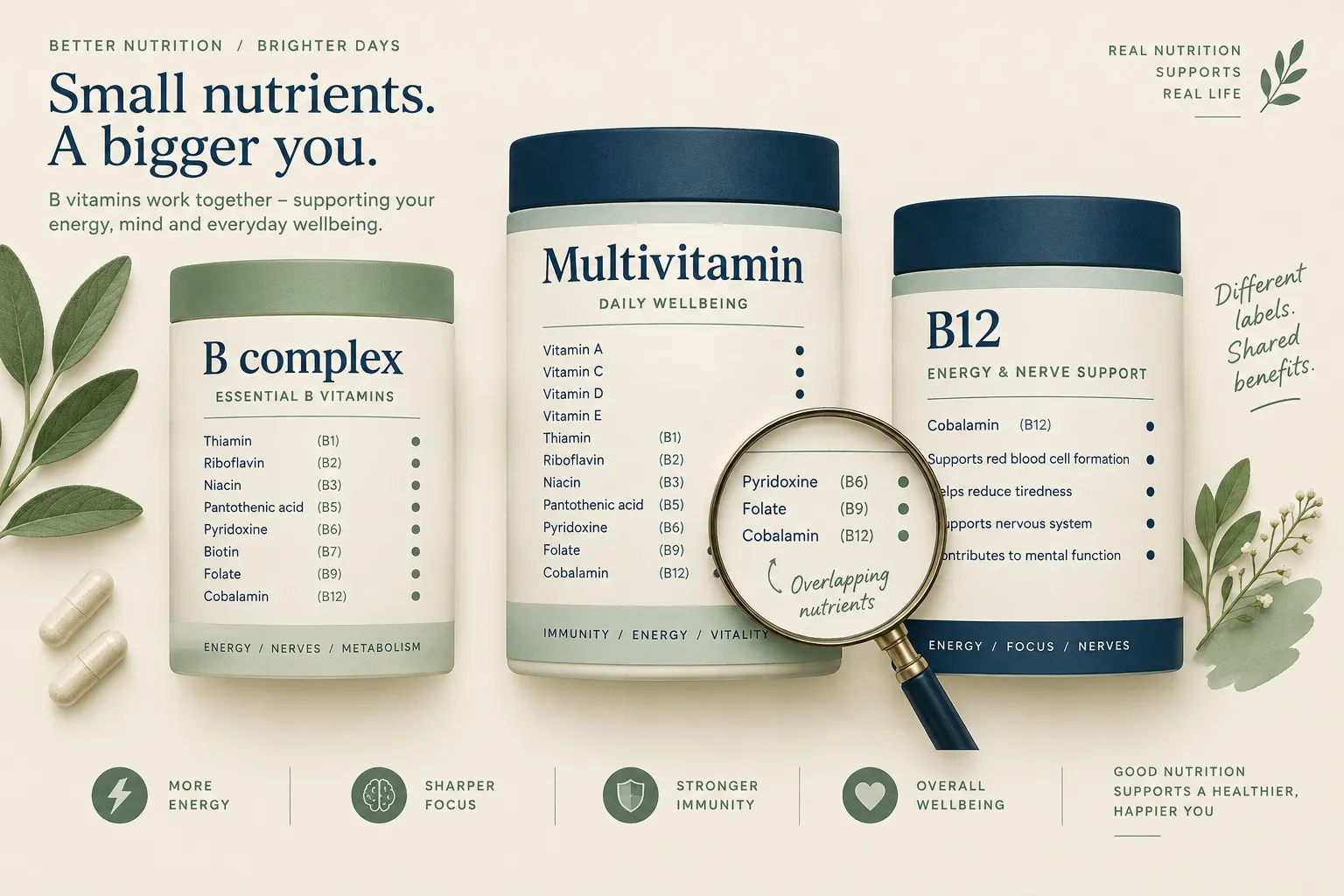
A complete B-complex contains the eight B vitamins: thiamin (B1), riboflavin (B2), niacin (B3), pantothenic acid (B5), B6, biotin (B7), folate (B9) and B12. The ingredients and doses vary between bottles labelled “complex”. Some vitamin B complex tablets include other ingredients as well, so read the nutrient panel.
Vitamin B1, vitamin B2 and vitamin B3 help the body release energy from food; a tablet does not give you an instant boost. B12 and folate matter for normal red blood cell formation. These roles explain why the vitamins are essential, though they do not establish that you need a supplement when your diet supplies enough.
A multivitamin combines B vitamins with other vitamins and sometimes minerals. For wider dietary coverage, it may make more sense than a B-complex. Still, the word “multivitamin” tells you little about which nutrients it contains or their amounts. Compare daily servings rather than ingredient counts.
Standalone B12 targets one nutrient. It cannot replace other B vitamins or the wider mix in a multivitamin. If B12 is your main concern, it can be simpler than adding a high-dose B-complex to the supplements you take.
|
Check on the packet |
B-complex |
Multivitamin |
Standalone B12 |
|---|---|---|---|
|
Main focus |
Several B vitamins |
Wider mix of vitamins, often minerals |
B12 only, unless combined with other ingredients |
|
Potential overlap |
B vitamins already in a multi |
Other supplements and fortified products |
B12 already in a multi or B-complex |
|
Best label question |
Are all the B vitamins included, and how much B6? |
Which nutrients are included and at what daily doses? |
How much B12 does the stated serving provide? |
A UK label checklist before you buy
1. Read the recommended daily serving. If the directions call for two tablets, the “per tablet” figure shows only half the day’s intake. Apply the same check to sprays and gummies.
2. Find the amount and % NRV for each nutrient. NRV means nutrient reference value. It is a labelling benchmark, not a personal prescription. A high percentage does not prove a product will work better for you. Use the amount when comparing overlapping doses.
3. Add up your overlapping products. Set your multivitamin, B-complex, standalone B12, energy blend and fortified products side by side. List ingredients repeated across their daily servings. The front labels may not make it obvious that two bottles both contain B6 and folic acid.
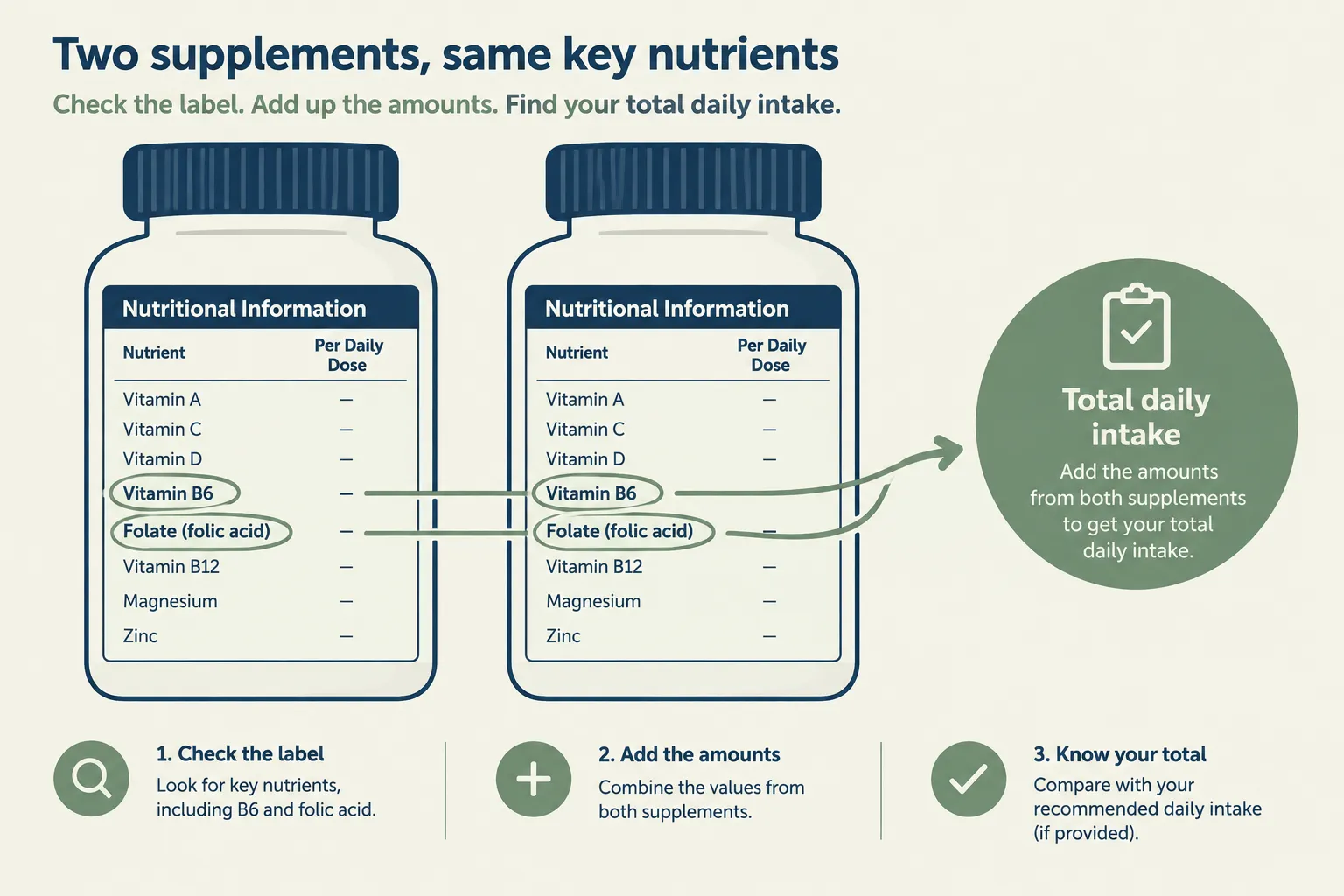
4. Pay particular attention to B6 and folic acid. The NHS advises no more than 10 mg of vitamin B6 a day from supplements unless a doctor advises otherwise. This limit is not a target dose. The NHS also cautions that more than 1 mg of folic acid can mask symptoms of B12 deficiency. “High potency” is no reason to double up.
“Do not take more than 10 mg of vitamin B6 a day in supplements unless advised to by a doctor.” – NHS, B vitamins and folic acid
5. Check the B12 amount. This matters most if you avoid animal foods. The amount per daily serving varies between products that contain B12. Choose a dependable source that fits your diet.
6. Consider who the product is made for. Pregnancy or trying to conceive calls for specific folic acid advice. A generic multivitamin-versus-B-complex decision is not enough. Check suitability for your dietary restrictions, and ask a pharmacist or clinician about relevant medicines.
InfiniVit groups its formulations by purpose, which can help you narrow your choice. You still need to read the serving size and check for overlap, even with a premium blend. Your dietary gap matters more than the length of the ingredient list.
When diet or medical advice changes the choice
B vitamins occur in a range of foods. If you eat a varied diet, feeling low on energy does not tell you that you need a B-complex. A supplement does not cure fatigue; persistent tiredness can have other causes. Read what to check before taking vitamins for tiredness if this is your concern.
Plant foods are not a reliable natural source of B12. The NHS guidance on vegan diets names fortified cereals, unsweetened soya drinks and fortified yeast products as sources, and says a supplement may be needed. If you rely on a multivitamin or B-complex for B12, read the amount per daily serving. See also how to choose vegan supplements.
For a diagnosed B12 or folate deficiency, follow your clinician’s recommended dose and form rather than choosing a standard shop-bought multi. The NHS lists pins and needles, numbness and balance problems among possible symptoms of B12 deficiency. Seek assessment instead of starting a general supplement for these symptoms.
For the timing of a B-complex you already take, see Best Time to Take Vitamin B Complex.
Is taking B-complex every day necessary?
B vitamins are essential, but a daily tablet is not the only way to get them. Your diet, circumstances and clinical advice determine whether a daily B complex supplement makes sense. More B vitamins will not give you extra energy if you already get enough. For the broader decision, see who actually needs supplements in the UK.
If you take a multivitamin with B complex, compare its B6, folic acid and B12 amounts before adding separate B complex supplements. Standalone B12 is more focused if that is your only concern. Without an identified gap, you may need neither.
For a wider dietary gap, a multivitamin may fit; for several B vitamins, consider a B-complex; for B12 alone, choose a focused source. Count doses across everything you take. InfiniVit offers UK shoppers targeted supplements with clearly described formulations, so you can compare the ingredient panel against what your diet needs.
FAQ
What are the key differences between a multivitamin and a B-complex?
A B-complex focuses on several B vitamins, while a multivitamin includes a wider range of vitamins and sometimes minerals. The ingredients and doses vary by product, so compare the daily serving on each label.
What is multi-B-complex good for?
It provides several B vitamins in one supplement when there is a reason to supplement them. It is not a substitute for a varied diet or a treatment for persistent tiredness.
What will happen if I take vitamin B complex everyday?
If your diet supplies enough, daily use may offer no benefit. Compare the daily amounts, especially B6, before taking a B-complex alongside a multivitamin.
Is it better to take B12 or B complex?
For a specific dietary B12 concern, a standalone source may be simpler. A B-complex provides several B vitamins; if you have a diagnosed deficiency, follow your clinician’s plan.
Can B vitamins help with nerve pain?
B12 deficiency can cause neurological symptoms, but nerve pain has other possible causes too. Speak to a clinician about new or persistent symptoms rather than using a B-complex as a treatment.