
 English
 Arabic
 Polish
 Russian
How to Judge Supplement Quality in the UK
Choosing supplements should not feel like guesswork. Yet for many UK shoppers, that is exactly what it becomes: glossy branding, big promises, crowded labels, and product pages that tell you everything except what you actually need to know.
If you want high quality supplements in the UK, the best approach is not to chase hype. It is to learn how to assess a product page, label, and brand using a practical quality checklist. That means looking beyond marketing to the signals that really matter: manufacturing standards, transparent labelling, sensible dosages, trustworthy testing, dietary certifications, and legally compliant claims.
This guide will show you how to do exactly that, whether you are shopping for daily vitamins, gut health support, immune formulas, supplements for men’s health, or broader wellness nutrition. If you are also comparing ingredients for immune support specifically, our guide to best vitamins for immune support in adults may help alongside this quality checklist.
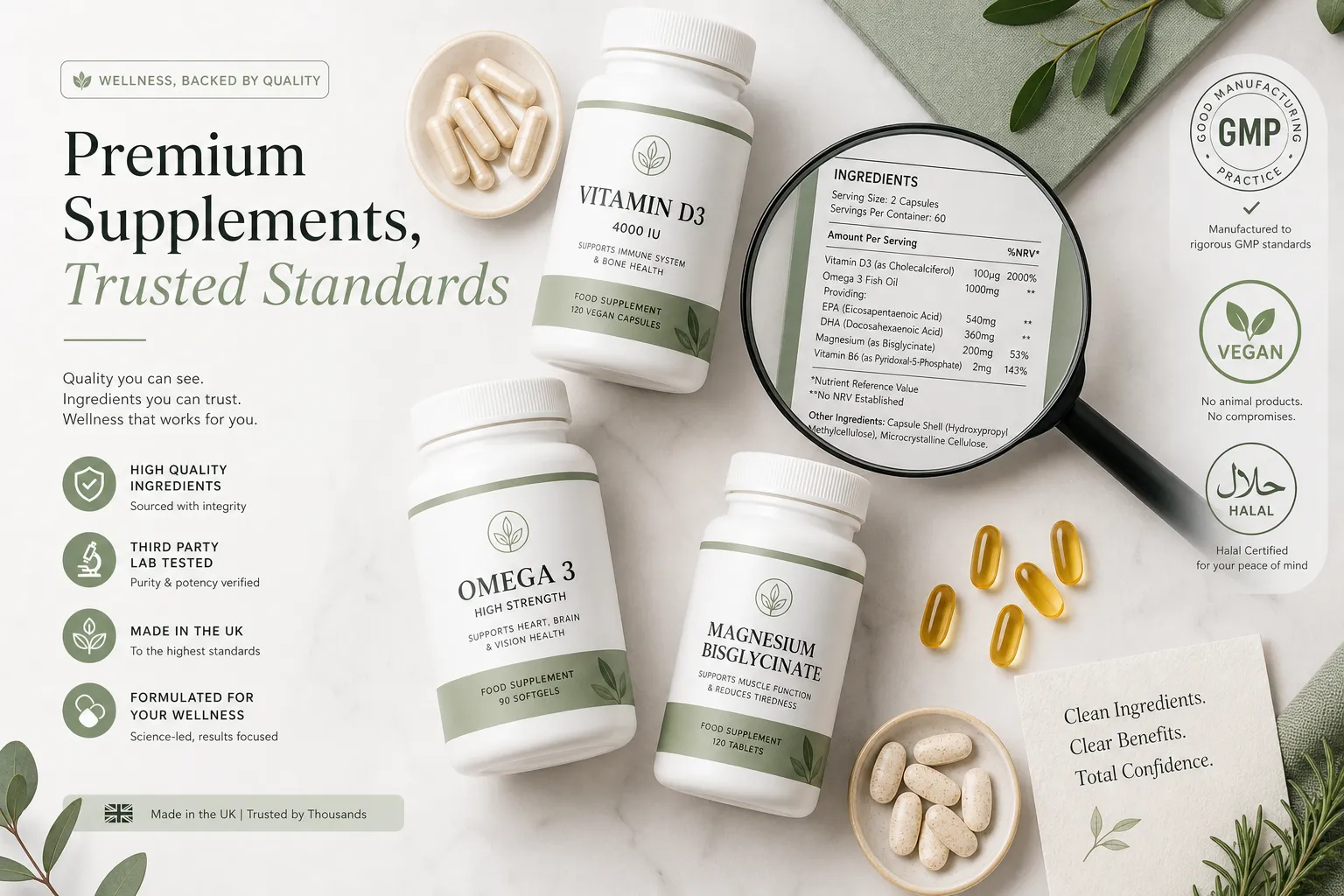
Why supplement quality matters more than clever marketing
Not all supplements are poor quality, but not all are created with the same care. Two products can look similar on the surface and differ greatly in:
-
ingredient quality
-
dose accuracy
-
manufacturing controls
-
purity standards
-
label clarity
-
suitability for specific diets
-
likelihood of delivering meaningful nutritional support
A low-cost product may still be acceptable, and a premium-looking one may still disappoint. The point is not to assume quality based on price or aesthetics alone. The point is to verify.
That matters because some nutrients can be genuinely useful when chosen well and taken appropriately, while others are often bought in forms, doses, or combinations that make little sense.
“Adults and children aged 1 year and over should consider taking a daily supplement containing 10 micrograms of vitamin D during the autumn and winter.” – British Dietetic Association
That single example shows why quality and context matter: some supplements have a clear public-health rationale, but that does not mean every product on the shelf is equally well-made.
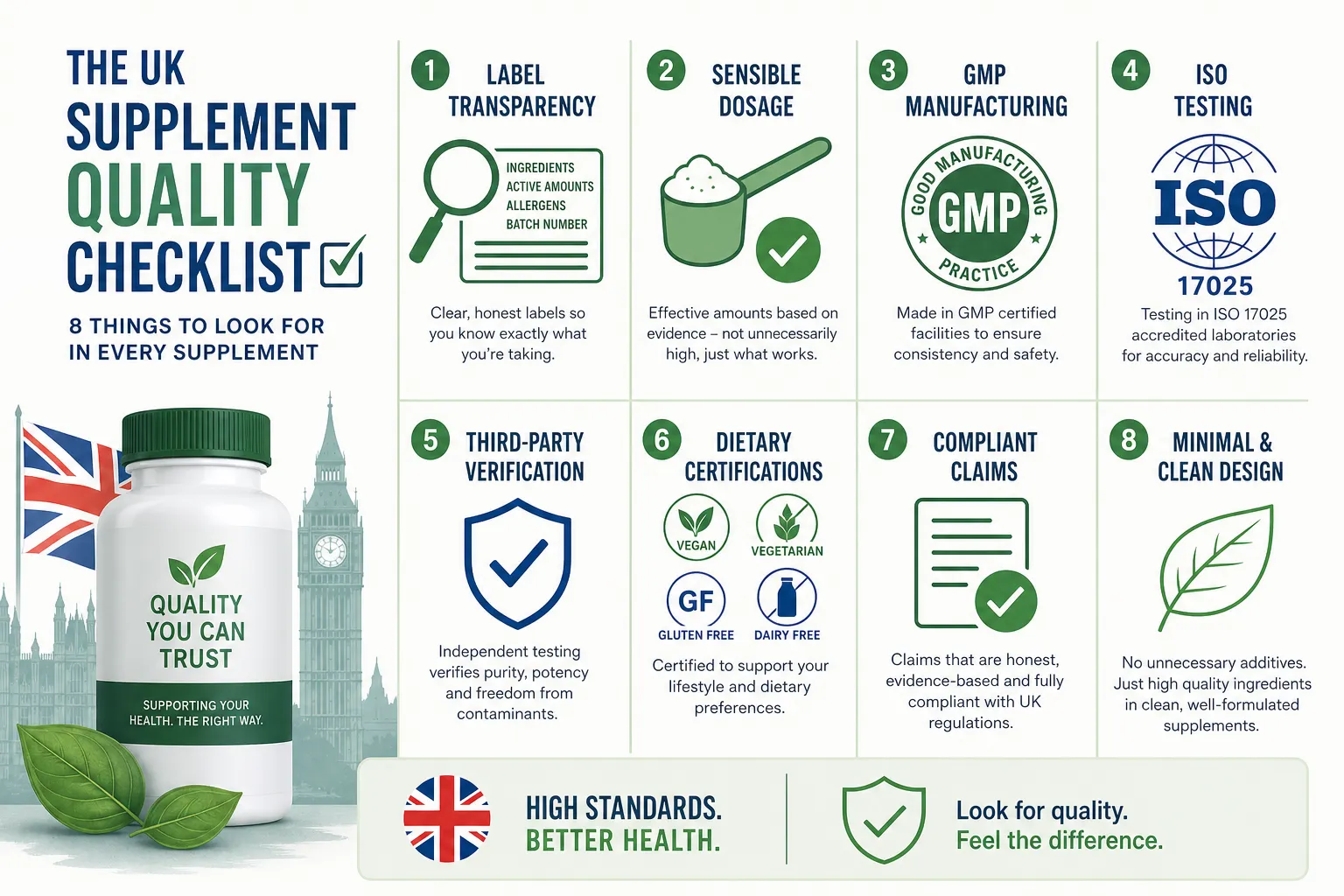
The quickest way to assess a supplement brand: a 10-point checklist
If you want the short version, use this checklist before buying:
|
Quality check |
What to look for |
Why it matters |
|---|---|---|
|
UK or reputable facility manufacturing |
Clear manufacturing location and standards |
Suggests better oversight and traceability |
|
GMP standards |
Brand states GMP manufacturing |
Indicates controlled production processes |
|
ISO or accredited quality systems |
ISO9001, ISO 22000, or lab accreditation references where relevant |
Supports consistency and quality management |
|
Full label transparency |
Active ingredients, forms, dosages, allergens, directions |
Helps you judge value and suitability |
|
Sensible dosages |
Neither token amounts nor reckless megadoses |
Reduces waste and avoidable risk |
|
Evidence-aware formulations |
Ingredient choices that make nutritional sense |
Suggests care rather than trend-chasing |
|
Third-party signals |
External testing, retail vetting, awards, accredited labs |
Adds credibility, though not proof of efficacy |
|
Dietary certifications |
Vegan, vegetarian, halal, kosher, organic if relevant |
Useful for fit, traceability, and consumer trust |
|
Compliant claims |
No miracle language or disease-treatment promises |
Good sign the brand takes regulation seriously |
|
Good support and contact details |
Real customer service, company information, clear policies |
Often separates serious brands from flimsy ones |
Start with the label, not the front of the pack
The front label is advertising. The back label is evidence.
A quality supplement should make it easy to find:
-
the exact ingredient name
-
the amount per serving
-
the number of servings
-
the nutrient reference value where relevant
-
instructions for use
-
allergen information
-
warnings and suitability notes
-
storage guidance
-
batch or traceability information
If a product page only tells you that a formula is “advanced”, “premium”, or “next generation” without disclosing the full panel, treat that as a warning sign.
Ingredient form matters, not just ingredient name
Good quality supplement brands do not just say what is inside; they tell you which form is inside.
For example:
-
magnesium can appear as oxide, citrate, glycinate, and more
-
vitamin B12 may appear as cyanocobalamin or methylcobalamin
-
omega oils vary widely in concentration and source
-
herbal extracts should ideally state standardisation where relevant
That does not mean one form is always universally best. It means the brand should be transparent enough for an informed customer to understand what they are buying.
Look for sensible dosages, not dramatic ones
More is not automatically better. In fact, excessively high doses can be pointless, poorly tolerated, or inappropriate for regular use.
A good product usually avoids both extremes:
-
underdosed formulas that sprinkle in fashionable ingredients at ineffective levels
-
overloaded formulas that rely on megadosing to look powerful
How to judge whether a dose is sensible
Ask:
-
Is the amount clearly stated per daily serving?
-
Does it align with a plausible nutritional purpose?
-
Is the formula overloaded with dozens of ingredients in tiny amounts?
-
Does the product explain who it is for and how often it should be taken?
-
Are there any nutrients that warrant caution, such as vitamin A, iron, iodine, or zinc?
The British Dietetic Association also notes that taking too much of a vitamin or mineral can be dangerous and advises avoiding unnecessary doubling up across multiple products. That is particularly important if you use a multinutrient alongside single supplements.
If you are evaluating digestive formulas, it also helps to understand how fibres, prebiotics, and supportive ingredients differ in purpose. For a deeper dive, see our guide to the ultimate fibre supplement.
Manufacturing standards: one of the strongest trust signals
If you are trying to separate good quality supplements in the UK from weaker options, manufacturing standards are one of the most useful markers.
GMP: what it means for supplement buyers
GMP stands for Good Manufacturing Practice. In practical terms, it means the facility follows controlled processes designed to support consistency, hygiene, documentation, and quality control.
For shoppers, GMP is valuable because it suggests the product is not being mixed and packed casually. It points to a structured system.
ISO standards: what they can and cannot tell you
You may also see references to quality systems such as ISO9001. This does not mean a supplement is clinically superior, but it can indicate a formal approach to quality management and process control.
Some reputable UK-based supplement companies highlight both GMP manufacturing and ISO-certified systems because they know informed customers are looking for evidence of rigour, not just branding. That kind of transparency is one marker of better practice in the market.
Third-party testing and external verification
Third-party signals are useful, but they need to be interpreted carefully.
A quality-focused brand may mention:
-
third-party tested ingredients or finished products
-
independent laboratory analysis
-
ISO 17025 accredited methods or laboratories
-
retail acceptance standards
-
industry awards or recognition
Eurofins, for example, describes supplement testing as a way to confirm dose accuracy, assess contaminants, support label accuracy, and help brands meet UK and EU requirements. That is exactly the kind of independent verification serious consumers should value.
What third-party testing should ideally help confirm
-
active ingredients are present as claimed
-
levels are within an acceptable range
-
contamination risks are monitored
-
labelling reflects what is actually in the product
-
quality is more than a marketing claim
But remember: third-party signals are supportive, not magic
Awards, premium retail stockists, and external mentions can be helpful trust indicators. A product being recognised by an awards body or stocked by a major retailer may suggest additional scrutiny. Some respected UK wellness brands, for example, cite recognition such as Nourish Awards or retail availability through established outlets as credibility markers.
Still, these are not proof that a supplement will work for every person, nor are they substitutes for checking the label, dose, and formulation logic yourself.
Compliant claims: the best brands sound more careful, not more dramatic
One of the easiest ways to spot weaker supplement marketing is to read the claims language.
In the UK, trustworthy brands tend to avoid statements that imply a supplement can diagnose, treat, or cure disease. Instead, they use carefully worded, regulation-aware language.
Good signs on claims
You are more likely dealing with a serious brand if it:
-
uses measured, non-sensational language
-
links product benefits to authorised nutrient functions where relevant
-
avoids miracle claims
-
distinguishes between nutritional support and medical treatment
-
includes warnings when appropriate
Red flags on claims
Be cautious if a product page says or strongly implies that a supplement will:
-
“cure” anxiety, menopause, gut issues, or fatigue
-
“detox” your whole body overnight
-
“balance hormones” with no nuance
-
replace a healthy diet
-
work for everyone in exactly the same way
The more exaggerated the promise, the more sceptical you should become.
Dietary certifications can be genuinely useful quality signals
For many shoppers, dietary suitability is not a side issue. It is central to trust.
Certifications and clear suitability markers can help verify whether a product is:
-
vegan
-
vegetarian
-
halal
-
kosher
-
organic
These signals are useful not only for lifestyle or faith-based choices, but also because they often reflect better ingredient traceability and clearer sourcing discipline.
What to look for
A good product page should make these claims easy to verify. Ideally, certifications are specific rather than vague. “Suitable for vegans” is clearer than “plant inspired”. “Organic” should correspond to an actual recognised standard where claimed.
This is an area where premium brands can stand out by offering a broad range of properly identified options, rather than forcing customers to guess. If you are comparing plant-forward nutrition more broadly, our article on organic supplements UK and wholefood-inspired nutrition explores the topic in more depth.
Beware of “proprietary blends” and half-disclosed formulas
A common frustration with supplement shopping is the formula that sounds impressive but reveals very little.
Why proprietary blends are a problem
If a label hides ingredient amounts behind a blend total, you cannot easily tell:
-
whether the key actives are meaningfully dosed
-
which ingredients dominate the formula
-
whether you are paying for substance or storytelling
That does not automatically make a product bad, but it reduces transparency. And transparency is one of the clearest signs of a trustworthy supplement brand.
Watch for practical red flags on any product page
If you land on a supplement website and see several of these issues at once, step back:
-
no full supplement facts panel
-
no clear company address or customer support
-
no mention of manufacturing standards
-
aggressive disease claims
-
poor grammar or copied content
-
no allergen information
-
no explanation of who should avoid the product
-
missing batch details or traceability signals
-
contradictory dosage instructions
-
suspiciously cheap pricing for a highly complex formula
In other words, if a product page asks for trust without offering evidence, it has not earned the sale.
How to compare two supplements side by side
A practical comparison framework can stop you getting distracted by branding.
Use this simple scoring approach
Give each product a score from 1 to 5 on the following:
|
Factor |
Product A |
Product B |
|---|---|---|
|
Label clarity |
||
|
Ingredient transparency |
||
|
Sensible dosage |
||
|
Manufacturing standards |
||
|
Testing or external verification |
||
|
Dietary suitability clarity |
||
|
Claims compliance |
||
|
Customer support and trust signals |
The product with the more transparent, evidence-aware presentation will often be the safer and more sensible choice, even before you consider price.
Can high street or online supplements still be high quality?
Yes. A supplement does not need to be obscure or ultra-expensive to be good. Equally, a polished direct-to-consumer brand is not automatically better.
What matters is whether the company behaves like a responsible manufacturer or marketer:
-
it explains what is in the product
-
it makes claims carefully
-
it gives you enough detail to assess value
-
it demonstrates credible production standards
-
it respects UK compliance expectations
That is the standard to hold any brand to, whether you buy in-store or online.
What a trustworthy UK supplement brand usually gets right
Across the market, better supplement brands tend to share a few habits:
-
they communicate clearly
-
they formulate with purpose
-
they manufacture to recognised standards
-
they support dietary diversity
-
they avoid pushing one-size-fits-all promises
-
they provide guidance rather than pressure
This is where premium supplements UK shoppers often prefer can justify their position: not through louder claims, but through stronger quality systems, cleaner communication, and a more thoughtful approach to formulation.
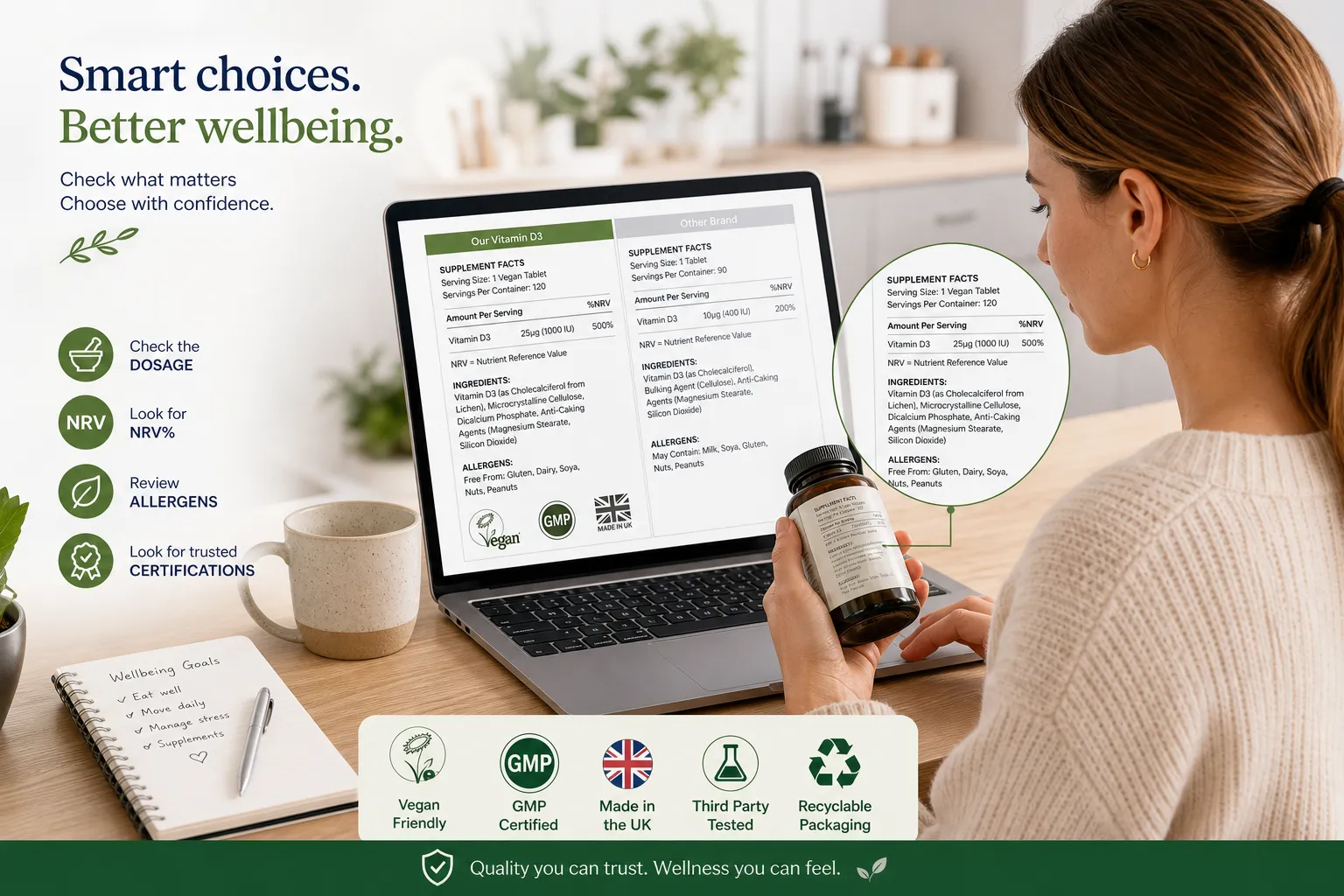
A better way to buy supplements in the UK
If you want to shop more confidently, think like a careful reviewer, not an impulse buyer.
Before you buy, ask:
-
Do I understand exactly what this product contains?
-
Is the dose clear and plausible?
-
Does the brand mention GMP or robust manufacturing controls?
-
Are the claims careful and compliant?
-
Can I verify suitability for my diet or preferences?
-
Are there reassuring external signals without overreliance on hype?
-
Would I still trust this product if the branding were stripped away?
If the answer to most of those is yes, you are likely looking at a better-quality option.
Final verdict
The best way to judge supplement quality in the UK is to move past popularity and focus on proof. High quality supplements are usually marked by transparent labels, sensible dosages, credible manufacturing standards, clear dietary suitability, and careful claims language. Those are the signals that help you identify trustworthy nutrition supplements in the UK without needing a roundup of “top supplement brands.”
For shoppers who value purity, science-led formulation, and strong quality standards, this mindset is exactly the right one. At InfiniVit, we believe supplement buying should feel informed, not intimidating: clear formulations, high-grade ingredients, UK quality standards, and trustworthy communication should be the baseline, not the bonus.
FAQ
How do I know if my supplements are good quality in the UK?
Check for full label transparency, clear dosages, manufacturing standards such as GMP, and sensible, non-exaggerated claims. Good quality supplements should also provide allergen information, directions for use, and clear company contact details.
How to verify the quality of supplements?
Start by reading the product page and label closely. Look for third-party testing, recognised quality systems, ingredient forms, dietary certifications where relevant, and wording that reflects UK compliance rather than miracle-marketing claims.
What are the highest quality supplement brands in the UK?
Rather than relying on popularity lists, focus on brands that show transparent labelling, robust manufacturing controls, credible external verification, and thoughtful formulations. The highest quality brands are usually the ones that make it easiest for you to verify what you are buying.
Who regulates supplements in the UK?
Supplements in the UK are governed through food law and related rules on labelling, composition, and claims. Responsible brands align with UK regulatory expectations and avoid presenting supplements as medicines or disease treatments.
Do supplements have to be regulated?
Yes, supplements must comply with relevant UK rules covering safety, labelling, and claims. That does not mean every product is equal, which is why shoppers should still assess dosage logic, manufacturing standards, and transparency carefully.
Are British supplements genuine?
Many British supplements are genuine and well made, especially when produced under GMP and strong quality systems. But quality still varies by brand, so it is wise to verify labels, standards, and claims rather than assuming all UK-made products are automatically superior.