
 English
 Arabic
 Polish
 Russian
When comparing sleep and stress supplements, read the label before the front-of-pack promise. Find each ingredient’s amount in the daily serving, total what you already take, and remember that a food supplement cannot claim to treat insomnia or anxiety. If poor sleep keeps returning, a new bottle may not address the cause.
Start with the problem, not the product
“Sleep support” covers mineral tablets, amino acids and herbal blends. The label can tell you what is in the bottle; it cannot explain why you wake at night or feel exhausted in the morning.
Before buying, write down what happens: do you struggle to fall asleep, wake during the night or feel unrefreshed? Think about late caffeine, alcohol, your wake time, medication and stress. If one of these keeps interrupting your sleep, start there.
| Your situation | Better first move |
|---|---|
| Occasional unsettled evenings, otherwise well | Review routine and compare a clearly labelled product if you want to try one |
| Already taking a multivitamin or several “calm” blends | Total up repeated ingredients before adding another product |
| Sleep difficulties persist or affect daily life | Speak to a GP rather than cycling through supplements |
Ingredients at a glance
| Ingredient | Why you might compare it | Check before choosing |
|---|---|---|
| Magnesium | Contributes to normal nervous-system function; not a treatment for insomnia | Elemental magnesium per daily serving, including other supplements |
| L-theanine | Studied for possible effects on perceived stress and sleep, but results are not conclusive | Its individual amount and whether the formula contains stimulants |
| Herbal extracts, such as passionflower or ashwagandha | Often included in evening blends; evidence varies by preparation | Plant part, extract amount, medicines and suitability warnings |
Compare ingredients without overpromising
Magnesium: read the elemental amount
Magnesium contributes to normal nervous-system function. A review of the available magnesium and sleep literature offers no basis for treating an ordinary nutrient claim as a promise to cure insomnia. If you already get enough magnesium, a larger dose should not be your default answer to poor sleep.
On a magnesium product, separate elemental magnesium from the weight of the compound, such as magnesium glycinate or citrate. The compound weight is not the amount of magnesium you receive. Compare elemental magnesium per daily serving, including any multivitamin or evening blend you take. Some forms or higher intakes can upset digestion. If you have kidney disease or take regular medication, speak to a pharmacist or GP before adding it.
L-theanine: promising does not mean proven
L-theanine is an amino acid found in tea and used in “calm” formulas. Small studies suggest possible effects on perceived stress or sleep, although researchers have used different preparations and measures. The amount on the label lets you compare products; it cannot predict how you will sleep.
An evening formula that also contains caffeine or another stimulant deserves a closer look. And if the label gives only the total weight of a blend, you still do not know its L-theanine dose.
Herbal products: the plant and preparation matter
You will find valerian, passionflower and ashwagandha in relaxation and sleep products. A study of one extract may say little about a different capsule or tea: the plant part, preparation and amount can vary. Sleep evidence is uneven, and herbs can interact with medicines.
Read the botanical name and plant part alongside the extract amount and any standardisation. If you take medicines or are pregnant or breastfeeding, discuss a mixed herbal formula with a pharmacist. A supplement cannot take the place of anxiety treatment.
Two valerian products may share a plant name while using different preparations. Read the directions and regulatory category for the one in your hand.
| Ingredient type | What to find on the pack | What you cannot infer |
|---|---|---|
| Magnesium | Elemental magnesium per daily serving and compound form | That a larger compound weight means more usable magnesium or better sleep |
| L-theanine | Its own stated amount and other active ingredients | That a “relaxation blend” contains a meaningful individual amount |
| Herbal extract | Plant identity, plant part, extract amount and standardisation if given | That every preparation has the same effects as the one studied |
Read the label in five passes
1. Find the serving size
The large number on the front may refer to several capsules. Compare the recommended daily serving instead of the amount in one capsule or the weight of the bottle. You should also be able to find ingredients, directions and warnings.
If cost matters, divide the bottle price by the number of days it lasts at the serving you would actually use. A cheaper bottle can cost more per day if it requires more capsules.
2. Find each active amount
An ingredient-by-ingredient breakdown lets you compare doses; a single blend total does not. For minerals, use the elemental quantity. For herbs, distinguish the extract amount from a raw-plant or “equivalent” weight. Without individual amounts, you cannot compare the products dose for dose.
Take InfiniVit InfiniNight as an example of a multi-ingredient evening formula: each capsule lists 50 mg magnesium and ashwagandha, alongside passionflower, camomile, lemon balm, L-Taurine, L-Tyrosine, Lavender and B vitamins. Magnesium contributes to normal nervous-system function, while vitamin B6 and niacin contribute to normal psychological function; these authorised nutrient claims do not establish that the blend improves sleep. Some herbal figures are marked as equivalent weight from extract should not be mistaken for the extract amounts in a study. InfiniNight is a multi-ingredient food supplement, not an insomnia treatment.
3. Add up overlapping products
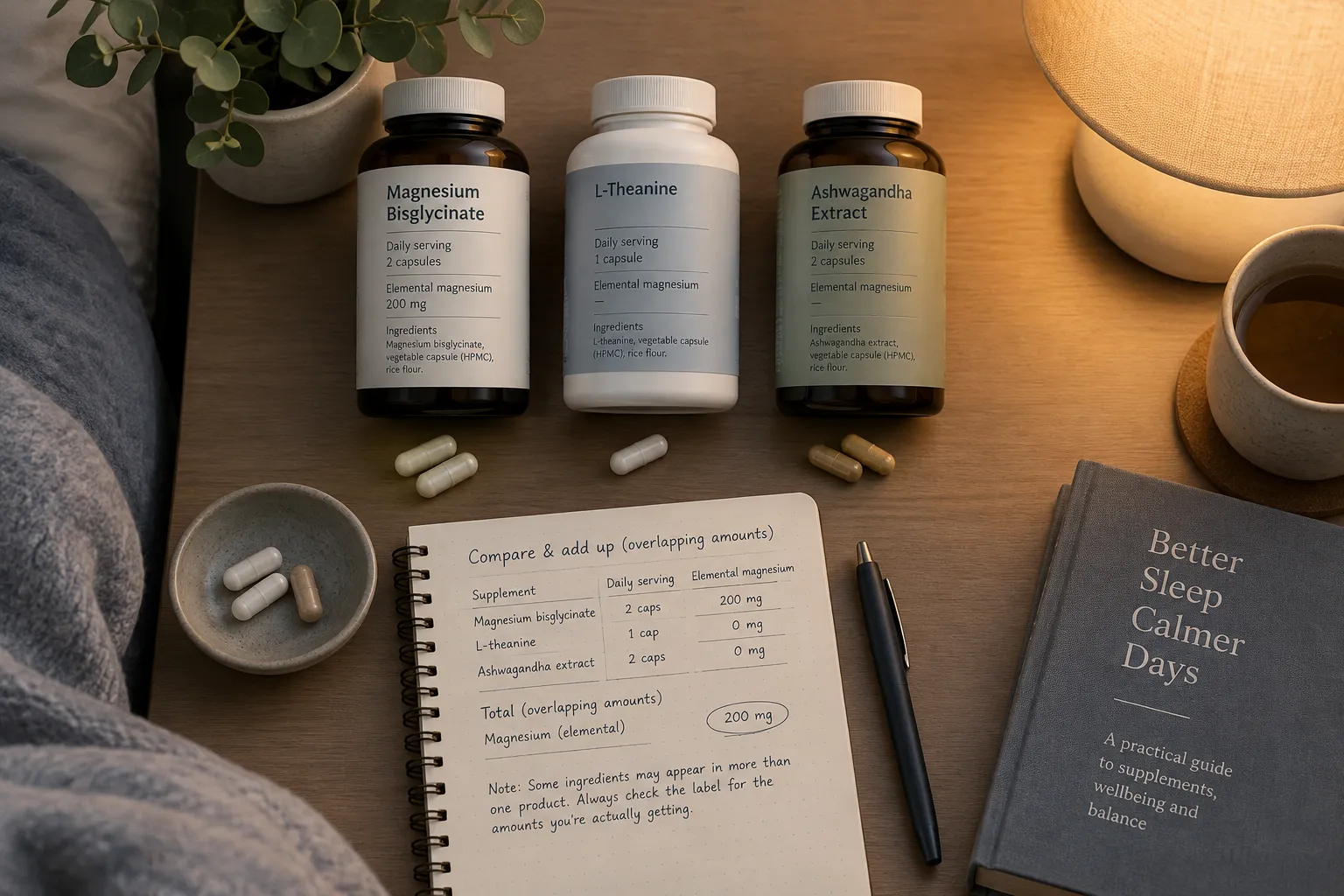
List your multivitamin, magnesium, evening blend and any fortified drinks or powders. Total repeated ingredients across their recommended servings: magnesium, B vitamins and herbs often appear in more than one product. If you start two blends together and feel unwell, you may struggle to work out which ingredient was responsible.
If your multivitamin and evening formula both contain magnesium, add their stated elemental magnesium amounts. A magnesium glycinate compound weight cannot go into that sum. Use the same units and the recommended serving for each product.
If you are unsure whether you need an extra nutrient in the first place, read who actually needs supplements in the UK before adding another daily product.
4. Check who the product is for
Read contraindications and medication warnings before considering a combination. Products with sedating herbs deserve particular care alongside medicines or alcohol. If you take prescribed medicines, are pregnant or breastfeeding, have a long-term condition, or are shopping for a child, ask a pharmacist or GP rather than assuming a general adult blend suits you.
5. Inspect the quality claim
GMP concerns manufacturing practices, while ISO 9001 concerns a quality-management system. Neither proves that the finished product improves sleep or that an independent body has certified every item. Look for a named business, batch or lot number, best-before date, complete ingredient list and contact details. Vegan, organic, halal and kosher descriptions address specific preferences; only claim certification for a particular product when that certification is shown.
For more detail on separating manufacturing standards from product-level evidence, use InfiniVit’s UK supplement quality checklist.
Know the UK difference between supplements and medicines
Food supplements are foods intended to supplement the diet. They are not licensed treatments for insomnia or anxiety. UK food supplement guidance says they must not be marketed as preventing, treating or curing disease. A permissible claim about a nutrient’s normal function must not be stretched into a promise that a blend will treat a medical condition. For example, the authorised magnesium claim about normal nervous-system function is not an insomnia claim. You can read more about what UK supplement claims really mean.
In the UK, melatonin is available on prescription only. Do not treat online “melatonin sleep gummies” or overseas supplement lists as a guide to what belongs in a UK shopping basket. Likewise, a herbal product with a traditional registration as a medicine is a different category from a food supplement. Its registration and leaflet need to be read on their own terms; “herbal” alone does not tell you the regulatory status.
Treat “switches off anxiety”, “fixes insomnia” and “works from the first night” as warning signs. Choose clear amounts and measured claims instead.
When poor sleep needs a GP conversation
Speak to a GP if difficulty sleeping has lasted months, affects daily life or has not improved after changes to your routine. Mention loud snoring with pauses in breathing, marked daytime sleepiness, low mood or distress about anxiety. A GP can investigate causes and discuss care; the NHS says this may include cognitive behavioural therapy (CBT) for insomnia.
“See a GP if: … your insomnia is affecting your daily life in a way that makes it hard for you to cope.” – NHS
Keep your wake time consistent and leave room to wind down before bed. You can also note whether caffeine or alcohol precedes a bad night. Bring those observations to the appointment if the problem continues; you do not need to solve it alone first.
Make a buying decision you can explain
If you want to try a supplement, choose one clearly labelled option for a specific reason. Compare daily servings, look for duplicate ingredients and read the suitability advice. A multi-ingredient product is convenient when you can see what is in it; it is still no cure.
InfiniVit is worth a look if you want a clearly described, multi-ingredient option. Its InfiniNight panel lets you calculate the magnesium and L-theanine amounts at either suggested serving, although a mixed formula makes it harder to isolate one ingredient’s effect. Read its full ingredient list and suitability information before buying. For persistent sleep problems, make the GP appointment first.
FAQ
Can stress cause insomnia?
Stress can make it harder to fall asleep or stay asleep. If sleep difficulties continue or affect your daily life, speak to a GP rather than relying on a supplement to treat insomnia.
Why am I waking up at 3am and can’t get back to sleep?
Night-time waking can have many causes, including stress, alcohol, an irregular routine or a health issue. A supplement label cannot diagnose the reason; persistent waking or daytime impairment warrants a GP conversation.
What vitamin helps you sleep?
No vitamin is a reliable cure for insomnia. Nutrients support normal bodily functions, but a sleep claim should not be inferred from that; check your diet and any existing supplements before adding another product.