 English
 Arabic
 Polish
 Russian
Before buying herbal supplements, read the back of the pack. In the UK, identify whether you are looking at a food supplement or a registered herbal medicine, then find the plant name, daily amount, claim wording and safety warnings. Manufacturing standards tell you something about production, but they cannot show that a product treats a condition.
First, identify what is being sold
“Herbal” names the type of ingredient, not the product category. You might find a plant extract sold as a food supplement and another preparation of the same plant sold as a traditional herbal medicine. The claims and category on the pack tell you which you are holding.
|
On the pack |
Herbal food supplement |
Traditional herbal medicine |
|---|---|---|
|
Category cue |
Labelled “food supplement” |
Has a traditional herbal registration (THR) and its certification mark |
|
What the category tells you |
A food intended to supplement the diet, not a medicine authorised to treat disease |
MHRA has assessed quality, safety and evidence of traditional use for its stated minor indication |
|
What it does not prove |
That a herbal ingredient treats a medical condition |
That efficacy has been demonstrated in clinical trials simply because it has a THR |
For a THR, the MHRA requires evidence of quality, safety and traditional use. It allows indications for minor conditions that do not require medical supervision. The registration means something specific: it rests on traditional use, not proven clinical efficacy. A food supplement containing the same herb cannot simply adopt the medicine’s treatment claim.
“The THR Certification Mark should be included on the mock up label and patient information leaflet to show that the product meets the required standards of quality, safety and evidence of traditional use.” – Medicines and Healthcare products Regulatory Agency
Read a botanical label in five checks
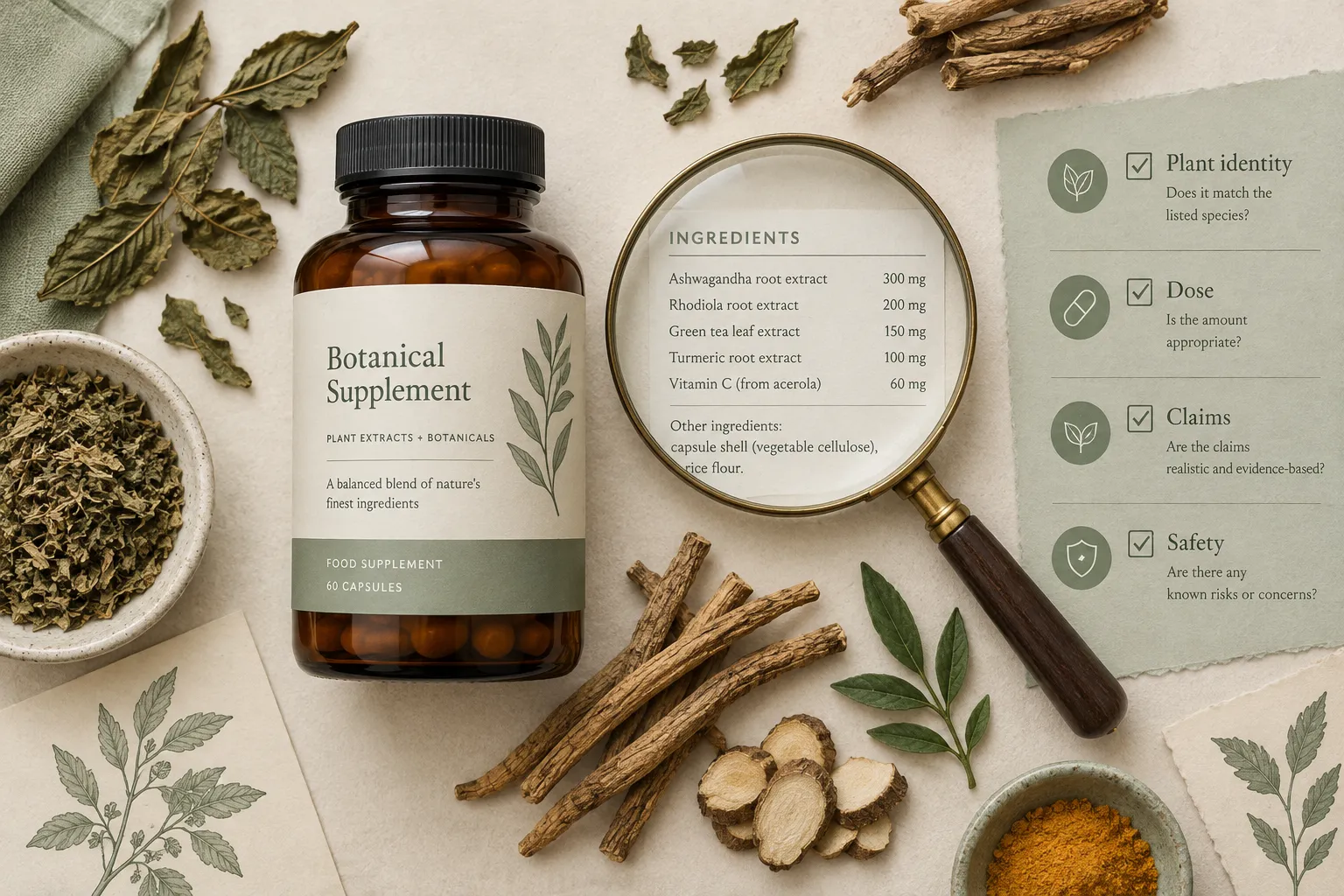
1. Find the plant’s identity and part
Find the botanical (Latin) name and the plant part: leaf, root or seed, for example. Common names can refer to more than one plant, while a study on a root preparation may tell you nothing about the leaf. “Herbal complex” gives you too little detail to compare a listing with published evidence.
2. Separate whole herb from extract
Check whether the label describes dried plant powder or an extract. For a standardised extract, read the named constituent’s percentage or amount alongside the extract quantity. An extraction ratio compares starting material with the resulting extract. On its own, that ratio cannot tell you whether the product works better or whether your body absorbs more of it.
3. Calculate the amount you would actually take
Use the recommended daily dose for comparisons. If the directions call for two capsules, “500 mg per capsule” is not the same as “500 mg per daily serving”. For a multi-ingredient blend, a big total can conceal small amounts of individual herbs. Look for the amount of each one.
4. Read the rest of the label
UK food supplement labelling guidance calls for a recommended daily dose, a warning not to exceed it, a statement that supplements do not replace a varied diet and advice to keep them out of young children’s reach. Read the complete ingredients list for other active ingredients and excipients if you have allergies or avoid particular substances. “Vegan”, “organic” and “natural” do not establish safety or efficacy.
5. Treat quality badges as one piece of evidence
Manufacturing standards and traceability give you some basis for judging consistency. They cannot establish a health benefit. A supplier should identify its ingredients, doses and manufacturing controls. GMP and ISO 9001 concern processes; neither is proof that a herbal formula will work for your goal. See also how to choose quality supplements in the UK.
Herbal supplements: decide which claims deserve trust
For foods sold in Great Britain, start with the GB nutrition and health claims register. A seller must meet the relevant conditions of use; a published study does not give it licence to promise any benefit it likes. Some botanical claims remain “on hold” and may still be used under specific government guidance while a decision is pending. That status is neither authorisation nor proof of clinical benefit. The plant part, health relationship, wording and conditions of use all matter. Northern Ireland follows a different claims framework tied to EU rules, so a GB register entry does not settle the position for every UK sale. For more on packaging language, read what UK supplement claims really mean.
|
Claim on a food supplement |
A sensible reading |
|---|---|
|
A specific, permitted health claim with applicable conditions met |
Relevant to the named nutrient or substance and its stated conditions, not proof that the entire blend treats illness |
|
A botanical claim described as “on hold” |
A qualified regulatory status, not a blanket approval for any plant part or stronger wording |
|
“Cures insomnia”, “treats arthritis” or “replaces medication” |
A disease-treatment promise, not an ordinary food-supplement benefit |
|
“Used for centuries” or “clinically inspired” |
Background or marketing language, not an outcome demonstrated for this finished product |
A valid claim about a vitamin in a blend applies to that vitamin when its conditions are met, not to the herbs beside it. A small study of one extract also cannot substantiate a different dose, plant part or mixture. For a closer look at that narrower goal, read the UK guide to herbal supplements for immune support.
Match the evidence to the finished formula
If a seller cites a study, look at the species, plant part, extract and daily amount the researchers used. Compare each detail with the product you are considering. A trial of one ingredient cannot establish the effect of a blend containing it. Nor does a change in a laboratory marker necessarily mean participants felt better.
“High strength” tells you little without a daily amount and extract description. “Standardised” means the maker has measured a constituent to a stated level, though that measurement does not establish a benefit. If the seller leaves out the plant part or the amounts in its blend, you cannot compare the product with a study on a like-for-like basis.
A worked label check
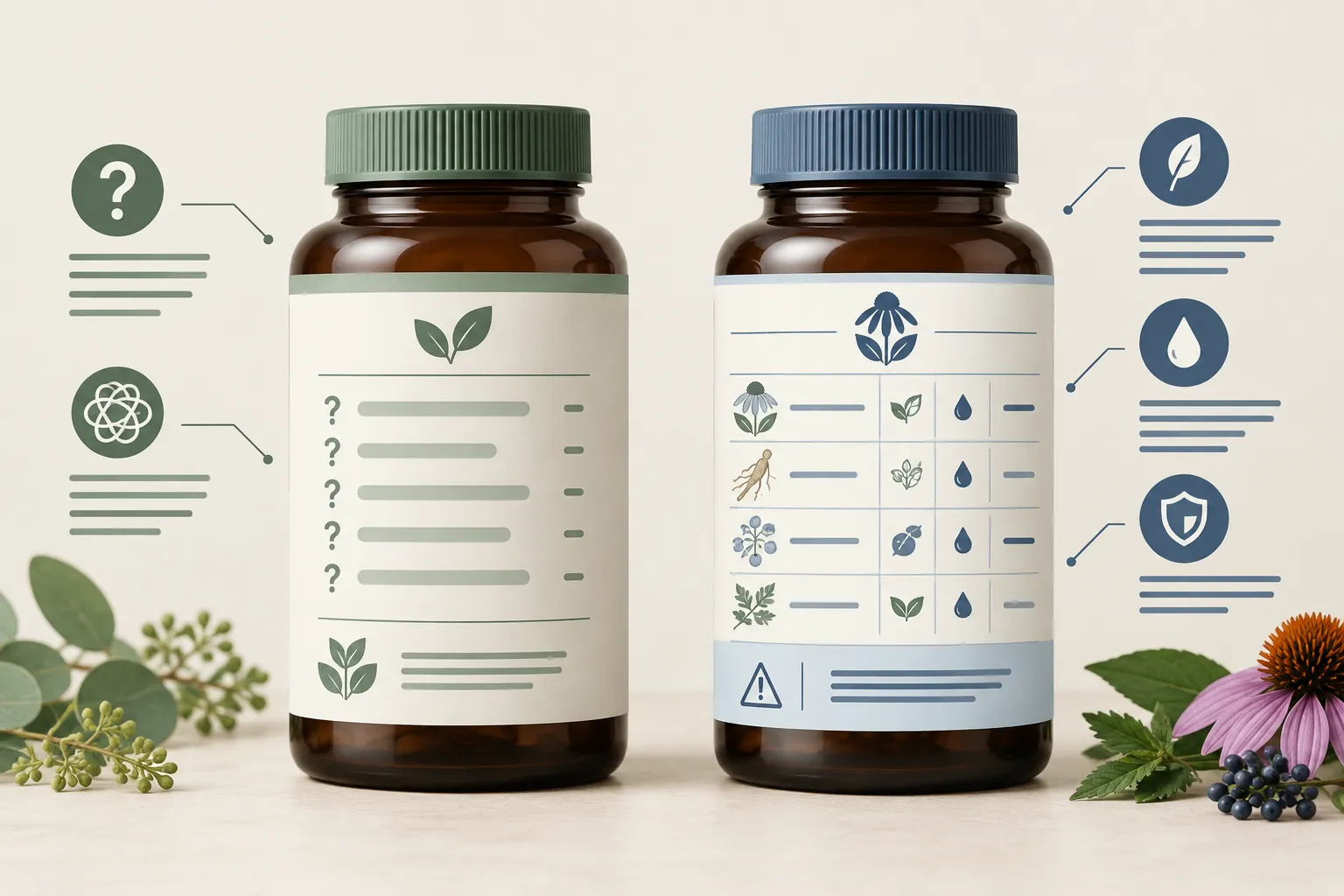
Consider these two fictional listings for a calming botanical. Neither description shows that the product improves sleep.
|
Listing A |
Listing B |
|---|---|
|
“Herbal sleep complex, 1,000 mg, maximum strength” |
Botanical name and plant part listed; each ingredient’s amount shown per recommended daily serving |
|
No breakdown of blend or clear extract details |
Extract type and any standardisation stated, alongside directions and warnings |
|
Promises to “cure insomnia” |
Makes no disease-treatment promise and states its food-supplement category |
With Listing B, you can compare the formula with the evidence for its ingredients. You still need to consider its claim, sourcing and safety. Listing A gives you no way to work out your intake of any single herb, despite the big number on the front; the promise to cure insomnia is another reason to leave it on the shelf.
Safety comes before the basket
Natural products can affect the body and interact with medicines. St John’s wort has important interactions with prescription drugs, and ginkgo may cause concern if you take blood-thinning medicine. Tell a pharmacist about the specific product and your medicines; the word “herbal” cannot answer an interaction question.
If you take prescribed medicines, particularly anticoagulants, speak to a pharmacist or clinician before using a herbal product. Do the same if you are pregnant or breastfeeding, have a long-term condition, or are preparing for surgery. Take the pack or a photo of its full ingredients and dose so they can discuss the exact formula with you. A promise of a natural alternative is no reason to stop prescribed treatment.
Persistent or worsening symptoms warrant clinical advice rather than another blend. A THR for a minor condition does not make a product suitable for treating a serious condition yourself.
Choose a product that answers your questions
Choose a product whose category, botanical identity, daily amounts and cautions you can understand before checkout. Neither a premium price nor a long ingredients list supplies those details. With a blend, look for the amount of each ingredient and wording that stays within the product’s claims rules.
InfiniVit offers carefully formulated wellness supplements with an emphasis on responsible claims. Its range gives you targeted daily-nutrition blends to consider if an unspecified herbal mix feels too vague. Browse InfiniVit’s wellness range and apply the same label checks to every product. A clear formulation gives you a basis for choosing; it does not promise a cure.
FAQ
What is an herbal supplement?
It is a food supplement containing a botanical ingredient, such as a plant powder or extract, intended to supplement the diet. The word “herbal” does not make it a registered medicine or establish a medical benefit.
Who shouldn’t take herbal supplements?
There is no single rule for every herb, but people taking medicines, those who are pregnant or breastfeeding, and anyone with a long-term condition should ask a pharmacist or clinician before use. The exact ingredients, dose and circumstances matter.
Do herbal supplements actually work?
Evidence varies by plant, preparation, dose and intended outcome. A THR medicine relies on evidence of traditional use for its stated minor indication, while a food-supplement claim must meet the applicable claims rules; neither label alone proves that a particular blend will work for you.