
 English
 Arabic
 Polish
 Russian
To choose among the best supplement brands in the UK, ask what a company can tell you about the product in your basket. Its label should give you a clear daily dose, but a claim such as “tested” leaves a question: was the finished product tested, or only its ingredients? We are InfiniVit, a UK supplement brand, so our perspective is not independent. Ask us the same questions you would ask any brand.
Instead of a top 10 list, use these checks on a product that suits your needs and diet. Read the label, then ask about anything you cannot establish from it. The replies should tell you what you would take, where the product is made and what supports its claims.
What makes a supplement brand worth considering?
Food supplements are regulated as foods in the UK. In Great Britain, nutrition and health claims must meet the conditions of the GB nutrition and health claims register; Northern Ireland has different applicable rules. Supplements are not medicines, and a supplement advert should not promise to treat, cure or prevent disease.
GMP describes manufacturing practice, not whether a formula works. GMP certification is not a general legal requirement for UK food supplements, although food-safety duties still apply. ISO 9001 concerns quality management systems rather than health outcomes. Read badges alongside the label and the company’s answers about testing.
Nine checks to make before buying
1. Can you identify the company and the people behind the formula?
Find the legal business name, a physical address and a working contact route. “UK-based” might describe the registered company, customer service or manufacturing, so ask which applies. Ask who develops the formulas and what expertise informs the ingredient choices. A contact form surrounded by slogans gives you little to go on.
2. Does it say where and how products are made?
“British brand” does not establish where a product was made. Look for a manufacturing statement that tells you which products it covers. GMP and ISO 9001 can point to documented production and quality systems when the company explains their scope. Neither certifies a health benefit. Food-safety controls still apply without a GMP badge.
3. Does “tested” mean anything specific?
Testing might establish the identity and purity of raw ingredients, measure an active ingredient in a finished batch, or screen for contaminants such as heavy metals and microbes. Each answers a different question. Ask who performed the test, what was tested and whether the result applies to the finished product you would receive. On a certificate of analysis (CoA), look at the date, batch reference and scope. You can ask for a batch certificate or a summary. “Third-party tested” is too vague on its own.
4. Can you work out your actual daily dose?
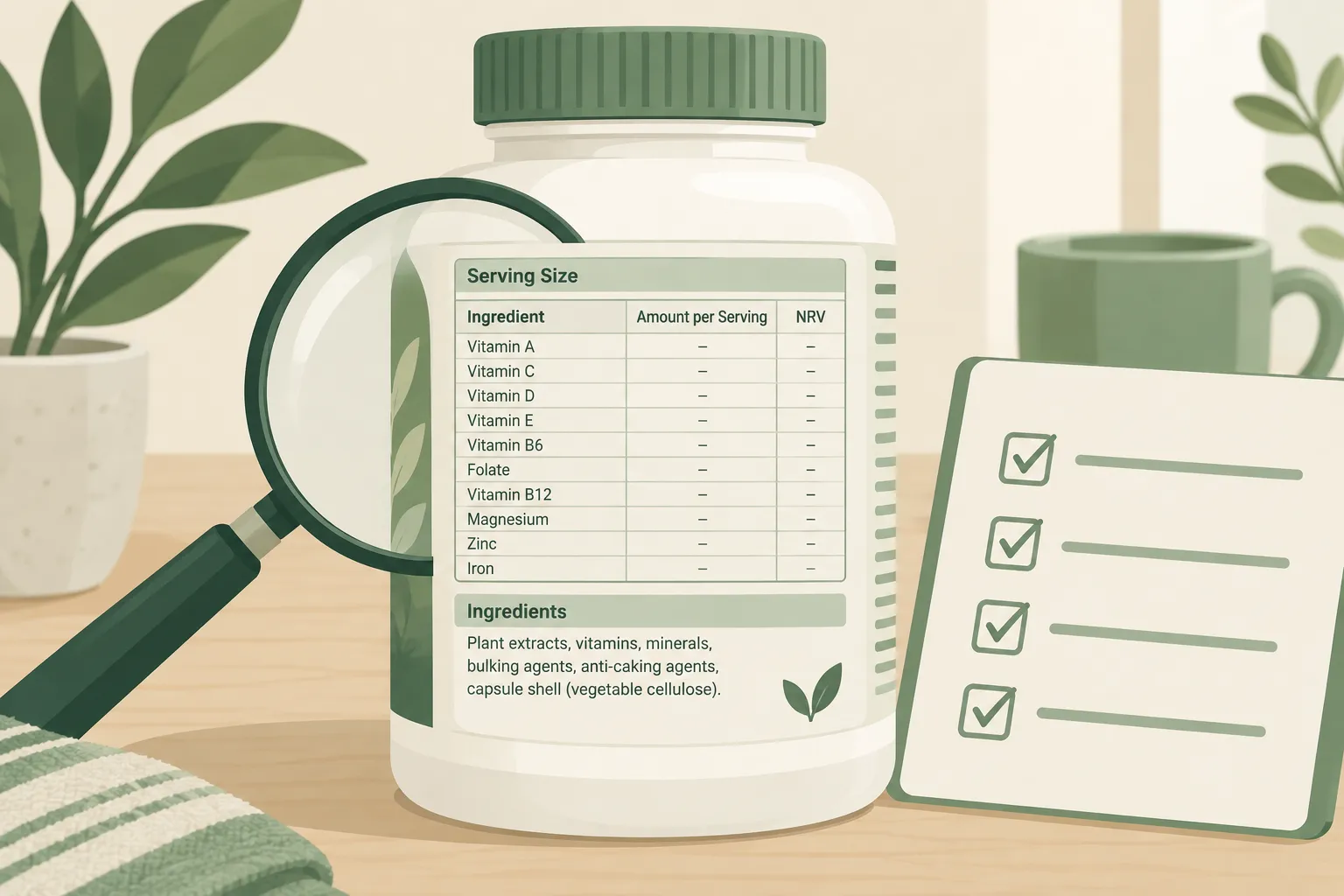
Read amounts per recommended daily serving. A per-capsule figure can mislead when the directions call for several capsules. For vitamins and minerals, look for the nutrient form and the percentage of Nutrient Reference Value (NRV) where applicable. A botanical label is more useful when it names the plant part and describes the extract. A proprietary blend with one combined weight hides individual doses, however long its ingredient list.
5. Are the claims restrained and lawful?
In Great Britain, authorised health claims have conditions of use. Wording may be adjusted for understanding without changing the claim’s meaning. For example, vitamin D contributes to the normal function of the immune system is an authorised claim; saying a capsule prevents an infection is a disease-prevention promise. Disease names, guaranteed outcomes and claims that fail to identify the relevant nutrient merit closer scrutiny.
6. Can you check the dietary or ethical credentials?
Organic, vegan, vegetarian, halal and kosher each have a different meaning. For an organic product, find the certifier, such as the Soil Association, and see what the certification covers. For halal or kosher products, ask which item is certified and by whom. Check vegan or vegetarian suitability for the item itself, including its capsule shell. A plant-based HPMC shell may suit someone avoiding gelatine; it does not tell you whether the rest of the formula meets other dietary requirements.
7. Does the range fit a clear need?
Your best fit depends on what you need. A broad catalogue can help you find nutrition, sleep-routine or sports-nutrition products, but avoid buying several formulas that repeat the same ingredients. Add up shared vitamins and minerals across products you plan to take together. If you take medicines, are pregnant, or have a medical condition, ask a pharmacist or other suitable healthcare professional about suitability before adding a supplement.
8. Where else can you buy it?
An established UK retailer may check suppliers before stocking them. That offers some reassurance, though a listing cannot establish efficacy, purity or suitability for you. Find the exact item on the retailer’s site; a brand listing does not cover every product it sells.
9. Will customer service give a usable answer?
Ask where an ingredient comes from or what a testing claim covers. The reply should address that product rather than repeat its front label. Read the returns terms before ordering, especially the rules for unopened items and changes of mind. You can email us, or any brand, about testing and sourcing; a good team will answer plainly or explain what it cannot share.
A scorecard you can use on any brand
Give each check 2 points for clear, product-relevant evidence, 1 for a partial answer and 0 when the information is missing or contradictory. Maximum: 18 points. A zero for dose clarity or disease-style claims deserves attention even when the total looks strong.
|
Check |
What good looks like |
Red flag |
|---|---|---|
|
Company transparency |
Legal name, real address, contact route and a clear account of formula development |
No identifiable business or accountable contact |
|
Manufacturing |
Country of manufacture and standards with a stated scope |
“UK brand” presented as proof of UK manufacture |
|
Testing |
Named material or product, test type, tester and available batch evidence |
“Tested” with no details of what or by whom |
|
Label clarity |
Full daily serving amounts, forms and applicable NRV percentages |
Hidden amounts inside a proprietary blend |
|
Claims |
Appropriate authorised claims used within their conditions |
Cure promises or disease names used as sales claims |
|
Certifications |
Product-specific credentials you can identify or ask to see |
One certification implied across an entire range |
|
Range fit |
A suitable formula without unnecessary overlap |
Pressure to buy a stack with repeated ingredients |
|
Retail presence |
Exact product listed with an established retailer |
Retail logo used without a corresponding listing |
|
Service and returns |
Direct answers and accessible returns terms |
Vague responses or hard-to-find terms |
Use the score to compare what brands disclose, not to predict a health result. Even a brand scoring 18 points has to sell a product with the right ingredients and serving for you. Compare the product first, then the company.
Why pack price tells you so little
Divide the pack price by the number of daily servings to find the cost per recommended daily serving. Then look at the form and dose of each ingredient, including anything you already take in another product. A larger bottle can cost more per day when its directions call for several capsules. If you need one ingredient, a single-ingredient product may be the more sensible purchase.
An expensive bottle and an “advanced” blend say little about manufacturing standards; a low pack price says little about them too. When two products make the same health claim, compare the claim conditions and labels to see what the extra spend buys.
Printable brand checklist
Keep this list beside a product page or take it into a shop:
-
I can identify the company, address, contact route and who develops the formula.
-
I know where this product is made and what any GMP or ISO 9001 statement covers.
-
I know what is tested, who tests it and whether batch evidence is available.
-
I can read every relevant dose per daily serving, including forms and applicable NRV percentages.
-
The health wording is measured and contains no treatment or cure promise.
-
Any organic, vegan, vegetarian, halal or kosher status applies to this specific product.
-
This purchase fits my needs without duplicating another supplement.
-
A claimed retail listing matches the item I intend to buy.
-
I understand how to ask a question and what the returns terms say.
InfiniVit against the same checks
InfiniVit Ltd is a UK company with a registered office in Wembley, London. Our own statements should get the same scrutiny as anyone else’s: we say our products are made in the UK under GMP and ISO 9001 standards, which speak to production and quality systems rather than health results. We use wording tied to authorised health claims in our product information rather than promising to treat disease.
We describe the range as including Soil Association organic, vegan, vegetarian, halal and kosher options. Some products use plant-based HPMC capsule shells. The status of each item matters: these attributes do not apply automatically across the range. Our site advertises more than 60 formulations for everyday nutrition and targeted wellness needs, with a selection listed by Holland & Barrett. Read the individual label even if you recognise the retailer.
For the testing row, we have not supplied a public batch certificate here, so do not award us two points on that statement alone. Email us to ask what testing applies to the particular item, including its raw materials, finished product and any contaminant checks, and what documentation can be shared. Apply the same standard to our returns and product information as you would to any other company. You can start with the InfiniVit supplement shop and choose the formula you want to assess.
The verdict
The best supplement companies in the UK are the ones that make a suitable product easy to understand and are willing to answer precise questions about it. Use the scorecard to shortlist brands, then decide on the individual label and daily cost. If InfiniVit fits your needs, browse our range or email info@infinivit.co.uk with questions about testing, sourcing or ingredients. We would rather help you make a considered choice than ask you to buy on a slogan.
FAQ
What are the best supplements in the UK?
There is no universally best supplement: the useful choice depends on what you need and what you already take. Start with a clearly labelled product that fits your diet and lets you compare the daily serving and cost; ask a healthcare professional if you need individual advice.
Which brand supplement is best?
Choose a brand that identifies its company and manufacturing location, publishes full serving amounts, makes appropriate claims and answers detailed testing questions. Score the specific product you want rather than assuming that every item from one company has the same credentials.