
 English
 Arabic
 Polish
 Russian
When shopping for high quality supplements in the UK, read the claim beside the ingredients and the amount you will take each day. “Premium” on the front of the pack tells you less. A food supplement can describe how a nutrient contributes to normal body functions; it cannot promise to cure anxiety, prevent colds or treat arthritis.
Sort the wording into three groups as you read: specific health claims, marketing slogans and medicine-style promises. Each calls for a different response.
The three kinds of claims you will see

1. Specific, authorised health claims
An authorised health claim is an approved statement about what a nutrient or other eligible substance does in the body. A seller must meet its conditions before using it. For example: “Vitamin C contributes to the normal function of the immune system.” That statement makes no promise that a capsule will stop you catching a cold; the product must also supply enough vitamin C.
“Vitamin C contributes to the normal function of the immune system.” – UK legislation, authorised health claims annex
A fictional “Daily C” tablet gives the vitamin C amount per serving and uses the normal-function wording above. That is useful information, though it cannot tell you whether you need extra vitamin C.
2. Vague marketing and quality language
“Premium”, “clean”, “pharmaceutical grade” and “doctor formulated” may sound reassuring. You still need the active ingredient amount and a specific claim to understand the proposed benefit. “Natural” does not guarantee suitability. A seller using the broad health statement “supports wellbeing” needs a specific authorised claim alongside it.
Turn the pack over. If the front says “high strength”, find the daily dose. If it says “clinically proven”, find what was studied, and whether the finished product was tested at that dose.
3. Red-flag medicine-style promises
“Cures IBS”, “heals arthritis”, “treats anxiety” and “prevents colds” promise medical outcomes. A seller making those claims for a food supplement markets it like a medicine without a medicine licence. Be cautious when “boosts immunity” promises that you will not get ill, too. A permitted statement about the normal function of the immune system makes a narrower point.
The same rule applies if the formula contains a familiar vitamin or herb: its ingredients cannot justify a disease promise on a food supplement.
How food supplement claims work in the UK
Food supplements in the UK are regulated as foods, not medicines. In Great Britain (England, Scotland and Wales), the official health claims register lists approved claims and conditions; Northern Ireland has different arrangements. For vitamin and mineral claims, a product generally needs a meaningful amount of the nutrient, usually at least 15% of its nutrient reference value (NRV). NRV puts the amount on a label in context; it is not everyone’s personal target.
Look at the nutrient and the serving
“Contains vitamin C” tells you an ingredient is present. “Vitamin C contributes to the normal function of the immune system” makes a defined health statement. Compare the amount in the recommended daily serving with the % NRV. A long ingredient list does not mean every ingredient appears in a useful amount or has an authorised claim.
General phrases such as “supports wellbeing” need a specific, relevant authorised health claim alongside them, as the government’s guidance on general health claims explains. Look beside the slogan for the named nutrient and what it does. Without that detail, “wellbeing” tells you very little.
Take care with botanical wording
Many botanical health claims remain “on hold” in Great Britain; sellers may still use some of them subject to conditions. That makes herb wording less straightforward than familiar vitamin claims. You can still look for the herb’s name, its amount per serving and any disease-treatment promise. Natural does not mean risk-free.
Trading Standards and the Advertising Standards Authority (ASA) have roles in food advertising; the Medicines and Healthcare products Regulatory Agency (MHRA) is relevant when products are marketed as medicines. When reading a label, focus on whether the promise describes a normal function or a medical outcome.
What common label words really tell you
The front of the pack catches your eye. The ingredient panel and serving details tell you more.
|
Wording you see |
What it can mean |
What to check |
|---|---|---|
|
“Supports immunity” |
A general message about normal immune function, or an overblown promise, depending on the surrounding wording |
Is there a specific authorised claim about a named nutrient, such as vitamin C, and its amount per daily serving? |
|
“Premium” or “high quality” |
A brand’s positioning, not a fixed standard for health benefits |
Are ingredients, quantities and directions easy to find? What quality measures are actually described? |
|
“Natural” or “clean” |
A description of sourcing or formulation, sometimes without a precise definition |
What is in the full ingredients list? Is a specific certification named where relevant? |
|
“Clinically tested” or “clinically proven” |
Something may have been studied, but the phrase alone does not say what |
Was the finished blend tested, or just one ingredient? Was it the same dose, and what outcome was measured? |
|
“GMP” |
A reference to good manufacturing practice and production controls |
Does the brand say which manufacturing standard applies? Do not read it as proof the supplement works. |
|
“Made in the UK” |
A statement about where manufacturing took place |
Does the brand distinguish manufacturing location from where ingredients came from? |
|
“High strength” |
A comparison or impression of potency without enough context |
What is the amount per recommended daily serving, and is it appropriate for you? |
|
“Doctor formulated” or “pharmaceutical grade” |
Language suggesting expertise or a high specification |
Who formulated it, what specification is meant and where are the ingredient amounts? |
Compare the dose with the promise
“Support” is easy to misread. “Supports the normal function of the immune system” and “supports recovery from flu” make very different promises. Read the words after “support”.
You should be able to compare quality supplements in the UK without guessing at doses. Read the daily serving and nutrient amounts. With a multi-ingredient blend, the blend name does not tell you how much of each ingredient you will get. Higher amounts can also duplicate nutrients you already take.
GMP or ISO 9001 describes manufacturing or quality-management systems, not effectiveness. A certified organic or plant-based formula might suit your priorities, while “no artificial colours” describes composition. None replaces a clear health claim.
Claims are not confined to the label

You might see a claim in a product name, search advert or influencer caption before you even reach the pack. Read each promise for what it implies about normal nutritional support or a medical result.
Claims can also appear in:
-
Product names. A fictional name such as “Cold-Stop Capsules” can imply prevention even if the small print uses gentler wording.
-
Reviews selected by the brand. When a seller features “My IBS disappeared”, that personal account becomes part of its marketing. It is not evidence that the product treats IBS.
-
Before-and-after images, which can suggest a dramatic result without showing what else changed or what the supplement can claim.
-
Social media and influencer posts. A short caption can make a stronger promise than the product description on the website.
Scientific-looking images tell you nothing about whether anyone studied the finished product at the dose you will take. Look at what the studies examined and at the result the brand promises.
A claim-check you can use in a shop or online
Use these checks while holding a box or scrolling a product page:
-
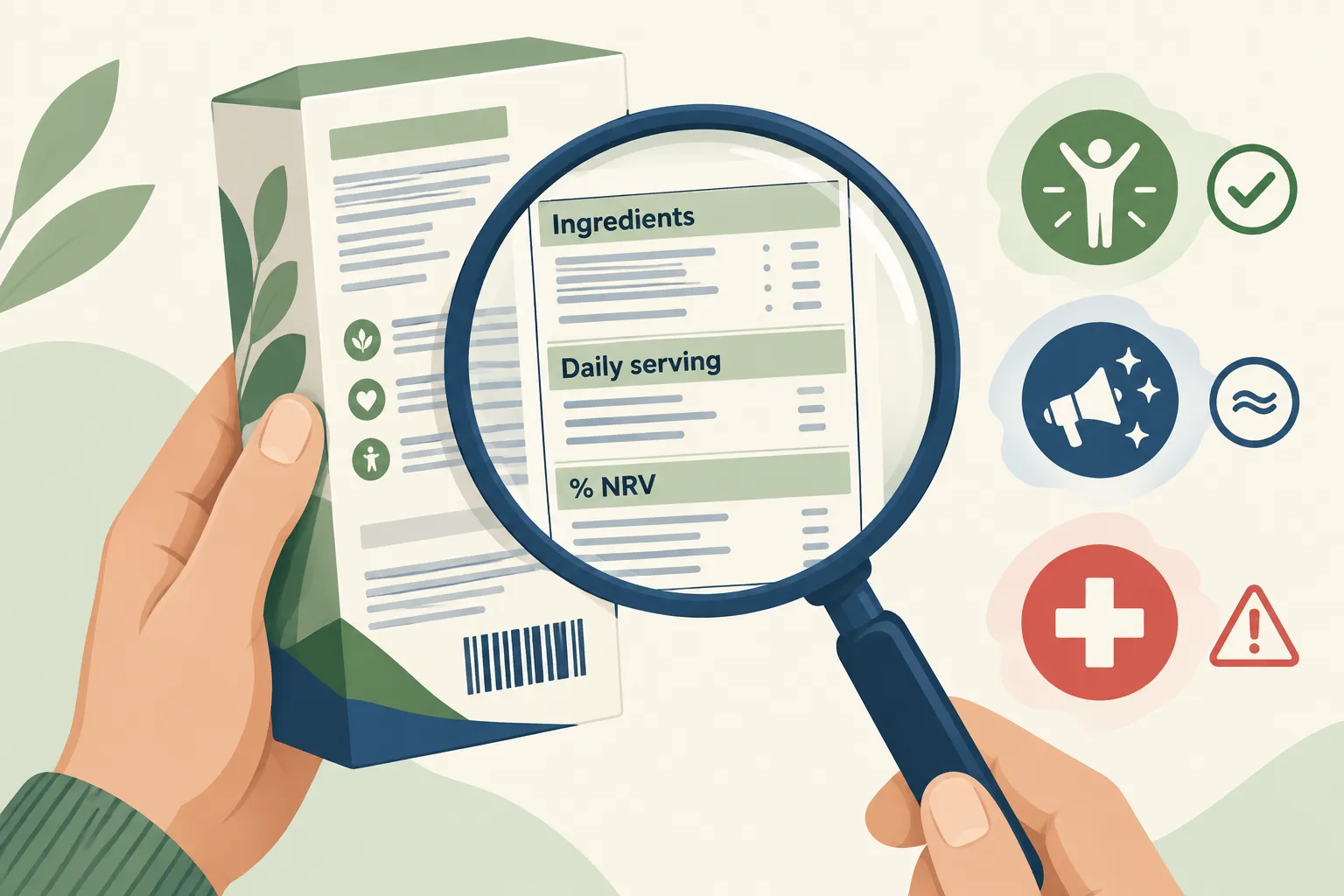
Circle the promise. Does it describe a normal function or say it will cure a named condition?
-
Find the ingredient behind it. For a broad “wellbeing” claim, look beside it for the specific authorised claim.
-
Read the daily serving, rather than the amount per capsule or the total weight of a blend. For vitamins and minerals, the % NRV gives context.
-
Ask what “premium”, “natural” or “clinically tested” refers to. Find the ingredients, the finished formula and the dose studied.
-
Look beyond the pack for disease promises in product names, brand-selected testimonials or social posts.
-
Decide whether it fits your situation. A clear label cannot tell you whether the product duplicates something you already take.
Suppose an invented “Everyday Defence” blend says “premium natural immune support” on the front. The panel lists vitamin C and its daily amount; the page says vitamin C contributes to normal immune-system function. If that page also says the blend “prevents winter colds”, treat that separate promise as a red flag. One careful sentence does not cancel another misleading one.
If you are pregnant, taking medication or managing a health condition, speak to a GP or pharmacist before starting a supplement. A compliant label is not a personalised recommendation. Food supplements are intended to supplement a diet, not stand in for medical care or a varied diet. If you are deciding whether you need one at all, consider which supplements are worth taking daily before choosing a formula.
Choose clarity over the biggest promise
If you are comparing the best quality supplements in the UK, favour clear ingredient quantities, relevant authorised wording and sensible directions. Manufacturing information helps you judge how a brand handles quality. The word “premium” alone cannot tell you any of that.
At InfiniVit, we word our product information using authorised health claims so you can see what a formula is intended to support without medicine-style promises. Browse the InfiniVit range, or email info@infinivit.co.uk with any question about a label.