
 English
 Arabic
 Polish
 Russian
How to Choose Quality Supplements in the UK
Choosing supplements should not feel like decoding marketing jargon. If you are comparing brands, scanning search results and wondering which quality signals actually matter, this guide is for you. We have pulled together the practical checks that help you sort genuinely well-made products from vague claims: clear labelling, sensible dosages, nutrient forms, manufacturing standards, retailer trust, and whether a product truly fits your goal.
For most people, the best starting point is not “What is the best supplement?” but “Do I need one, and if so, what would make it a good fit for me?” That small shift can save money, reduce confusion and help you choose quality supplements UK shoppers can feel confident about.
What the best supplement guides often miss
A lot of supplement advice online focuses on ingredients alone. That matters, but it is only part of the picture. Two products can list the same vitamin or mineral and still differ greatly in quality because of:
-
the form of the nutrient
-
the actual amount per serving
-
whether the label is easy to verify
-
how transparent the brand is about testing
-
where the product is made and sold
-
whether the formula suits your needs rather than a trend
That is the real decision framework. Not hype, not “top 10” rankings, and not packaging that looks expensive.
First principle: start with your goal, not the product
Before comparing premium supplements UK brands, get clear on what you want support with. A good product should match a genuine need, not just a vague hope.
Ask yourself these questions first
-
Am I trying to fill a known dietary gap?
-
Has a GP, pharmacist or dietitian suggested a nutrient?
-
Is there a life stage reason to consider supplementation?
-
Am I choosing this for convenience, or because I actually need it?
Diet still comes first. Supplements are designed to supplement the diet, not replace it. If you are pregnant, trying to conceive, taking prescription medicines, or managing a health condition, it is sensible to speak to a GP or pharmacist before starting anything new.
Understand how supplements are regulated in the UK
In the UK, food supplements are regulated as foods, not medicines. That means brands must follow food law, safety rules and permitted claims rules, but they cannot legally present supplements as treating, curing or preventing disease.
This is where many shoppers get caught out. A polished website or dramatic customer story does not prove quality. Instead, look for compliance and transparency.
What good compliance looks like
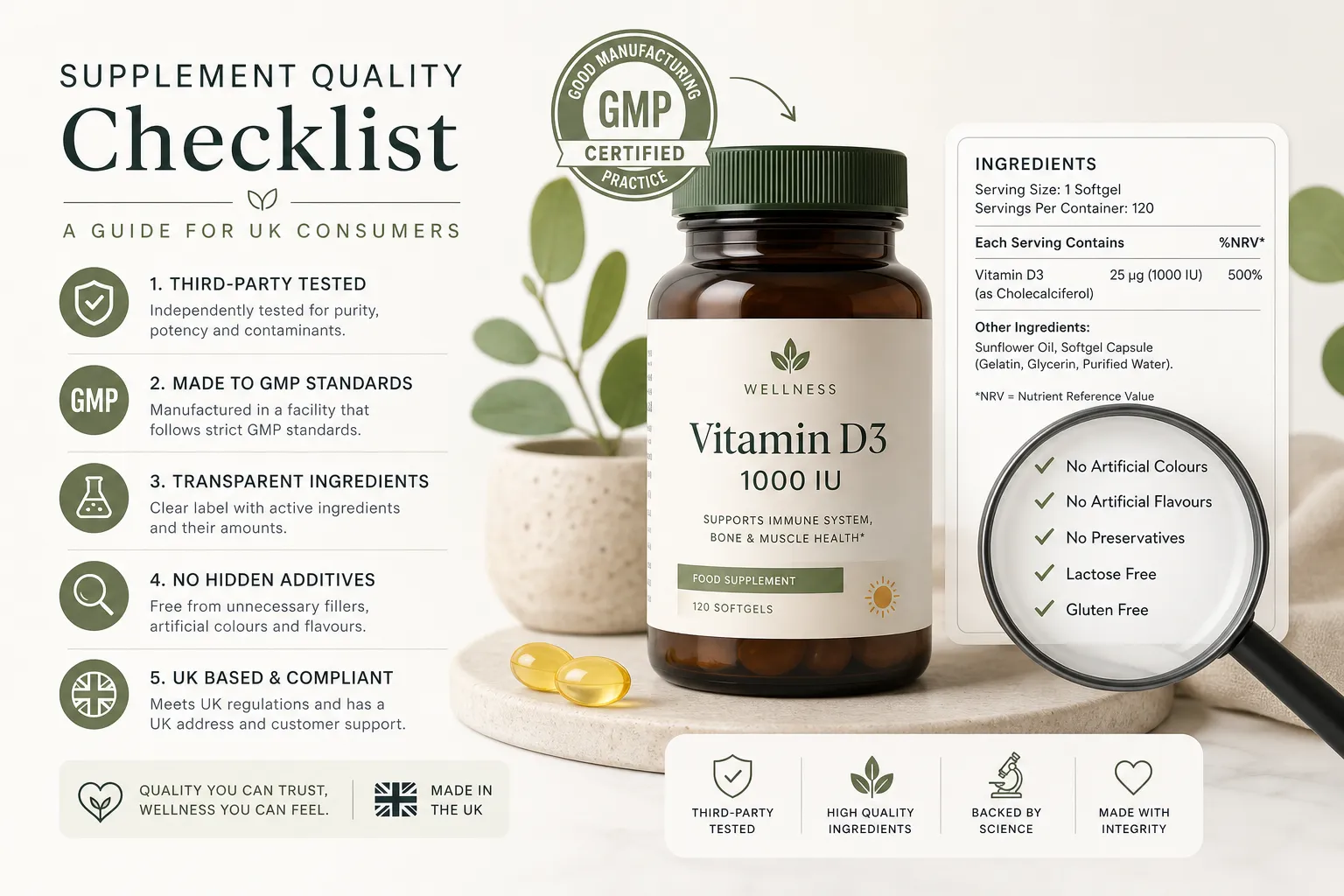
A trustworthy supplement brand should usually offer:
|
Quality signal |
Why it matters |
|---|---|
|
Clear ingredient list |
Lets you see exactly what you are taking |
|
Amount per serving |
Helps you compare properly |
|
NRV percentage where relevant |
Shows contribution to daily reference values |
|
UK company details |
Reassuring for accountability and customer support |
|
Batch number and best-before date |
Important for traceability |
|
Allergen and dietary suitability information |
Essential for safe purchasing |
|
Sensible authorised claims |
Suggests the brand understands UK rules |
GMP, ISO and what they actually tell you
GMP gets mentioned a lot in supplement marketing. It is worth knowing what it means.
GMP is a quality signal, not a magic badge
Good Manufacturing Practice refers to systems and controls designed to help ensure products are made consistently and hygienically. In plain English, it is about reducing avoidable mistakes in sourcing, handling, manufacturing and quality control.
It is a useful signal, but it is not proof on its own that a formula is the best quality vitamin supplements UK shoppers can buy. A product can be manufactured to high standards and still be poorly designed, underdosed or confusingly labelled.
ISO9001 is another helpful sign because it relates to quality management systems. Again, it supports trust in process rather than proving clinical effectiveness.
How to read a UK supplement label properly
This is where many buying decisions are won or lost. The front of the pack is marketing. The side or back panel is where the real information sits.
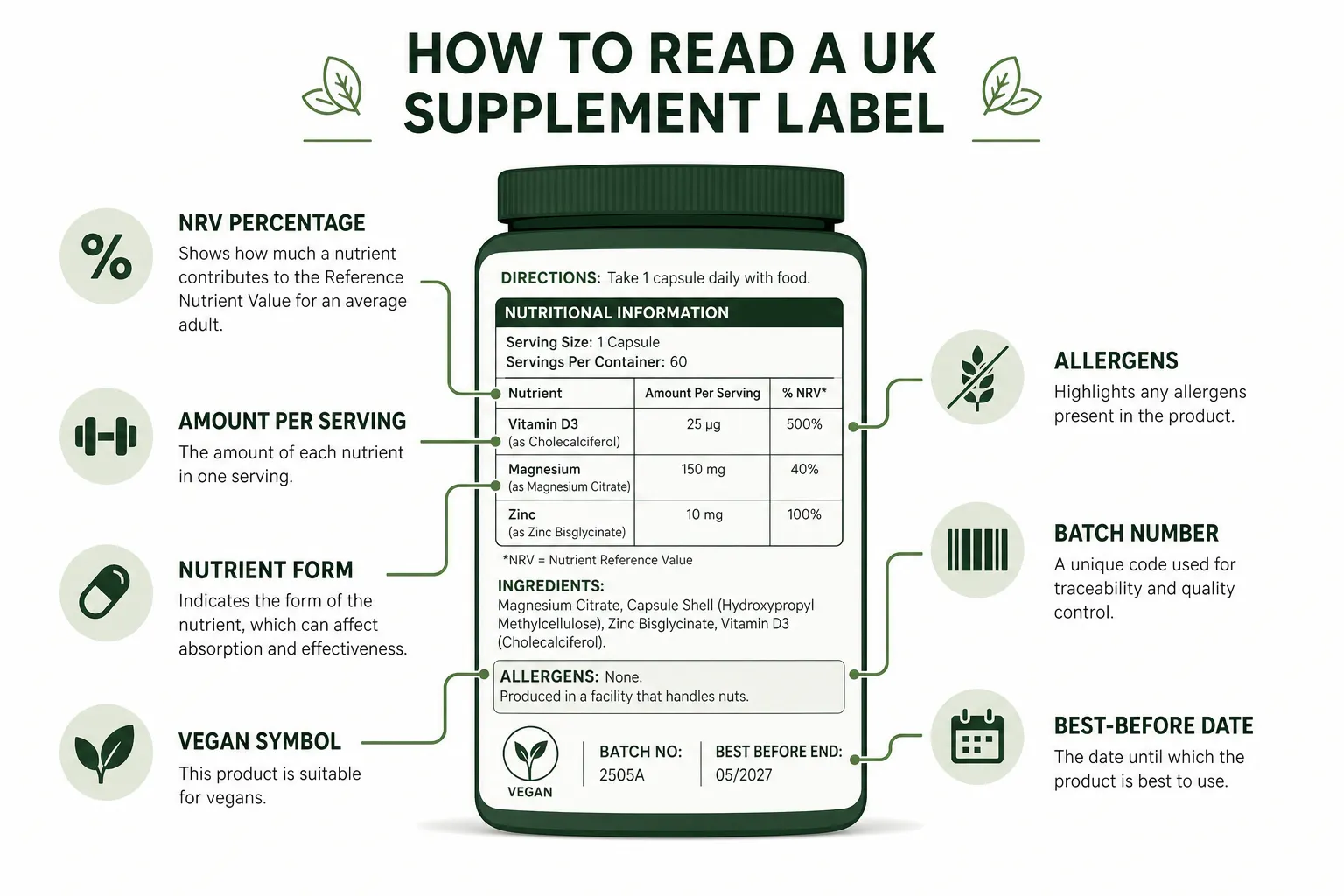
Check the amount per serving, not just per capsule
Some labels highlight a nutrient amount that only applies if you take two, three or even four capsules. Always check:
-
serving size
-
amount per serving
-
amount per capsule or tablet
This makes comparison much easier and stops you assuming a product is stronger than it really is.
Look at NRV percentages in context
NRV stands for Nutrient Reference Value. It gives you a benchmark for vitamins and minerals, but more is not always better.
High percentages can be appropriate in some cases, but if a product provides levels far above the NRV without explaining why, that is worth questioning. Good quality supplements explain their logic clearly.
Check the form of the nutrient
The form matters because different forms behave differently in the body and vary in tolerability.
Examples include:
-
magnesium citrate or glycinate versus magnesium oxide
-
methylfolate versus folic acid
-
methylcobalamin or cyanocobalamin for vitamin B12
-
calcium citrate versus calcium carbonate
That does not mean one form is always “best” for every person, but it does mean labels should be specific. Vague listings such as “magnesium blend” tell you very little.
For instance, when looking at mineral products, it helps to see the exact form and serving detail clearly, as you would expect from a transparent magnesium formula such as Tri Magnesium Matrix.
Check elemental amounts
Some minerals are listed as compounds, but what you often need to know is the elemental amount. For example, magnesium citrate weighs more as a compound than the actual elemental magnesium it provides. A quality label should make that understandable rather than leaving you to guess.
Scan for excipients and fillers
Excipients are not automatically bad. Many are used for stability, capsule structure or flow during manufacturing. The issue is not their mere presence, but whether the label is transparent and proportionate.
Watch for:
-
very long lists of unnecessary additives
-
colours or sweeteners where they add no real value
-
undeclared processing aids
-
vague terms with no explanation
Check allergens and dietary suitability
If you need vegan, vegetarian, halal, kosher or allergen-aware options, the label should make this easy to find. This is especially important with softgels, flavoured products and blended formulas.
Find the batch number and best-before date
These are basic but important. A batch number supports traceability, while a best-before date helps show stock control and freshness standards.
Look for a UK address or real contact details
If a pack or website has no proper UK company details, that is a red flag. Established brands should make it easy to contact them.
Third-party testing: useful, but only if it is specific
“Third-party tested” sounds reassuring, but on its own it does not tell you much.
A better question is: tested by whom, for what, and can the brand share anything meaningful?
Ask what the testing actually covers
A credible brand should be able to explain whether testing relates to:
-
identity of ingredients
-
purity
-
microbiological safety
-
heavy metals
-
potency
-
batch consistency
If a claim is vague and unsupported, treat it cautiously. Good quality supplements brands are usually happy to tell you more, even if full certificates are shared only on request.
Red flags that should make you pause
Many poor purchasing decisions come down to missing simple warning signs. Here are some of the biggest.
Proprietary blends hiding doses
If a label groups several ingredients into a “proprietary blend” without showing exact amounts, you cannot assess value or suitability properly. It may hide underdosing, overcomplication or both.
Very high doses with no explanation
A very high dose is not automatically superior. It may be unnecessary, unsuitable for some people, or included because it looks impressive in marketing.
“Clinically proven” without context
This phrase is often used loosely. Ask:
-
clinically proven for what?
-
in what amount?
-
in what form?
-
in whom?
If the label does not tell you, the claim is not doing much useful work.
No UK company details
If you cannot see where the brand is based or how to reach them, think twice.
Imported products sold through unclear channels
Where you buy matters. Established UK retailers and brands with a UK-registered company and clear support details generally offer a more reliable experience than anonymous marketplace listings.
Match the product to the goal
The best quality supplements are the ones that fit the person and the purpose. A beautifully packaged formula is still the wrong choice if it is mismatched to your actual goal.
For immune support
Look for straightforward formulas and authorised claim language. Vitamin C contributes to the normal function of the immune system, and vitamin D contributes to the normal function of the immune system as well. That does not mean every “immune” product is well designed.
If you are comparing options in this area, our guide to best supplements for immune support in adults explains what to look for in a more goal-specific way.
For digestive support
Blended gut formulas need particularly careful label reading because ingredients can vary widely in dose and purpose. Some combine fibre, botanicals, probiotics or enzymes, but the best quality vitamins and supplements in this category are clear about what is included and why.
A transparent example would be a digestive formula where serving details and ingredient structure are easy to follow, such as Digestive Enzymes Plus, if enzymes are relevant to the shopper’s goal.
For sleep, stress or everyday balance
Forms matter here too. Magnesium, botanicals and supporting nutrients are often grouped together, but clarity still matters more than trendiness. If your routine includes evening supplements, practical timing can matter as much as formulation, which is why readers often find best time to take vitamins in the UK helpful.
Two practical reminders from UK guidance
Even the strongest decision framework should sit alongside sensible public health advice.
“Everyone should consider taking a daily vitamin D supplement during the autumn and winter.” – NHS
“If you’re pregnant or could get pregnant, it’s recommended you take a 400 microgram folic acid tablet every day before you’re pregnant and until you’re 12 weeks pregnant.” – NHS
These are useful examples because they show how supplementation is often most helpful when it is targeted, evidence-aware and tied to a clear need.
A simple framework for comparing products side by side
Use this when narrowing down your shortlist.
|
Question |
Good sign |
Red flag |
|---|---|---|
|
Is the goal clear? |
Product matches a defined need |
Broad promises for everything |
|
Is the label transparent? |
Full amounts and forms shown |
Proprietary blends or vague terms |
|
Are the dosages sensible? |
Clear serving logic and context |
Mega-doses with no rationale |
|
Can you verify the brand? |
UK address and customer support |
No meaningful contact details |
|
Is testing explained? |
Specific testing information available |
“Third-party tested” with no detail |
|
Is the formula readable? |
Clear allergens, excipients, suitability |
Hidden fillers or unclear symbols |
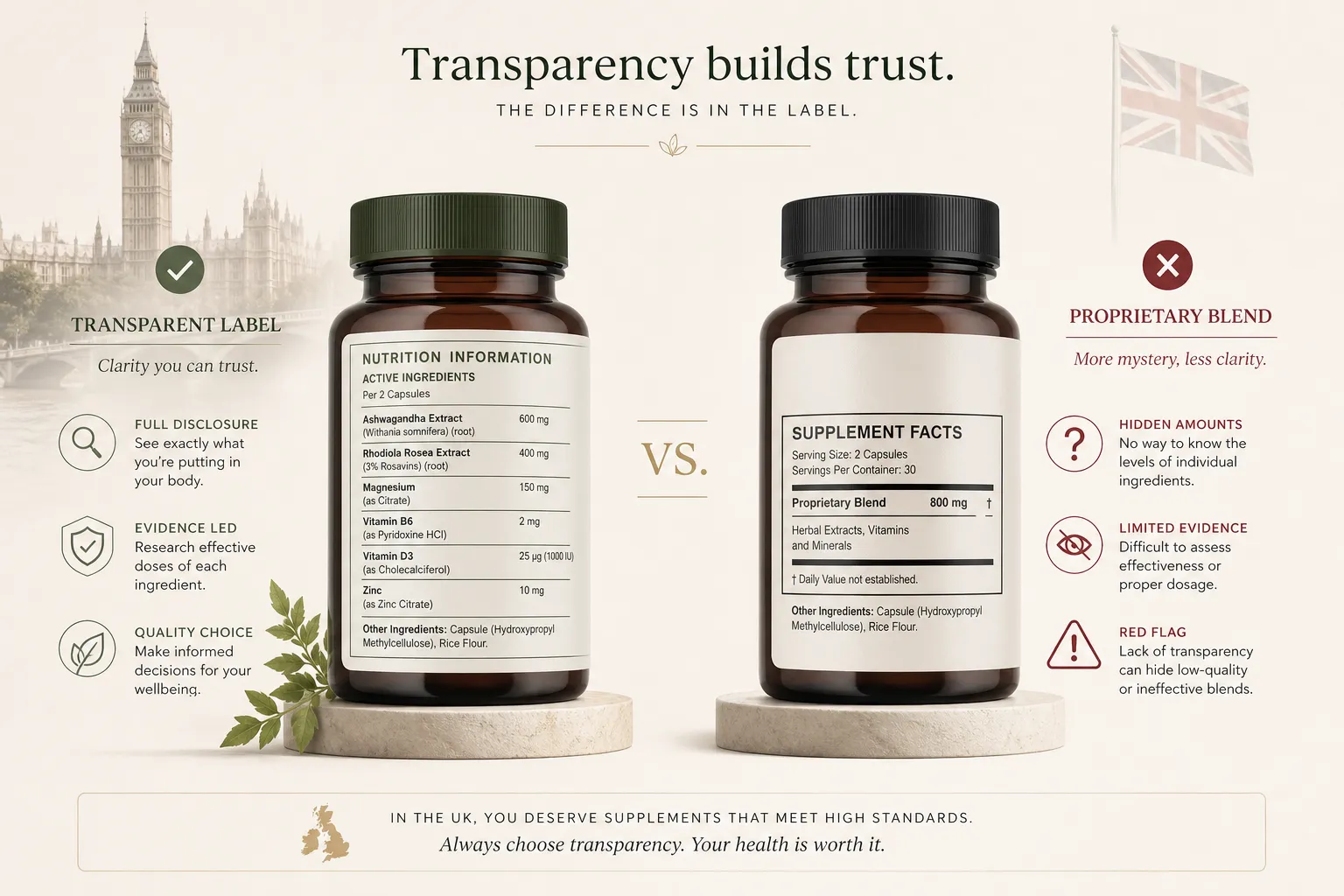
Printable checklist: how to choose quality supplements UK shoppers can trust
You can save or print this section for quick use.
Your supplement quality checklist
-
Does the product fit a genuine goal or need?
-
Is the serving size easy to understand?
-
Are nutrient amounts shown clearly per serving?
-
Are vitamin and mineral forms named properly?
-
Is the NRV percentage shown where relevant?
-
Are elemental amounts clear for minerals?
-
Are fillers and excipients listed transparently?
-
Are allergens and dietary suitability easy to spot?
-
Is there a batch number and best-before date?
-
Does the brand provide UK contact details?
-
Are manufacturing standards explained sensibly?
-
If it says “third-party tested”, does it say by whom and for what?
-
Are the claims measured and compliant rather than dramatic?
Final thoughts
Finding proper supplements does not require a science degree, but it does require slowing down long enough to read beyond the front label. The best quality supplements UK consumers can buy tend to have a few things in common: they are clear about what is inside, sensible about dosage, easy to trace back to a real UK business, and honest about what they can and cannot do.
At InfiniVit, we believe good quality supplements should feel reassuring rather than confusing. That means transparent labelling, thoughtful formulations, high manufacturing standards and plain-English guidance you can actually use. If you would like help choosing from our range, you are welcome to browse the collection or email info@infinivit.co.uk with questions.
FAQ
How do I know if a supplement is high quality?
Look for clear labelling, named nutrient forms, sensible serving sizes, UK company details, batch information, and transparent claims about testing. A high-quality supplement should make it easy to understand what is in it, how much you are getting, and why it is there.
Which supplements do the NHS recommend?
The NHS advises that people in the UK should consider a daily vitamin D supplement during autumn and winter. It also recommends 400 micrograms of folic acid before pregnancy and until 12 weeks pregnant for those who are pregnant or could become pregnant.
What are the top 3 best supplements to take?
There is no universal top three, because the right choice depends on your diet, life stage, health goals and medical context. For many UK adults, common starting points include vitamin D, a targeted nutrient based on need, or a well-chosen formula for a specific goal such as digestive or magnesium support.