
 English
 Arabic
 Polish
 Russian
If you are comparing menopause supplements in the UK, look at the daily serving on the label before the promises on the front of the pack. Food supplements can add nutrients to your diet, but that alone does not show they relieve hot flushes, improve sleep or treat menopause symptoms. Note what you hope to address, read the amounts in a full day’s serving and speak to a clinician if symptoms affect your life.
If HRT is part of your decision, this British Menopause Society video explains it:
Menopause supplements in the UK: start with your stage
During perimenopause, periods may change and symptoms may begin. The NHS defines menopause as 12 months without a period when you are not using hormonal contraception; postmenopause follows. Knowing your stage helps you describe your experience to a clinician. It cannot tell you whether a product marked “perimenopause” will address your symptoms, and people at the same stage may have different nutritional needs. The ingredient panel tells you far more than “menopause support” on the front.
|
What you are noticing |
Useful next step |
What a supplement label can tell you |
|---|---|---|
|
Irregular periods, sleep disruption or hot flushes |
Discuss symptoms and treatment options with a GP or nurse |
Ingredients and amounts, not whether the product treats those symptoms |
|
A possible gap in dietary intake |
Look at food first and relevant general guidance; discuss a suspected deficiency with a clinician |
Whether a nutrient is supplied and how much per daily serving |
|
An existing prescription or several supplements in use |
Ask a pharmacist about interactions and total intake |
Ingredients to bring to that conversation |
Vitamin D is one general nutritional consideration. NHS vitamin D guidance recommends that everyone consider 10 micrograms daily in autumn and winter; people with little sun exposure may need to consider it year-round. The recommendation concerns intake and says nothing about treating menopause. For other nutritional priorities, see supplements for women over 50.
Read the label in five passes
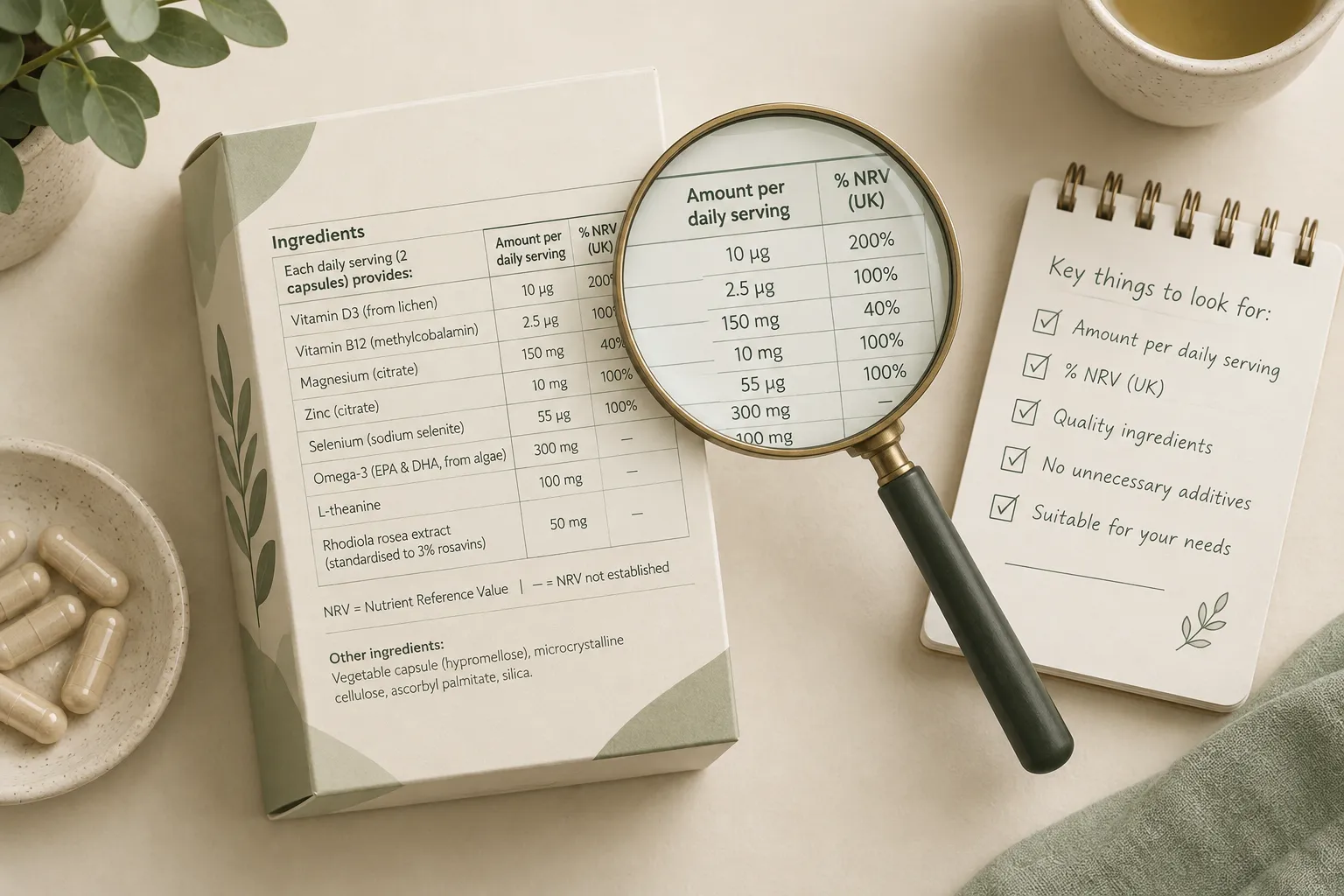
1. Convert everything to the daily serving
To work out your daily intake, multiply the “per capsule” figure by the number of capsules in the instructions. Add any matching nutrients from your other supplements. A tub of 60 capsules lasts 60 days at one a day, or 20 days at three, so compare cost per day as well as price per tub.
InfiniVit MENO Support makes a useful worked example. Its label lists 5 mg vitamin B6 and 2.5 mg zinc per capsule, while one usage panel says one capsule two to three times daily. That gives 10 to 15 mg B6 and 5 to 7.5 mg zinc daily. Elsewhere, the page gives a higher initial intake and warns that long-term intake above 10 mg B6 daily may cause mild tingling and numbness. Ask the seller or a pharmacist which directions to follow before taking it, especially if another product you use contains B6.
2. Separate nutrient amounts, %NRV and herbal extracts
“%NRV” gives the percentage of a nutrient reference value, a labelling benchmark. It cannot tell you whether a dose relieves symptoms or whether more would be better. Read the milligrams or micrograms beside it. An extract ratio such as “10:1” describes processing; the “equivalent to” plant weight differs from the weight of extract in the capsule. For a standardised botanical, read its stated constituent percentage alongside the extract weight. Without individual amounts for a blend, you cannot compare doses.
|
Label detail |
What to compare |
What it does not establish |
|---|---|---|
|
B6 5 mg per capsule, 357% NRV |
Milligrams across the instructed daily serving and other products |
That B6 treats hot flushes |
|
Red clover extract 20 mg, 8% isoflavones |
Extract weight and standardised percentage |
That 800 mg “equivalent” is 800 mg of extract |
|
Soya isoflavones 20 mg, 40% |
The declared ingredient amount and concentration |
That this is a dose proven to relieve symptoms |
|
60 capsules in a tub |
Days of use at the directed serving |
Better value without a cost-per-day comparison |
3. Match each health claim to the exact nutrient
The GB nutrition and health claims register lists permitted claims in Great Britain. Vitamin B6, for instance, contributes to the regulation of hormonal activity and to the reduction of tiredness and fatigue. Those are claims about B6. They give you no reason to assume the entire blend restores oestrogen or treats menopause. If the pack says “hormonal balance”, look for the precise authorised wording. See also what UK supplement claims mean.
GOV.UK guidance on supplement labelling says foods cannot claim or imply that they treat, prevent or cure medical conditions. Treat any food-supplement label promising to treat menopausal symptoms with caution.
4. Read the full ingredients and warnings
The nutrition panel gives only part of the picture. In the full ingredients list, look for allergens such as soya, check the capsule material and note herbs that could matter for your medicines or health history. “Natural”, “vegan” and “made in the UK” each describe something different; none proves clinical benefit. Manufacturing standards matter, but cannot substantiate a symptom claim.
5. Compare like for like
Use the same fields for each product you compare. A longer ingredient list does not automatically make a better choice.
|
Comparison question |
Product A |
Product B |
|---|---|---|
|
How many capsules make a normal daily serving? |
Write the label instruction |
Write the label instruction |
|
How much of each nutrient or extract is in that serving? |
Multiply per-capsule quantities |
Multiply per-capsule quantities |
|
Are botanical amounts and standardisation disclosed? |
Record extract weight and any percentage |
Record extract weight and any percentage |
|
Are claims specific to named nutrients and authorised wording? |
Note the precise claim |
Note the precise claim |
|
Is there an allergen, interaction or overlapping nutrient? |
Mark for pharmacist discussion |
Mark for pharmacist discussion |
|
What is the cost per day at the labelled serving? |
Tub price divided by days of use |
Tub price divided by days of use |
Safety checks before you buy
The NHS says herbal menopause remedies such as red clover and black cohosh do not undergo the same testing and regulation as HRT, leaving their safety and effectiveness for symptoms uncertain. Some herbs, particularly St John’s wort, can interact seriously with medicines. Tell a healthcare professional about all the drugs and supplements you take, including sleep or mood products and blood thinners. Your medical history also matters when you consider a herbal blend.
“The quality, purity and ingredients cannot always be guaranteed, and they may cause unpleasant side effects.” – NHS
B6 in a multivitamin, a menopause blend and an “energy” formula all counts towards your daily intake. If you develop tingling or numbness while taking a supplement, stop taking it and seek medical advice. Read soya allergen advice, and consider botanicals such as red clover in the context of your health history.
When a supplement is not the answer
If hot flushes, night sweats, low mood, disrupted sleep or vaginal symptoms disrupt daily life, talk to a GP or nurse. A symptom record and a list of medicines and supplements will help you explain what is happening. Ask about NHS treatment choices, including HRT. HRT can be used during perimenopause; you do not have to wait until periods stop.
The NHS also lists non-hormonal options, including cognitive behavioural therapy for some symptoms. A clinician can explain whether HRT suits your circumstances, along with its benefits, risks and alternatives. Supplements cannot diagnose the cause of a symptom.
A sensible way to choose
Decide whether you want to fill a dietary gap or address symptoms. A healthy lifestyle and varied diet are the starting point for nutrition. If you consider a supplement, calculate its daily amounts, match claims to named nutrients and note allergies, interactions and duplicated ingredients. Conflicting directions are a reason to pause.
For a more detailed product-by-product comparison, use the checklist in How to Judge Supplement Quality in the UK. If you want to browse a menopause-focused option, InfiniVit MENO Support is a food supplement containing B6, zinc and a botanical blend, including soya and red clover. Its published dosage instructions need clarification as noted above. It supports wellbeing as a food supplement, not as a treatment for menopausal symptoms or a substitute for HRT or clinical advice.
Choose a product only when you can explain its daily amounts, warnings and permitted claims in plain English. When symptoms are your main concern, begin with a health conversation.
FAQ
When should I start taking perimenopause supplements?
There is no set point in perimenopause when you need to start a supplement. Consider your diet and any specific nutrient need first; if symptoms are troubling you, discuss treatment options with a GP or nurse rather than waiting for a capsule to work.
What are the three stages of menopause?
Perimenopause is the transition leading up to menopause. Menopause is reached after 12 months without a period when not using hormonal contraception; postmenopause is the period afterwards. The stage alone does not tell you which supplement, if any, you need.
What not to do during menopause?
Do not assume “natural” means safe or that a food supplement can replace HRT or medical advice. Avoid stacking products without adding up shared nutrients and discussing potential herbal interactions with a pharmacist, especially if you take medicines.