
 English
 Arabic
 Polish
 Russian
Best Time to Take Vitamin B Complex
If you are wondering about the best time to take vitamin B complex, the short answer is simple: for most people, timing matters less than consistency.
There is no strong evidence that taking a B-complex at a precise hour will create extra benefits on its own. In practice, the most useful routine is the one you can stick to comfortably. For many adults, that means taking it in the morning, often with breakfast, but evening can also be fine if it suits your routine and does not cause discomfort.
This guide explains what actually matters: morning versus night, taking it with food, individual tolerance, and how to build a routine that works in real life.

What vitamin B complex actually is
A vitamin B complex usually contains several or all of the eight B vitamins:
-
B1 (thiamin)
-
B2 (riboflavin)
-
B3 (niacin)
-
B5 (pantothenic acid)
-
B6
-
B7 (biotin)
-
B9 (folate/folic acid)
-
B12
These vitamins have different roles in the body. Depending on the specific nutrient, authorised health claims include support for normal energy-yielding metabolism, normal psychological function, normal function of the nervous system, and reduction of tiredness and fatigue.
That is important context, because people often assume timing changes how these vitamins “work.” Usually, it does not. What matters more is:
-
whether you actually need the supplement
-
whether you tolerate it well
-
whether you take it regularly enough to fit your plan
Does the time of day really matter?
For most people, not very much.
A B-complex supplement is not like a medicine that must be taken at an exact hour to work properly. In general, the body does not reward perfect timing nearly as much as it rewards regular use when supplementation is appropriate.
What matters more than the clock
The biggest practical factors are:
-
Consistency
Taking it at roughly the same time each day helps you remember it. -
Tolerance
Some people feel better taking it with food. Others are comfortable taking it on an empty stomach. -
Your own routine
A supplement that fits your daily habits is far more useful than one attached to an unrealistic “ideal” schedule.
If you are trying to build a sensible overall routine, our guide to what supplements should you take daily explains how to think about regular use more broadly.
Morning or evening: which is better?
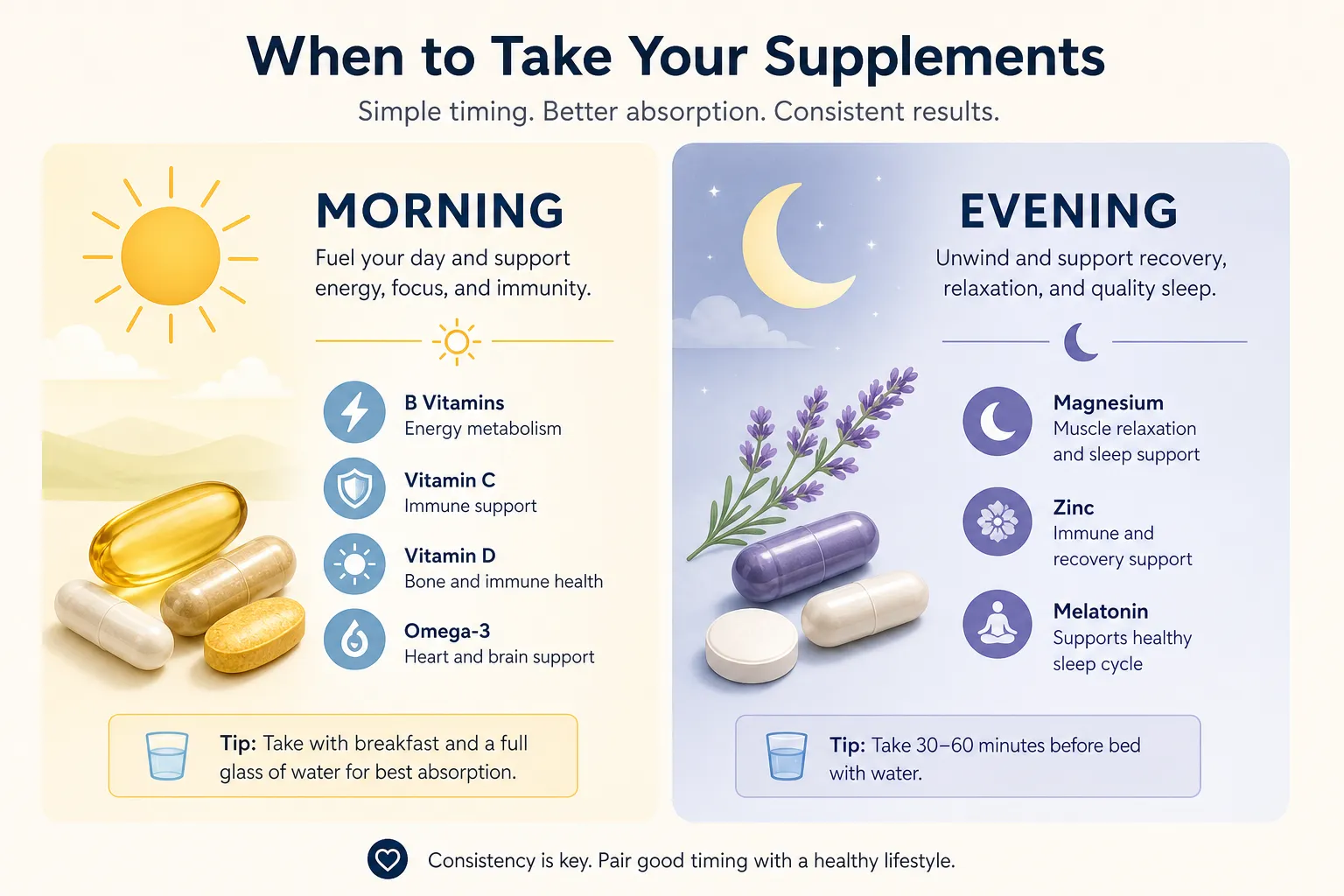
For most adults, morning is the most practical default. But that is mainly about routine and comfort, not because morning creates superior results.
Why many people choose morning
Taking a B-complex in the morning can be convenient because:
-
it is easy to pair with breakfast
-
it becomes part of an established routine
-
some people prefer not to take multiple supplements later in the day
There is also a common perception that B vitamins should be taken early because they are linked with energy metabolism. That idea is understandable, but it should not be overstated. Supporting energy metabolism does not mean a B-complex acts like a stimulant or gives an instant energy boost.
When evening may be fine
Taking vitamin B complex at night may also be perfectly acceptable if:
-
you remember it more reliably then
-
you eat dinner consistently and prefer taking supplements with food
-
it does not upset your stomach
-
it does not seem to interfere with your sleep
A small number of people prefer to avoid late dosing simply because they feel more comfortable taking supplements earlier in the day. That is a personal response, not a universal rule.
Should you take vitamin B complex with food?
For many people, yes, taking it with food is a sensible choice.
A B-complex can often be taken with or without food, but taking it alongside a meal or snack may help reduce the chance of:
-
nausea
-
mild stomach irritation
-
queasiness
-
general digestive discomfort
This is especially useful if you have a sensitive stomach or if you have previously felt uncomfortable after supplements.
Good practical options
You do not need a heavy meal. Often, any of the following is enough:
-
breakfast
-
lunch
-
a light snack
-
dinner, if evening works better for you
The goal is not to create a complicated rule. It is simply to make the supplement easier to tolerate.
If digestive comfort is a recurring issue, you may also be interested in broader nutrition habits that support the gut, including these natural supplements for gut health.
Is it okay to take vitamin B complex on an empty stomach?
Sometimes, yes. But it depends on the person.
Some adults can take a B-complex first thing in the morning with water and feel absolutely fine. Others may notice:
-
nausea
-
a “warm” stomach feeling
-
mild cramps
-
queasiness
If that happens, the easiest fix is usually to take it with food instead of on an empty stomach.
A simple rule of thumb
Use this approach:
|
Situation |
Best practical choice |
|---|---|
|
You tolerate it well fasting |
Taking it without food may be fine |
|
You feel nauseous or uncomfortable |
Take it with breakfast or another meal |
|
You often forget morning supplements |
Move it to a meal you rarely miss |
|
You are unsure |
Start with food and adjust if needed |
Why consistency matters more than perfect timing
When people search for the best time to take vitamin B complex, they often expect there to be one ideal answer. In reality, the more helpful question is:
What time can I take it consistently without discomfort?
That is because the benefit of a routine comes from regular use when appropriate, not from chasing the “perfect” minute on the clock.
A practical consistency checklist
Choose a time that is:
-
attached to a daily habit
-
easy to remember
-
comfortable for your stomach
-
realistic on workdays and weekends
Common examples include:
-
with breakfast
-
after brushing your teeth in the morning
-
with lunch at work
-
with dinner if evenings are more predictable
Can taking vitamin B complex at night affect sleep?
For some people, possibly, but not for everyone.
There is no universal rule that a B-complex will disturb sleep. Still, people vary. If you feel more alert, uncomfortable, or simply prefer not to take supplements before bed, moving it earlier in the day is reasonable.
What to do if you are unsure
Test it practically:
-
try taking it in the morning for one to two weeks
-
if that does not suit your routine, try lunch
-
only keep evening dosing if it feels comfortable and does not appear to affect sleep
That kind of simple self-observation is often more useful than rigid supplement folklore.
If sleep support is one of your wider health goals, our article on best vitamins for sleep and anxiety explores that topic separately.
Does vitamin B complex give you energy right away?
Not in the way many people imagine.
B vitamins are involved in normal energy-yielding metabolism, but that does not mean taking a capsule at 8 a.m. will automatically make you feel energised by 8:30 a.m. If you are deficient in a particular nutrient, correcting that deficiency may help over time. But timing alone is not a shortcut to better energy, sharper performance, or immediate vitality.
That distinction matters because it helps keep expectations realistic.
When timing advice should become more individual
General advice works well for many people, but sometimes your circumstances matter more than generic routines.
You may need a more personalised approach if you:
-
have a diagnosed vitamin deficiency
-
take prescription medicines
-
have a digestive condition affecting absorption
-
are pregnant or breastfeeding
-
have had stomach or intestinal surgery
-
feel unwell after taking supplements
-
have symptoms such as ongoing fatigue, tingling, numbness, or unexplained weakness
In those cases, the question is not just when to take a B-complex. It may also be whether a B-complex is appropriate at all, whether a single nutrient is more relevant, and what dose makes sense.
What if vitamin B complex upsets your stomach?
This is one of the most useful real-world questions, and it is often overlooked.
If a B-complex makes you feel sick or uncomfortable, try the following:
1. Take it with food
This is the first and simplest adjustment.
2. Move it to a different meal
Breakfast may not suit you, but lunch might.
3. Check the dose
Some high-strength formulas may feel harsher for certain people.
4. Review the full ingredient list
Sometimes the issue is not only the B vitamins themselves but other ingredients, fillers, or added nutrients.
5. Pause and ask a professional
If symptoms continue, especially if they are strong or unusual, speak with a pharmacist, GP, or qualified clinician.
A simple routine guide
If you want a straightforward answer, this is the most practical framework.
Best default routine for most adults
|
Question |
Practical answer |
|---|---|
|
Morning or night? |
Morning is often easiest, but night can also be fine |
|
With food or without? |
With food is often gentler on the stomach |
|
Does perfect timing matter? |
Usually no |
|
What matters most? |
Consistency and tolerance |
|
What if it causes nausea? |
Take it with food or move it to another meal |
|
What if evening seems to affect sleep? |
Switch to earlier in the day |
What competitor articles often miss
Many articles on this topic repeat the same shallow advice: “take it in the morning for energy.” That is simple, but it is not especially helpful.
What often gets missed is:
-
the difference between energy metabolism and feeling instantly energised
-
the practical importance of individual tolerance
-
the reality that with food vs without food can matter more than morning vs evening
-
the fact that a sustainable routine beats idealised timing
-
the need to avoid turning normal supplement use into exaggerated claims
At InfiniVit, we believe supplement guidance should be clear, balanced, and grounded in quality health communication. That means focusing on what is actually useful in everyday life, not overstating what timing can do.
How to think about supplement quality without overcomplicating timing
Even though this article is about routine rather than shopping, it is worth remembering that good supplement practice is not only about when you take something. It is also about informed, careful choices overall.
That means looking for:
-
clear labelling
-
sensible dosing
-
transparent ingredient lists
-
high manufacturing standards
-
claims that stay within evidence-based and authorised boundaries
For a broader framework, see our guide on how to judge supplement quality in the UK.
Final verdict
The best time to take vitamin B complex is usually the time you will remember it and tolerate it well.
For many people, that means morning with breakfast. But there is nothing magical about that timing. Evening can also work if it feels comfortable and fits your routine. If the supplement upsets your stomach, taking it with food is often the simplest fix.
So rather than chasing a perfect hour, focus on the basics:
-
be consistent
-
take it in a way that suits your digestion
-
adjust based on personal tolerance
-
get medical advice if you have symptoms, a deficiency, or a health condition that changes the picture
That is the most practical and trustworthy way to approach vitamin B complex.
FAQ
When should I take vitamin B complex, morning or night?
For most people, either morning or night can be fine. Morning is often the easiest default because it fits naturally with breakfast, but the best choice is the time you can take it consistently and without discomfort.
What to avoid while taking vitamin B complex?
Avoid treating timing as if it will create extra benefits on its own, and avoid taking it on an empty stomach if that makes you feel unwell. It is also wise to avoid high-dose or unnecessary supplementation without advice if you have medical conditions, take medicines, or have symptoms that need proper assessment.
Is it better to take B12 or B-complex?
That depends on why you are taking it. A B-complex contains several B vitamins, while B12 is a single nutrient, so the better option depends on whether you need broader support or have been advised to focus on a specific deficiency.
Does B-complex make you sleepy?
Usually, no. A B-complex does not normally act like a sedative, but people respond differently, so if taking it at night feels uncomfortable or seems to affect sleep, moving it earlier in the day is a sensible adjustment.
What happens if you take B-complex every day?
For some people, daily use may be appropriate, especially if it fits a planned routine or professional advice. What matters most is that it is necessary, well tolerated, and used consistently, rather than assuming daily use is automatically beneficial for everyone.
What is the best vitamin for tiredness and fatigue?
There is no single best vitamin for everyone because tiredness can have many causes. If fatigue is linked to a nutrient deficiency, correcting that deficiency may help, but persistent tiredness should be assessed properly rather than managed by guessing with supplements alone.