
 English
 Arabic
 Polish
 Russian

Joint support supplements may help you meet nutritional needs for normal bones and cartilage. They cannot cure arthritis, and you should not count on them to stop joint pain. Before buying one, look at the ingredient claims, the amounts in a daily serving and the symptoms that may need medical attention.
Do joint supplements work?
For normal nutrition, some ingredients have a defined role. Vitamin C has an authorised claim for normal collagen formation for the normal function of cartilage. Calcium and vitamin D have claims relating to normal bones. These claims apply under specified conditions; they do not show that higher doses will ease a painful knee or rebuild damaged cartilage.
If you want to fill a nutritional gap, you need different information from someone dealing with persistent pain, stiffness or swelling. UK food supplements guidance does not allow joints support supplements to be marketed as preventing, treating or curing arthritis.
For osteoarthritis, NICE recommends tailored therapeutic exercise and says not to offer glucosamine to manage the condition. Supplements do not replace diagnosis, exercise or a treatment plan.
What UK supplement claims actually mean
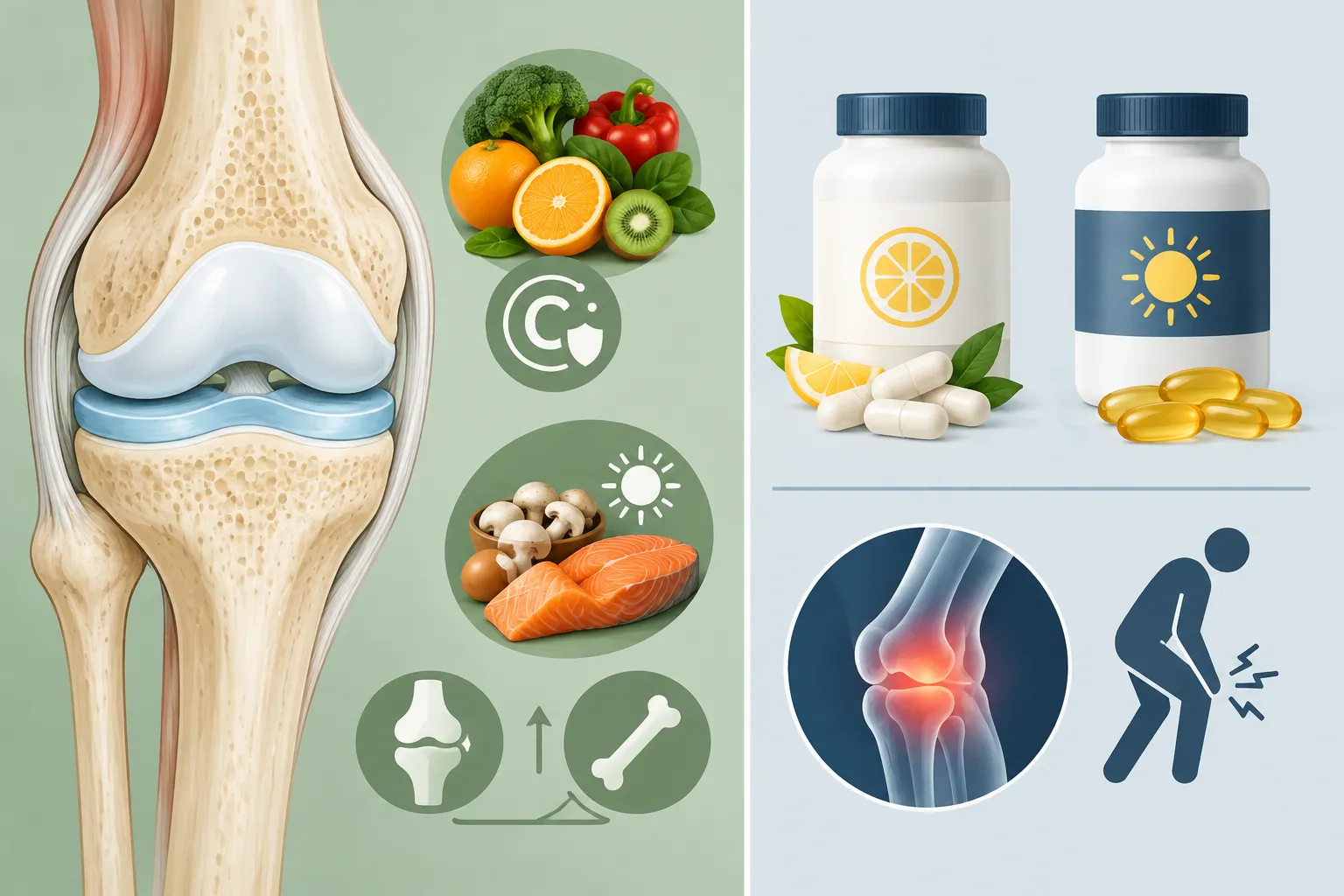
In Great Britain, a food supplement can use a health claim only if it is authorised in the GB register and the product meets its conditions of use. Putting a vitamin in a blend does not entitle the maker to any claim it chooses. In particular, normal cartilage function is a different claim from pain relief.
|
Nutrient |
Example of authorised wording |
What it does not establish |
|---|---|---|
|
Vitamin C |
Contributes to normal collagen formation for the normal function of cartilage |
That a collagen-containing product repairs a damaged joint |
|
Vitamin C |
Contributes to normal collagen formation for the normal function of bones |
That it treats bone or joint disease |
|
Calcium |
Is needed for the maintenance of normal bones |
That it relieves knee pain |
|
Vitamin D |
Contributes to the maintenance of normal bones |
That extra vitamin D treats arthritis |
|
Vitamin K |
Contributes to the maintenance of normal bones |
That it reverses joint damage |
|
Manganese |
Contributes to the normal formation of connective tissue |
That it restores worn cartilage |
The permitted health claims list sets out these nutrient-specific claims. Each has conditions a product must meet. A joint care blend does not gain permission to promise pain relief because it contains one of the listed nutrients.
Ingredient evidence at a glance
On a shelf of joints health supplements, a claim about normal bone function can sit next to a promise about pain. Those require different evidence. Arthritis UK’s glucosamine guidance describes mixed results; its fish oils guidance distinguishes rheumatoid arthritis from osteoarthritis.
|
Ingredient |
Why it appears in joint formulas |
Sensible interpretation |
|---|---|---|
|
Vitamin C, calcium, vitamin D, vitamin K and manganese |
Normal cartilage, bone or connective-tissue claims, depending on the nutrient |
Useful for assessing nutritional coverage; no claim here means pain relief |
|
Glucosamine and chondroitin |
Promoted for cartilage and osteoarthritis symptoms |
Glucosamine evidence is mixed, with modest effects in some research; NICE says not to offer it for osteoarthritis management. Do not assume adding chondroitin makes a formula a treatment |
|
Collagen peptides or type II collagen |
Marketed as a way to support joint structures |
Taking collagen is not the same as proving a product rebuilds human cartilage or treats arthritis. Do not transfer vitamin C’s collagen-formation claim to collagen itself |
|
Omega-3 fish oil |
Associated with inflammatory processes |
Evidence for fish oil is stronger in rheumatoid arthritis than in osteoarthritis; neither makes a general omega oil product an arthritis medicine |
|
MSM, turmeric and hyaluronic acid |
Included in many multi-ingredient products for comfort or lubrication messaging |
A plausible mechanism or popular use does not establish reliable pain relief from the finished blend |
Read a nutrient claim and a symptom study separately. One describes a permitted normal-function statement; the other investigates an outcome in a particular group. Neither lets you use a supplement in place of an osteoarthritis treatment plan.
How to compare a joint supplement label
Read the daily serving first. The number on the front of the pack might be “per capsule” rather than the amount you would take in a day. For help interpreting the wording, see what UK supplement claims really mean. Then use these checks:
-
Find the active amounts. Look for each vitamin or mineral amount per daily serving and its nutrient reference value (NRV). For an extract or blend, see whether the individual ingredients and their quantities are disclosed rather than hidden behind a single combined weight.
-
Match claims to ingredients. Ask whether the wording refers to normal bones, cartilage or connective tissue, or whether it promises to fix pain or arthritis. The latter is not an ordinary food-supplement claim.
-
Avoid accidental overlap. Compare the label with any multivitamin, vitamin D, calcium or omega supplement you already use. More of a nutrient is not automatically better; choosing a vitamin D supplement starts with what else you take.
-
Look beyond the front label. Check the suggested serving, allergen statement and whether animal-derived ingredients fit your diet. Fish oil, marine collagen and some glucosamine sources matter for people avoiding particular animal ingredients.
-
Account for medicines and conditions. Ask a pharmacist before adding a supplement if you take regular medication, especially medicines for which interactions matter, or have a condition being treated. Bring the pack or a photo of the full ingredient panel.
The NHS advises considering 10 micrograms of vitamin D daily in autumn and winter and says adults should not take more than 100 micrograms a day unless a doctor advises otherwise. Add together the daily amounts if you use more than one product. A higher-dose joint blend offers no automatic advantage.
If you take warfarin, the full ingredient panel is especially important. The NHS says not to take vitamin K supplements with warfarin, and MHRA safety information says the glucosamine-warfarin combination is not recommended.
A clear label and appropriate manufacturing controls help you judge what you are buying. They cannot tell you whether the blend will ease your pain. You can use how to choose quality supplements in the UK for more on product quality.
When joint pain needs care instead of another supplement
Pain that keeps returning, interferes with ordinary activity or comes with stiffness or swelling deserves a clinical assessment. The NHS advises seeing a GP when it has not improved after two weeks of home care. Treatment depends on the cause. For osteoarthritis, NICE recommends tailored therapeutic exercise, including strengthening or aerobic activity.
“For all people with osteoarthritis, offer therapeutic exercise tailored to their needs”. – NICE osteoarthritis recommendations
The NHS joint pain advice says to seek urgent GP advice or NHS 111 if a painful joint is hot and swollen, or you feel unwell with a fever or shivering. Very bad pain after an injury or being unable to bear weight needs emergency assessment. Do not wait to see whether a supplement takes effect.
The practical verdict
Buy a joint supplement to meet a specific nutritional need. Look for a clear daily serving and authorised claims relevant to its ingredients, and account for the supplements you take already. Persistent pain calls for clinical advice and a movement plan suited to its cause.
InfiniVit’s joints and bones range gives UK shoppers a place to compare targeted formulas alongside individual nutritional options. Use the same label checklist for its products as for any other brand: assess the listed ingredients and serving against your needs, without interpreting a normal-function claim as a promise to relieve arthritis.
FAQ
What vitamins are good for women’s joint health?
The authorised claims do not change by sex: vitamin C contributes to normal collagen formation for the normal function of cartilage, while vitamin D contributes to the maintenance of normal bones. Neither claim says a vitamin treats painful joints. Choose based on your diet and circumstances, not a gendered joint-pain promise.
What does the NHS recommend for joint pain?
The right advice depends on the cause. NHS guidance flags a hot, swollen joint or fever as needing urgent advice; very bad pain after an injury or inability to bear weight needs emergency assessment. For osteoarthritis, NICE recommends tailored therapeutic exercise and does not recommend offering glucosamine.
What form of collagen is best for joints?
There is no clear basis here to name one form as the best treatment for joint pain. Collagen peptides and type II collagen are sold in supplements, but a vitamin C claim about normal collagen formation does not prove either collagen supplement repairs cartilage or treats arthritis. Compare the actual serving and ingredients rather than the type name alone.
What vitamins am I lacking if my joints hurt?
Joint pain alone cannot identify a vitamin deficiency. Vitamin C and vitamin D have authorised claims relevant to normal cartilage function and bone maintenance respectively, but those claims are not a diagnosis or a pain treatment. If pain persists or recurs, ask a clinician to assess the cause rather than guessing from a supplement label.
What stops joint pain naturally?
No supplement is a reliable universal fix for joint pain. For osteoarthritis, NICE recommends therapeutic exercise tailored to your needs, including strengthening or aerobic activity. A hot, swollen joint or fever calls for prompt clinical advice instead of self-treatment.