
 English
 Arabic
 Polish
 Russian
Premium vitamins are worth paying for when the extra cost buys something you need: a suitable dose, a useful ingredient form, a dietary requirement, or credible evidence about the finished product. A supermarket tablet that supplies the same relevant nutrient at an appropriate dose can be the better buy. First, decide whether you need a supplement at all.
This short label-reading video is a useful starting point before you compare two packs:
Premium vitamins vs supermarket vitamins: match the job, not the price
Both price tiers include reasonable choices. If you know which specific nutrient you need, a single-nutrient product may do the job. A more costly blend becomes interesting when its disclosed ingredients and amounts serve your purpose. Ingredient count and packaging tell you little about the likely benefit.
Compare recommended daily servings rather than bottle prices or the number of nutrients on the front. Start with a goal you can assess. “I want a vitamin D supplement” gives you a basis for comparison; “I want more energy” leaves open the reason you feel tired.
Compare the label before the price
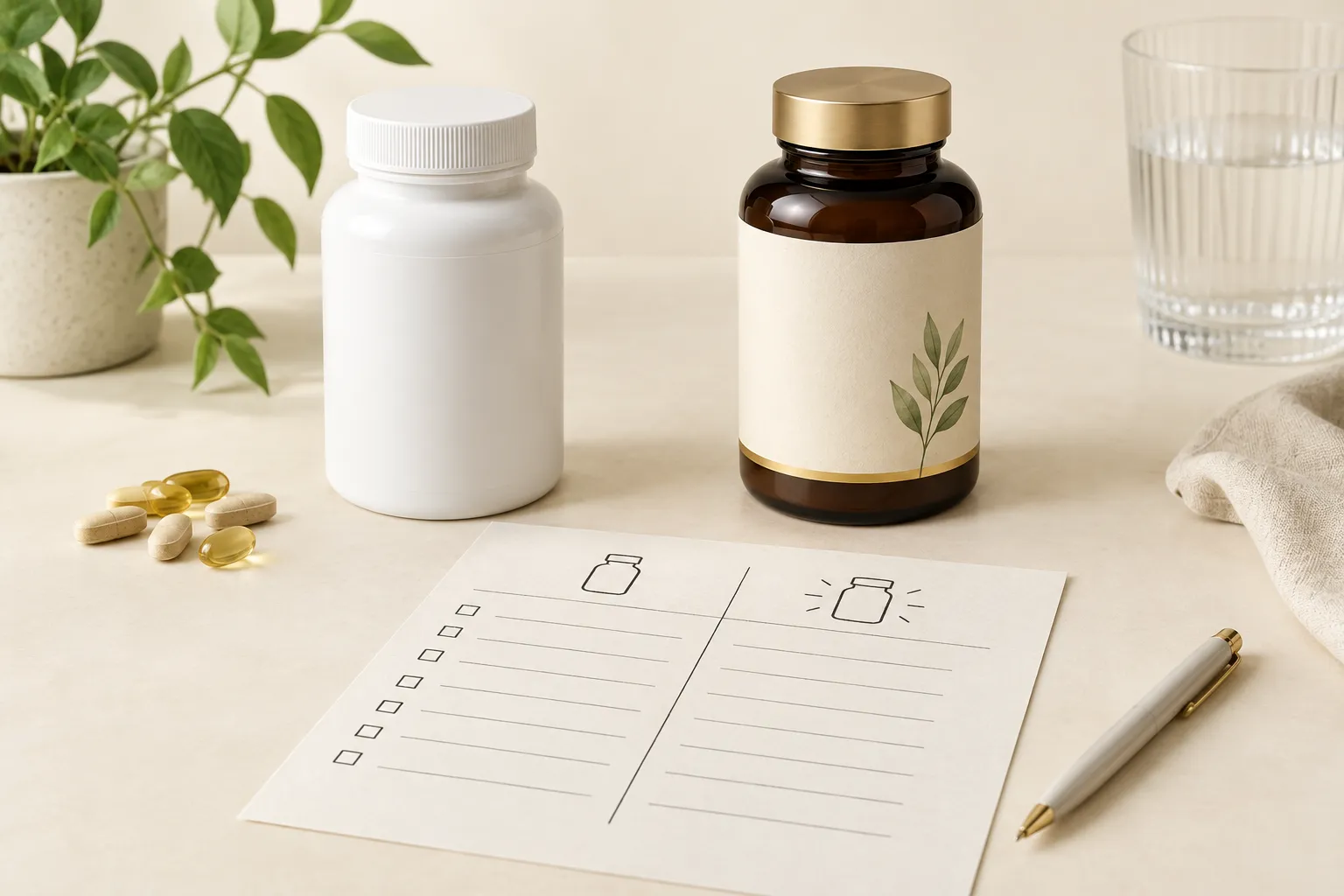
Put two products with the same intended purpose side by side. Fill in the worksheet from their labels, and leave any undisclosed detail blank.
|
Check |
Supermarket option |
Premium option |
What decides the winner? |
|---|---|---|---|
|
Purpose and active nutrients |
Write the stated purpose and named actives |
Write the same |
Compare products meant to do the same job |
|
Daily serving and amount |
Record tablets or capsules per day and amount of each relevant nutrient |
Record the equivalent amounts |
Compare per day, not per pill |
|
% NRV |
Note the nutrient reference value percentage |
Note the percentage |
Useful context, not a target to maximise |
|
Form and other ingredients |
Record the named form, allergens and capsule ingredients |
Record the same |
A different form matters only if it fits a real need |
|
Evidence for the benefit |
Note the exact claim and the nutrient it refers to |
Note the same |
Look for an authorised claim, not a vague promise |
|
Finished-product checks |
Record any batch-specific certificate or named independent testing |
Record the same |
An independently checked finished batch is stronger evidence than a general quality slogan |
|
Daily cost |
Bottle price ÷ number of daily servings |
Do the same calculation |
Pay for the useful dose, not unused extras |
Take a hypothetical £6 bottle with 60 one-a-day servings: it costs 10p per day. A hypothetical £18 bottle containing 60 capsules at two per day gives you 30 servings at £1.20 per day. That is twelve times the daily cost. The useful question is what relevant ingredient or verified assurance you get for the difference; these figures are arithmetic examples, not current shop prices.

Dose: compare what you will actually take
Check the amount of each ingredient per recommended daily serving. The nutrient reference value (NRV) percentage helps you compare amounts, though a higher percentage does not make a formula better. A pack may appear stronger because its recommended serving contains more capsules. Consider your diet and any other supplements before deciding whether the amount suits you.
For blends, look for a quantity beside each important ingredient. A single total “blend” weight leaves you unable to judge the amounts behind the names on the pack.
Form: ask what difference it makes
Labels may name different chemical forms of the same nutrient. That detail may matter for tolerance, dietary preference or a clinical recommendation. A fashionable ingredient name does not show a better result. Where the label provides it, compare the amount of the nutrient itself as well as the weight of the compound.
The rest of the formulation matters if you need a vegan capsule, an allergen-free product or a format you find easier to take. If a different form changes nothing for you, it need not change your budget.
Evidence and testing: separate four different claims
An authorised health claim describes a nutrient’s relationship to a specified function under set conditions. It does not establish that every blend containing that nutrient will improve how you feel. Manufacturing standards concern processes, while raw-ingredient tests concern inputs. A certificate tied to a finished-product batch offers more direct reassurance about that batch.
For “third-party tested” claims, look for the tested material, the laboratory, the measurements and a link to the product batch. GMP or ISO language alone does not establish independent testing of each bottle.
When a supermarket vitamin is enough
A basic option makes sense for a straightforward nutrient when the dose and form suit you and the label gives you enough information. A multi-ingredient formula adds little if you need only one nutrient. Herbs and blends are poor reasons to spend more when the amounts are undisclosed or irrelevant to your goal.
Vitamin D is a useful example of a specific shopping goal:
“Everyone (including pregnant and breastfeeding women) should consider taking a daily supplement containing 10 micrograms of vitamin D during the autumn and winter.” – NHS
For that routine purpose, a suitable, clearly labelled 10-microgram product need not be premium. Compare formats in choosing a vitamin D supplement if you need a different option.
If you take a multivitamin as a backstop, compare the nutrients you want against your intake from other supplements. A higher price does not guarantee a more complete formula, and “high strength” may be unnecessary. Food remains the starting point for most people; give each supplement a clear purpose.
|
Your situation |
Cost-effective starting point |
Reason to consider paying more |
|---|---|---|
|
You want one specified nutrient |
A clearly labelled single-nutrient product with a suitable daily dose |
A required form or dietary format that the basic version lacks |
|
You want a daily multivitamin |
Compare the nutrients you need and avoid unnecessary overlap |
Disclosed amounts and a formulation suited to a defined need |
|
You want immune support or more energy |
Identify the relevant nutrient and read its actual claim first |
A targeted formula only if its additional actives, doses and evidence are useful to you |
When premium vitamins may be worth it
Consider paying more for disclosed ingredients that serve a defined goal, a plant-based format you require, or accessible product-level quality information. Weigh that difference against the daily cost; a simpler product may already cover the main nutrient. Supplements belong alongside a healthy lifestyle.
InfiniVit offers targeted supplements for immunity, gut health and sleep, alongside multi-ingredient formulas and dietary options. That range lets you compare targeted formats in one place. As with any complex formula, the limitation is that more ingredients do not establish better outcomes. Assess the label and evidence for the specific product; manufacturing standards and general purity claims do not prove that an individual InfiniVit product underwent independent testing.
If your main concern is supplier standards rather than the premium-versus-basic choice, use How to Choose Quality Supplements in the UK for a general checklist. If you are choosing among companies rather than formulas, see Best Supplement Brands in the UK for brand comparisons.
Claims, safety and sensible use
“Supports vitality” says little on its own. Find the named nutrient, its precise claim and the amount in the daily serving. Even a valid nutrient claim cannot show that an expensive blend prevents illness or replaces treatment.
In Great Britain, the register of authorised nutrition and health claims lists permitted claims and their conditions. You can use it to assess a nutrient claim, though inclusion in the register does not certify an individual supplement’s effectiveness.
Products sold for different purposes can contain the same nutrients: a multivitamin may overlap with an immunity blend or a standalone tablet. Follow label directions. If you take medicines, are pregnant, have a medical condition or have persistent symptoms, speak to a pharmacist or clinician before choosing by price.
The verdict
Choose the lower-cost vitamin when it gives you the right nutrient and dose in a usable format. Pay more for a relevant label difference, a dietary fit you need or useful evidence about the finished product, provided the daily cost makes sense. A long ingredient list or luxurious pack is not enough.
If you want a targeted formulation, InfiniVit gives you options to compare with a basic supplement. Put the labels through the worksheet and choose the product that meets your goal at a price you are comfortable paying.
FAQ
What is the highest quality multivitamin on the market?
There is no single best multivitamin for everyone. Compare the nutrients and amounts per daily serving with your needs, then look at ingredient disclosure, dietary fit and any finished-product testing that can be substantiated. A higher price or longer ingredient list alone does not establish quality.